
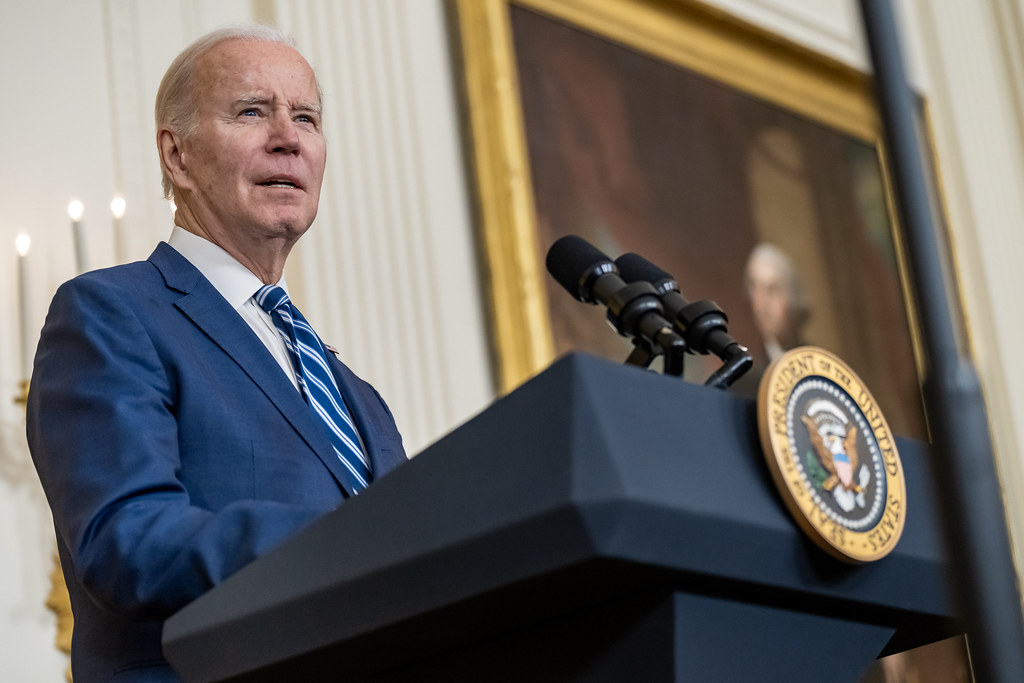

Two similar takes in the aftermath of the debt ceiling negotiations.
POLITICO (“Just don’t boast: How Biden world sought to ace the debt ceiling standoff“):
In the days after striking a deal with House Speaker Kevin McCarthy to raise the nation’s debt ceiling, White House officials sought to downplay what they privately considered to be a substantial victory.
Aides feared that any crowing about the agreement would endanger its passage. They advised allies to be restrained, fearful of driving up Republican opposition.
But there was another consideration at play. Biden world wanted to emerge from the process with the public perception of being the “adults in the room;” mediators in an era of sharp partisanship. Getting lawmakers to collectively step back from the financial cliff was as big a victory as any specific provision from the debt ceiling package. And it would serve as a blueprint for the reelection campaign to come.
With the debt ceiling bill having passed the House on Wednesday, and soon to pass the Senate, the president’s team is aiming to use the negotiations around it to its political advantage, according to more than a half dozen people familiar with the plan but not authorized to discuss internal strategy. Biden’s advisers are betting that voters will reward him for getting a big thing done in a bipartisan fashion. They plan to portray the president as a steady hand in stark contrast to the extremes of the Republican Party.
The strategy has risks: Biden has rankled some progressives — over some of the compromises he made with McCarthy — who have warned that it could impact enthusiasm among voters next year. His above-the-fray approach also largely ceded the messaging space to the GOP, worrying some Democrats that they lost an important political cudgel.
But those close to his reelection bid believe that the president’s poise will stand in sharp relief to the overheated political brinkmanship put forth by Republicans, especially by Biden’s most likely 2024 opponent, Donald Trump.
“There are some MAGA Republicans in the House who know the damage that it would do to the economy,” said Biden recently when asked whether he would shoulder any blame if that nation defaulted, underscoring his argument that politics was being placed ahead of patriotism. “And because I am president, and presidents are responsible for everything, Biden would take the blame. And that’s the one way to make sure Biden is not reelected.”
Biden has long prized bipartisanship, warmly recalling his decades in the Senate when reaching across the aisle happened with more regularity than it does today. In his first two years, he was able to shepherd some bipartisan legislation through — including a massive infrastructure bill as well as a more modest gun safety package — although he relied on only Democrats for Covid funding and his signature Inflation Reduction Act and used executive action for items like student debt relief. But now, with Republicans narrowly in control of the House, Biden has no choice but to work with the opposing party on legislative matters, including on warding off a catastrophic default.
WaPo’s David Ignatius (“Biden is delivering on his most far-fetched pledge: Compromise“) is less cynical:
President Biden this week accomplished what America elected him to do — govern from the center and make deals that solve problems. Progressive Democrats don’t seem to like that cooperative spirit, which is a big reason their candidates keep failing to become president.
“The agreement represents a compromise, which means not everyone gets what they want. That’s the responsibility of governing,” Biden said last weekend in announcing the deal to raise the debt ceiling. It’s a defining Biden line.
The president’s congenital centrism is easy to criticize, especially in this era of hard, polarizing views. He’s a conciliator, a dealmaker who likes to say yes and has trouble saying no. He’s also risk-averse, and he avoids escalation when facing potential catastrophe, whether it’s war with Russia or a budget default.
But Biden’s critics miss the glaringly obvious fact that he is behaving precisely as he said he would. His inaugural address was a pledge to restore normal order. “I know speaking of unity can sound to some like a foolish fantasy,” he said, but still, “we can join forces, stop the shouting, and lower the temperature.”
Join forces with Republicans? Was Biden nuts? Yet gradually over the past two years, dodging brickbats from the left wing of his party, he has done it. First with a bipartisan infrastructure bill, then with a modest gun-control measure, then with the bipartisan Chips Act, and finally with the budget agreement. As Biden said on Wednesday, when the House passed the deal, “I have been clear that the only path forward is a bipartisan compromise that can earn the support of both parties.”
The most damning criticism of Biden’s budget agreement is that he capitulated to Republican hostage-takers threatening to destroy the nation’s financial health if they didn’t get their way. Progressives wanted the president instead to roll the dice on the untested legal theory that 14th Amendment — which states that “the validity of the public debt … shall not be questioned” — renders the debt limit unconstitutional.
The deeper point is that the budget agreement wasn’t capitulation but compromise. Biden got the essence of what he wanted, which was an extension of the debt limit without savage cuts to domestic spending. As for the GOP hostage-takers, it’s true (and outrageous) that they were holding a gun to the nation’s head. But as the FBI will tell you, in a hostage situation, someone needs to negotiate with the crazies — and keep talking until they agree to put down the gun.
What I like best about this deal is that it begins to reestablish a broad bipartisan political center. In the House vote, the agreement was backed by 165 Democrats and 149 Republicans, for a total of about two-thirds of the chamber. The rejectionists included 46 Democrats and 71 Republicans, and a Post analysis showed that they skewed toward the more liberal and more conservative members of each party.
Honestly, I just think this is who Biden is. Yes, it’s how he positioned himself during the 2020 primaries and general election and I’m sure his team thinks it’s the right posture for 2024. But he’s spent most of his adult life in the Senate and deal-making is just the name of the game.
While not everyone agrees that Biden trounced McCarthy and company in the negotiations (Kevin Drum, for example, thinks the latter pretty much got what they came for) I’m not sure that’s even how Biden thinks about these things. He needed to get a deal done to avoid default, gave as little ground as he thought he could in order to achieve that end, and got the deal done.









