
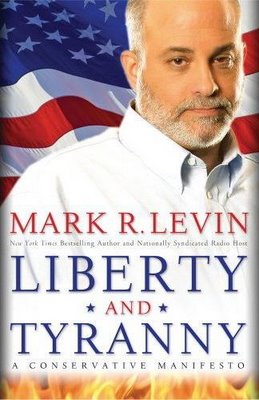

Chapter 4 – On the Constitution, pp. 36-48
Mark Levin has a law degree from Temple, has served in a legal capacity to the government and practiced as a private attorney. So I’ve actually been looking forward to reading his chapter on the Constitution. Whatever ignorance Mark Levin may display about history in his book, surely his treatment of the law and jurisprudence should have a nuance and thoughtfulness that you’d expect from someone who has expertise in the field, right?
Alas…..
We begin with a typical Levin non sequitur —
Language consists of words, words have ordinary and common meanings, and those meanings are communicated to others through the written and spoken word.
I don’t know why Levin keeps kicking off his chapters with this kind of pseudo-intellectual sounding nonsense sentences. Note to Mr. Levin: the ability to write a complex sentence is not, in and of itself, an expression of intelligence. The sentence still needs to be coherent and understandable. Additionally, brevity is always appreciated. Indeed, some thoughts don’t require communication at all. For example, the target audience for a book always includes people who are literate. It’s a fair bet that literate people are familiar with the concept of “words.”
But I digress.
Levin then goes on to explain that a Conservative (always with capital C, by the way, which annoys me to no end) “believes that much like a contract, the Constitution sets forth certain terms and conditions for governing that hold the same meaning today as they did yesterday and should tomorrow.” He then notes that “[t]o say that the Constitution is a ‘living and breathing document’ is to give license to arbitrary and lawless activism.”
As a point of fact, I don’t disagree with this. At all. Indeed, most legal scholars — left, right, libertarian and socialist — pretty much agree on this fundamental point. Indeed, I think Levin might actually be surprised to learn that in the realm of legal jurisprudence virtually nobody disagrees with this. Levin continues by stating that
The Conservative seeks to divine the Constitution’s meaning from its words and their historical context, including a variety of original sources — records of public debates, diaries, correspondence, notes, etc. While reasonable people may, in good faith, draw different conclusions from the application of this interpretative standard, it is the only standard that gives fidelity to the Constitution.
Once again, I don’t disagree with Levin. And again, very few legal scholars do! Now, if you thought this was going to lead into a nuanced discussion of the difference between the conservative interpretative framework championed by, for example, Justices White, Black and Scalia against frameworks by Justices such as Brennan, Holmes, and Brandeis well — you forgot whose book we were reading.
Once again, the Statist boogeyman appears. And this time — HE’S COMING FOR YOUR CONSTITUTION!!!!
The Statist is not interested in what the Framers said or intended. He is interested only in what he says and he intends.
Paging Mr. Pot. Mr. Pot… are you there?
Consider the judiciary, which has seized for itself the most dominant role in interpreting the Constitution.
I love how he used the word “seized,” as though there was some sort of recent coup, and not something that happened in 1803’s Marbury v. Madison decision. A Court decision that was, I might add, penned by John Marshall, who was part of the Virginia delegation that recommended to the House of Burgesses that the Constitution be adopted. (Defeating his political rival, Patrick Henry.) He was joined in this decision by William Paterson, who signed the Constitution; Samuel Chase, who signed the Declaration of Independence; and Bushrod Washington — George Washington’s nephew. I have a feeling that these Justices might have had some inkling of “what the Framers said or intended.”
Levin then goes on to criticize the jurisprudence of Justices Marshall and Goldberg for pursuing the “just result” as an approach for interpreting the Constitution. Seriously, I’m not kidding. This is a serious complaint. In Mark Levin’s world, the pursuit of justice is apparently not the job of a Supreme Court Justice!
This is, of course, an absurd position. One of the stated goals of the Constitution, as stated in its own preamble, is to “establish Justice.” Using justice as a criteria for Constitutional interpretation is right there in the text!
Levin then extends this criticism:
Or is not the Statist saying that the law is what he says it is, and that is the beginning and end of it? And if judges determine for society what is right and just, and if their purpose is to spread democracy or liberty, how can it be that the judiciary is coequal with the executive or legislative branch?
There’s a lot of nonsense to unpack in this statement. Clearly, when Justices Marshall and Goldberg referred to pursuing a just result, they did not claim that they were not bound by the law, nor did they claim to “determine for society what is right and just.” In any case that occurs before a Court, there is always a dispute. The role of a judge is to settle the dispute based on the law, and he is to interpret that law through the use of judicial precedent. But it is a long, long tradition in Anglo-American jurisprudence that judges take into account the justice of a situation when making their decision. Indeed, the Common Law is nothing but judge-made law designed to reach just results.
Based on this tradition, we trust the judge’s discretion and prudence to interpret the law in such a way as to produce a just result. Now, sometimes a judge can’t — there may be no way to interpret the law other than to reach a just result. And when that happens, you’ll often see a judge opine in favor of the aggrieved party even as the judge rules against that party. But when you have several valid interpretations of a law, a judge should go for one the produces the best result.
No doubt, this is a messy process. It’s a process that doesn’t always lead to consistent decisions and it adds a layer of risk to litigation. But relying on a judge’s discretion to find a just result is a principle that’s served the United Kingdom, the United States, and other Anglosphere countries well. What Levin seems to desire, on the other hand, is a rigid and literalist school of legal interpretation. This type of school, however, is a profoundly un-American one (in a historical sense) and much more in keeping with the Civil Law traditions of most European nations.
Also, and equally funny to me, where in the Constitution designated as “coequal with the executive or legislative branch”? Go ahead, I’ll wait while you look it up.
Couldn’t find it? That’s because it isn’t there. The idea that the branches of government are “co-equal” is an interpretation of the Constitution. It’s not in the original text.
After this, Levin keeps the Statist boogeyman going, ending with quite possibly my favorite line in the book so far.
And the Statist on the Court tolerates representative government only to the extent that its decisions reinforce his ends. Otherwise, he overrules it.
This is my favorite because I’m not sure where he’s going with it. Is Levin trying to say that any judicial decision that overturns a law passed by a legislative body is bad? Even if that law conflicts with the Constitution? He sure seems to imply that, doesn’t he? But this point goes unaddressed for the remainder of the chapter. Too bad, because I’m interested in learning whether this only applies to liberal decisions.
Levin then goes on to continue his previous attacks on Franklin Delano Roosevelt. In particular, Levin attacks Roosevelt’s “Second Bill of Rights” speech, which was Roosevelt’s speech in 1944 in favor of more economic justice in the United States. Regardless of what one thinks of the merits of FDR’s policies, Levin’s attacks are hyperbolic and nonsensical.
This is tyranny’s disguise. These are not rights. They are the Statist’s false promises of utopianism, which the Statist uses to justify all trespasses on the individual’s private property. Liberty and private property go hand in hand. By dominating one the Statist dominates both, for if the individual cannot keep or dispose of the value he creates by his own intellectual and/or physical labor, he exists to serve the state.
I’m sorry, but this is crap. I will grant you that a Communist state, one where there is no private property at all, is inevitably going to be totalitarian. No question there. But Levin’s inability to distinguish market liberalism from Communism exposes a complete misunderstanding of the nature of both.
Let’s be clear on this. Property rights are important. Property rights should, to a certain degree, be respected. But they’re not inalienable, and they’re not on the same level of fundamental human rights such as freedom of speech or freedom of religion. Indeed, government can’t exist without some abrogation of the rights of property. Taxes violate the right of property. Eminent domain violates the right of property. The Constitution provides for both. Frankly, if you believe in absolute property rights, you can’t believe in government at all. Anarchism is the only logical end of a belief in absolute property rights.
This distinction between fundamental human rights and rights to property is one that many of the Founding Fathers’ acknowledged. Thomas Paine, for example, in his Agrarian Justice, argued that ownership of land was a social convention, and that nobody had a natural right to own it. Thomas Jefferson was well-read in Locke, but changed Locke’s formulation of “life, liberty and property” to “life, liberty, and the pursuit of happiness.”
Moreover, note that Levin includes in his formulation of property rights the “protection of intellectual… labor.” But this is another point where many of the Founding Fathers would disagree with Levin. The Constitution doesn’t allow for the protection of intellectual property as a matter of right. It allows for such protection in order to “promote science and the useful arts.” In other words, intellectual property is merely seen an an instrumental tool to improve social well-being — not a right to be protected. Indeed, Thomas Jefferson opposed any such intellectual property right as all. Despite being a prolific inventor, Thomas Jefferson said, in a letter to James Madison, that:
He who receives an idea from me, receives instruction himself without lessening mine; as he who lights his taper at mine, receives light without darkening me. That ideas should freely spread from one to another over the globe, for the moral and mutual instruction of man, and improvement of his condition, seems to have been peculiarly and benevolently designed by nature, when she made them, like fire, expansible over all space, without lessening their density in any point, and like the air in which we breathe, move, and have our physical being, incapable of confinement or exclusive appropriation. Inventions then cannot, in nature, be a subject of property.
Given that Levin has lauded Jefferson on several occasions thus far in this book, I doubt that Levin considers him a “Statist.” However, Levin’s views on private property are positively radical compared to those of Jefferson and many of his contemporaries.
The next four pages consist entirely of Levin denigrating the work of Robin West, Cass Sunstein, and Bruce Ackerman. But he doesn’t provide any reason why. He simply assumes that it’s self-evident that their ideas are wrong. (In fact, he quotes a long passage from Cass Sunstein about the reality of the role of the government in the economy that I couldn’t actually find fault with.)
Levin then actually tries something interesting. He actually makes an argument, rooting his argument for property rights in a natural law theory.
What differentiated man from the rest of the animal kingdom was, in part, his ability to adapt his behavior to overcome his weaknesses and better master his circumstances. It is how he makes his home, finds or grows food, makes clothing, and generally improves his life. Private property is not an artificial construct. It is endemic to human nature and survival.
I’m actually almost so flabbergasted that Levin’s making an argument here that I’m tempted to just leave it be, the way you put a 2 year old’s first drawing on the fridge without criticism, because it’s neat that they did something besides just scribble randomly.
But I can’t leave it be. I can’t. Because it’s wrong.
Here’s the thing — private property is an artificial construct. Human beings, by nature, are not farmers and city builders. They are hunter-gatherers. And virtually every hunter-gatherer society in history has communal, not private, property. What we think of as civilization — property, hierarchy, laws, science — are products of agriculture. (Jared Diamond has some excellent work on this very subject — I’d encourage that you read it.) Because agriculture forces human communities to remain rooted in one place, rather than nomadically following food, property was a development that enabled society to work. As Thomas Paine explains in Agrarian Justice:
There could be no such thing as landed property originally. Man did not make the earth, and, though he had a natural right to occupy it, he had no right to locate as his property in perpetuity any part of it; neither did the Creator of the earth open a land-office, from whence the first title-deeds should issue. Whence then, arose the idea of landed property? I answer as before, that when cultivation began the idea of landed property began with it, from the impossibility of separating the improvement made by cultivation from the earth itself, upon which that improvement was made.
Property rights, then, are a product of civilization — they are not endemic in the human condition. This doesn’t mean that property rights don’t exist at all, nor does it mean, as the radical leftists of the 60s put it that “all property is theft.” I would argue that one’s work in trade does produce a property right, and that the fruits of one’s labor should be protected from predation and theft. Nevertheless, not everyone’s property is produced through one’s labor. You might receive a gift. You might inherit. There is no natural means of deriving these rights — they’re simply respected through law and custom. As such, they are rights that are secondary to the more fundamental rights of life and liberty. Property rights are only worthy of protection insofar as they promote the general welfare of society. This was the position of the classical liberals of the Enlightenment, and is still the position of most modern liberals today. Levin’s view is a radical departure from Enlightenment thinking.
Indeed, Levin views people who share this way of thinking as
an arrogant lot who reject the nation’s founding principles. They teach that the Constitution should not be interpreted as the Framers intended–limiting the authority of government through “negative rights,” that is, the right not to be abused and coerced by the government; instead, they urge that the Constitution be interpreted as compelling the government to enforce “positive rights”
First of all, it’s false on its face to assume that Framers intended the Constitution merely as a means of protecting “negative rights.” The Constitution’s goals are defined in the preamble as:
to form a more perfect Union, establish Justice, insure domestic Tranquility, provide for the common defence, promote the general Welfare, and secure the Blessings of Liberty to ourselves and our Posterity
This goes beyond merely “protecting rights.” Indeed, the Constitution had to be amended to force the government to protect free speech, freedom of religion, etc. And its clear that the early Founding Fathers had a vision of the country that went beyond Levin’s. Let’s take a look at the first ten years of our nation through the eyes of the first Five Congress’s. All of them passed at least one major piece of legislation that went beyond merely protecting the “right not to be abused and coerced by the government.”
- The First Congress passed an Act establishing the First Bank of the United States. A controversial institution whose goal, promoted by Alexander Hamilton, had the goals of providing a single unit of currency in the country, establishing credit for the United States, and resolving debts based on the currency issued by the Continental Congress. None of these goals had anything to do with protecting rights and had everything to do, in the eyes of Congress, with promoting the general welfare.
- The Second Congress passed the Postal Service Act, which established the United States Post Office. Again, this was all about promoting general welfare and not protecting rights.
- The Third Congress passed several laws directing the building of lighthouses along the East Coast.
- The Fourth Congress passed a law empowering the President to use the armed forces to enforce quarantines as necessary.
- The Fifth Congress passed the Marine Hospital Service Act, which established Federal hospitals for civilian merchant seamen and made other provisions for their relief and health.
As you can see, Levin’s idea that the intent of the Founding Fathers was to establish a government whose sole purpose is to protect rights is proven wrong by both the words of the Constitution itself and the acts of the first Congresses. The examples I listed above are just a fraction of the laws that were specifically adopted to improve the country — not merely to protect rights.
Indeed, Levin’s entire thesis, throughout this chapter, demonstrates that is political philosophy is not that of the Enlightenment classical liberals, but rather has its roots in the radical libertarianism that developed in the 1930s as a reaction to Roosevelt. Levin’s “conservatism” is the philosophy of Albert Nock, Isabel Paterson, and Rose Wilder Lane — NOT Washington, Hamilton, Madison, Adams, Paine, and Jefferson. And that’s fine, as far as it goes. If Levin wants to argue for his version of radical libertarianism, I’m willing to hear those arguments.
But the problem is, he doesn’t make those arguments. He makes assertions about the “way things ought to be”, wraps them in a flag, chisels them in stone, and pretends that the Founding Fathers delivered his philosophy from God, as spoken to his prophets on Mount Vernon. It’s dishonest and disgusting. And frankly, libertarians and conservatives both would do better to repudiate Levin’s dishonest defenses of their principles.
Levin closes his chapter with a quote from Frederic Bastiat. I’ve never cared for Bastiat, so I’d rather close with a quote on the importance of the judiciary from our first President, George Washington.
“Impressed with a conviction that the due administration of justice is the firmest pillar of good Government, I have considered the first arrangement of the Judicial department as essential to the happiness of our Country, and to the stability of its political system; hence the selection of the fittest characters to expound the law, and dispense justice, has been an invariable object of my anxious concern.”
Next time – we explore Levin’s thoughts on Federalism. Be there!









