
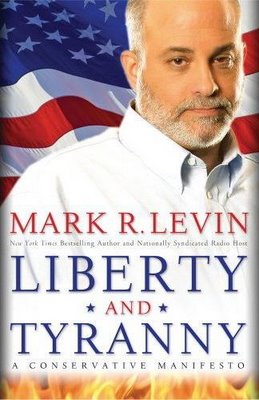

Part two of a continuing series wherein Liberty and Tyranny is blogged.
Chapter 1 – pp. 4-11 (hardcover edition)
Since this is a Conservative Manifesto, and Manifestos tend to manifest against something, and we live in polarized times, I’m sure it’s not hard to guess what comes next. Liberal Bashing.
“The Modern Liberal,” according to Levin, “believes in the supremacy of the state, thereby rejecting the principles of the Declaration” and further believes that “the individual’s imperfection and personal pursuits impede the objective of a utopian state.” Is it even worth explaining how silly it is to think that liberals reject the Declaration of Independence and want an all-powerful state? Are the liberals who spoke out against torture during the Bush Administration representative of the “supremacy of the state”? Is Glenn Greenwald advocating an all-powerful state when he argues against pervasive surveillance and violations of the laws of war? Is Matthew Yglesias advocating for an all-powerful state when he calls for an end to most rent-seeking, zoning regulations, and licensure laws? It’s absurd and empirically, demonstrably false.
Levin then goes on to state that “it is more accurate, therefore, to characterize the Modern Liberal as a Statist.”
This is, of course, nonsense. In the broad strokes, there’s actually quite a bit of political consensus in the United States — much more so than in other countries. Most of the heavy fighting is on the margins, and is over social issues. Because American institutions don’t really allow for multi-party systems, in modern times people have a tendency to pick a camp and stick with it, because that’s where political authority is. To write off half the country as “Statists,” rather than fellow citizens with whom one disagrees about politics is an incredibly ignorant, naive, Manichean worldview.
After this little tidbit, we are then given a completely false picture of America from 1789 to 1932 as a nation where “Federal power was confined to that which was specifically enumerated in the Constitution and no more.”
Except for, of course, the Bank of the United States. And the Second Bank of the United States. And the Louisiana Purchase. And the Trail of Tears. And the annexation of Spanish Florida. And the French Embargo. And the Alien and Sedition Acts. And the Palmer Raids. And the Espionage Act of 1917. And President Cleveland using the army to stop the Pullman Strikes.
And that list is just off the top of my head. While there were definitely politicians who thought that the enumerated powers should be adhered to strictly, the fact of the matter is that throughout American history, most politicians have broadly interpreted the Constitution along Alexander Hamilton’s lines, and quite a few have simply ignored the Constitution altogether. To say that Federal power was limited until 1932 requires, basically, not cracking open a single history book. Ugh.
Levin then goes on to castigate the New Deal as the time when “the Statists successfully launched a counterrevolution that radically and fundamentally altered the nature of American society.” I find the rhetoric here and in the paragraphs that follow because they imply that the New Deal was some sort of conspiratorial horror imposed from above on an unwilling American populace, rather than a wildly popular set of initiatives, many of which survive to this day, but were hardly unprecedented — large scale federal intervention in the economy began with the Bank of the United States and the Federal government’s supplantation of the state role in many areas of economic regulation began in the 1870s with the Interstate Commerce Commission. And while federal economic regulation suffered some setbacks with the Lochner v. New York decision imposed during the Gilded Age, it still moved largely unchecked and most of the New Deal can find predecessors in the Teddy Roosevelt, Wilson, Coolidge, and Hoover Administrations. It’s not like the New Deal sprang up magically overnight.
Again, Levin’s knowledge of history appears to be sorely lacking, which is easily the most frustrating thing about reading this book. Also, I have 199 pages to go, which is terrifying right now. But I’m not going to abandon this project, so let’s press on to the post-New Deal stuff.
No, wait, I have to stop here. There’s one line that’s incredibly annoying:
Ironically, industrial expansion resulting from World War II eventually ended the Great Depression, not the New Deal. Indeed, the enormous tax and regulatory burden imposed on the private sector by the New Deal prolonged the economic recovery.
Okay, no, this is crap. Virtually every economist who’s studied the Great Depression noted that the length of the depression in most countries was linked to how long they kept the Gold Standard. Milton Friedman, Ben Bernakke, and Christina Romer all agree on this point, and if you have consensus between these three, you’ve got a decent chance of noting the correct cause of recovery. Hoover’s stubborn insistence on hanging on to the outdated gold standard prolonged the deflation of the dollar and that deflation prolonged the Depression. Upon abandoning the Gold Standard in 1933, the economy surged. Unemployment dropped from 25% to 11%. The economy continued to improve until 1937 recession, when Roosevelt cut federal spending significantly in an attempt to balance the budget. And the idea that World War II somehow magically made the economy better is a charge that’s often asserted, but rarely supported.
Okay, now let’s move on.
For the next few pages, Levin mostly talks about the Statist boogeyman, who “has an insatiable appetite for control”, “speaks in the tongue of the demagogue”, and is constantly “concocting one pretext and grievance after another to manipulate public perceptions”.
Another note about Levin’s style. Apart from his love of italics, he also so far appears to be immune to irony.
At any rate, he keeps blah blah blahing in this tone as he builds up his Statist boogeyman. A boogeyman who appears to exist entirely in Levin’s imagination, at least in the American context. My favorite bit is this, though:
As the Statist is building a culture of conformity and dependency, where the ideal citizen takes on dronelike qualities in service to the state, the individual must be drained of uniqueness and self-worth, and deterred from independent thought or behavior. This is achieved through varying methods of economic punishment and political suppression.
Does Levin think this is actually happening in the United States? Seriously? And keep an eye on the line “the individual must be drained of uniqueness and self-worth, and deterred from independent thought or behavior”, because I know…. I just know that later on in the book, we’re going to find this idea come head to head with Levin’s earlier assertion that “the individual has a duty to respect…the values, customs and traditions, tried and tested over time and passed from one generation to the next, that establish society’s cultural identity.” At least, I hope so, because that’s going to be really fun.
At any rate, in the next couple of paragraphs Levin takes a swipe at Michael Gerson, David Brooks, and William Kristol, whom he refers to as “neo-Statists” and not really conservative. He then goes on to describe the solution to the Statist devil as, of course, Conservatism, which he states is the “antidote to tyranny precisely because its principles are the founding principles.”
Except that based on the first chapter, I’m going to hypothesize that what Levin sees as “founding principles” are nothing like what the Founding Fathers had in mind. And also that what he sees as “Conservatism” is pretty much limited to “Mark Levinism”.
Coming Next: Chapter Two – which features Burke! And Hoffer! Will they be taken out of context to prove points they had no intention of making? Stay tuned to find out!









