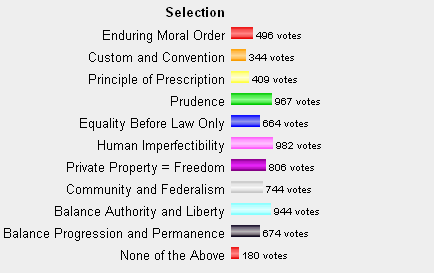
 This follows on the heels of another post, an oldie-but-goodie, which puts up Kirk’s famous “10 principles of conservatism.” I subscribe to 7 or 8 of them, demurring only on Custom, Prescription and, depending on how it’s construed, Enduring Moral Order. (There’s a lot of redundancy in the list; he was apparently straining to come up with a neat list of 10.) Then again, those are the first three listed principles.
While I can’t vouch for his heart or his mind, I would argue that George W. Bush is a conservative who emphasizes those first three principles but seems not to care so much about most of the remaining seven. He has a strong sense of morality but, unlike traditional conservatives, believes in perfectability especially — and quite oddly — in foreign policy.
Most obviously, he’s deficient in this one:
Conservatives are guided by their principle of prudence. … Any public measure ought to be judged by its probable long-run consequences, not merely by temporary advantage or popularity. Liberals and radicals, the conservative says, are imprudent: for they dash at their objectives without giving much heed to the risk of new abuses worse than the evils they hope to sweep away.
And, motivated by his strong belief that he’s right, he often turns a blind eye to this one:
The conservative perceives the need for prudent restraints upon power and upon human passions. … It is characteristic of the radical that he thinks of power as a force for good—so long as the power falls into his hands. … A just government maintains a healthy tension between the claims of authority and the claims of liberty.
Now, whether all this has caused long-term harm to the conservative moment is debatable. For one thing, “conservative” is a moving target, Kirk’s devotion to an idyllic past notwithstanding. The United States, and the West generally, has been moving inexorably toward a welfare state for decades now and our standards of morality constantly evolve, too.
Still, Bainbridge is right:
We controlled the White House, the Senate, the House of Representatives, and (more-or-less) the judiciary between 2002 and 2004, but what was accomplished? Did government get smaller? Did we hack away at the nanny state? Were the unborn any more protected? Did we really set the stage for a durable conservative majority? No on all counts.
Still, given the razor thin majorities in Congress and the polarization that accompanied the 2000 election aftermath, it’s doubtful a Ronald Reagan could have achieved those things. On the other hand, Bush didn’t much try, except perhaps on abortion.
Recall that Bush campaigned on a platform of “compassionate conservatism,” applying a modifier to persuade people that he wasn’t a heartless meanie like Newt Gingrich. Partly out of lack of conviction, partly out of crash electoral politics, partly because he stepped into a budding recession, and partly because of the fallout of 9/11 Bush presided over a massive expansion in the size of government. Still, few people are complaining about the increased federal involvement in education and health care; indeed, they’re clamoring for more.
Bush has certainly harmed the Republican Party, contributing mightily to the loss of both Houses of Congress in the most recent midterm election (with plenty of help from his counterparts in the legislature) and making it much harder for a Republican to win the White House in 2008. It’s not clear, however, that conservatism per se has suffered any long term damage.