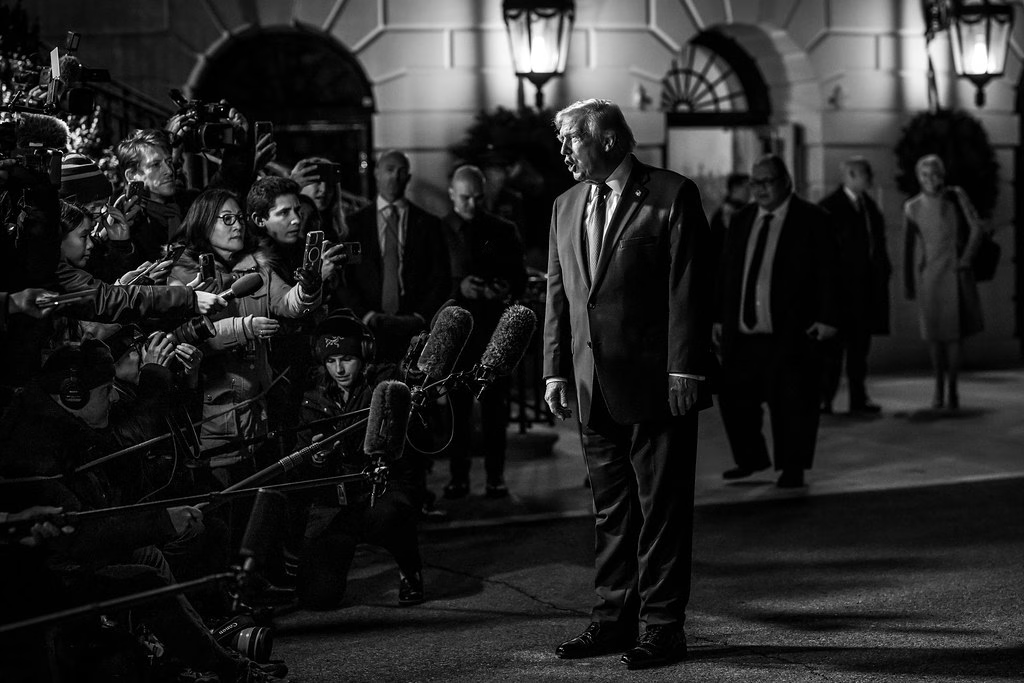
In an interview with ABC’s George Stephanopoulos, President Bush conceded that the present situation in Iraq “could be” at a turning point like the Tet Offensive was in Vietnam.
Stephanopoulos asked whether the president agreed with the opinion of columnist Tom Friedman, who wrote in The New York Times today that the situation in Iraq may be equivalent to the Tet offensive in Vietnam almost 40 years ago. “He could be right,” the president said, before adding, “There’s certainly a stepped-up level of violence, and we’re heading into an election.”
This response garnered the headline “Bush Accepts Iraq-Vietnam Comparison” and has many on the Left excited that Bush is finally admitting this is just like Vietnam.
TigerHawk correctly notes the real lesson of Tet:
Tet, however, was not a military disaster for the United States. Quite to the contrary, history has revealed that the Tet offensive was in fact a crushing defeat for the Viet Cong, and effectively required that the Communists conquer the South by invasion from the North, rather than by civil insurgency. The Viet Cong were only able to turn a military disaster into strategic victory by persuading the American media that the United States was mired in stalement. With the domestic political support for the war fading fast, the United States decided to withdraw from Indochina, even though it would take Nixon and Kissinger another four years to accomplish it.
Then again, nobody credible is arguing that the current sectarian mayhem is hiding “a crushing defeat” for our enemies in Iraq. But the other part of the analogy, that the perception of futility is being fed by the panoptic nature of this war, is apt.
Bush was surprisingly good in the interview, at least judging from the text. (Brent Baker at Newbusters has the video of the interview in multiple formats.)
“George, my gut tells me that they have all along been trying to inflict enough damage that we’d leave,” Bush said. “And the leaders of al Qaeda have made that very clear. Look, here’s how I view it. First of all, al Qaeda is still very active in Iraq. They are dangerous. They are lethal. They are trying to not only kill American troops, but they’re trying to foment sectarian violence. They believe that if they can create enough chaos, the American people will grow sick and tired of the Iraqi effort and will cause government to withdraw.”
Bush said he could not imagine any circumstances under which all U.S. troops would be withdrawn from Iraq before the end of his presidency. “You mean every single troop out? No,” he told Stephanopoulos.
Bush also had some tough words for Democrats, saying that pulling troops from Iraq would be the equivalent of surrender. “If we were to leave before the job is done, in my judgment, the al Qaeda would find a safe haven from which to attack. This is exactly what they said,” Bush said. The president insisted he was not disparaging his opponents. “It’s not questioning their patriotism. I think it’s questioning their judgment,” he said.
[…]
Stephanopoulos pointed out that 72 Democrats running for the House had used Bush in their campaign ads.
“Are they saying good things?” Bush joked. “Look, maybe that strategy will work; maybe it won’t work. I’ve always found that when a person goes in to vote, they’re going to want to know what that person’s going to do. What is the plan for a candidate on Iraq? What do they believe?”
This is indeed the choice we face. Whether we should have done things differently at the tactical level–or even gone to war in Iraq in the first place–we are where we are. While elections are and should be a referendum on the past performance of leaders on the ballot, they are also a means of deciding future policy.
It’s quite likely that we’ll wind up with something less than the Middle East equivalent of the shining city on the hill that the neocons were hoping for when we went into Iraq. It may be that we’ve reached a turning point in the sectarian violence from which there is no return and that we’ll ultimately wind up leaving in defeat. But if the president has accurately described the consequences of that outcome–and I believe he has–then we should continue trying to figure out how to win unless and until we are absolutely sure we can’t.
UPDATE: As an aside, when was the last time you saw a Tom Friedman column being debated? The NYT’s decision to put its columnists behind a paid subscriber wall has, as widely predicted, substantially dimished their relevance. In Friedman’s case, at least, that’s truly a shame.