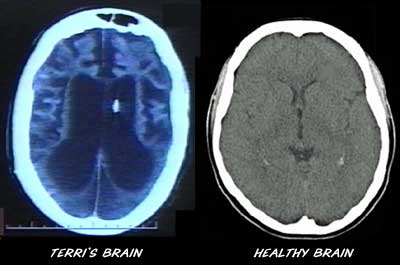
President Bush signed the hastily passed bill making a federal case out of Terri Schiavo’s status in the wee hours this morning. The parents of Terri Schiavo can now try to get a federal judge to overturn over a decade of consistent rulings from the Florida state courts.
Bush signs Schiavo bill into law (CNN)
President Bush has signed legislation transferring jurisdiction of the Terri Schiavo case to a U.S. court. His signature followed a 203-58 vote in the U.S. House early Monday morning approving the bill.
“Today, I signed into law a bill that will allow federal courts to hear a claim by or on behalf of Terri Schiavo for violation of her rights relating to the withholding or withdrawal of food, fluids, or medical treatment necessary to sustain her life,” a statement from the president said. “In cases like this one, where there are serious questions and substantial doubts, our society, our laws, and our courts should have a presumption in favor of life.”
An attorney for Schiavo’s parents said he was headed to a U.S. District Court in Florida to file a lawsuit and request for a restraining order under the new law.
The Bush administration also formally entered the legal fray, as Justice Department lawyers filed court documents in U.S. District Court in support of legal efforts to keep Schiavo alive, a senior Justice Department official told CNN.
Obviously, no suit will be filed “by” Terri Schiavo, given that she’s been in a persistent vegetative state for 15 years. Further, the courts have consistently made the finding of fact that pulling the feeding tube in a situation like this was her wish. That this extraordinary action was taken without even a majority vote in the House (which has 435 Members) is all the more amazing. Plenty of coverage of the odd details of this hasty process at WaPo, NYT, AP, and Fox.
CBS legal analyst Michael Cohen dubs this “Trial by Legislation.” His assessment of what the bill means:
It means that Congress has literally made a “federal case” out of the Schiavo dispute. It means that Schiavo’s parents now have a right to assert essentially the same claims they already have asserted in state court in Florida in a new forum– federal court– and applying federal constitutional principles instead of state constitutional principles. It means that the federal trial judge who presides over the case must review all of the facts and law from scratch, without deferring to the legal judgments and factual conclusions the Florida courts have reached after many years of litigation– and 21 separate, written, published rulings in the case. It means that the federal trial judge may order the tube reinserted into Terri Schiavo almost immediately upon getting the case. It means that Congress has interjected itself into a state law dispute, at the end of that dispute, on the side of one litigant over another.
From a constitutionality standpoint:
There are plenty of serious constitutional issues raised by this law. First, it applies only to one family and thus may create equal protection problems– after all, why shouldn’t other people who want to keep their loved ones on life support over the objections of others not also received tailor-made legislation? Second, as Harvard Law School Professor Laurence Tribe points out, it arguably deprives Terri Schiavo herself of the constitutional right to “halt the unwanted bodily invasion by a tube” and does so without any due process to her (and her husband and guardian). Third, it raises big separation of powers problems and also federalism concerns– the Supreme Court in particular hasn’t been receptive to federal intrusion into matters normally resolved by the states– matters like guardianship laws.
[…]
Look, there is no other way to put it: this is the most blatant and egregious power-grab by one branch over another in my lifetime. Congress is intruding so far into the power of the judiciary, on behalf of a single family, that it is breathtaking. It truly will be fascinating to see how federal court judges react to this– whether they simply bow down to this end-run or whether they back up their state-court colleagues.
This is indeed a blatant abuse of legislative power, although Cohen is likely overstating the historical significance of this a bit. Surely, some of the more aggregious overreaches by the Supreme Court, notably Roe v. Wade, have had more of an impact on society.
Presumably, though, a federal judge would be hesitant not to temporarily order the feeding tube re-inserted, meaning Terri will have to go through this process yet again if, as presumably will ultimately happen, the husband prevails yet again in asserting his status as next of kin.
Update (1016): Rusty Shackleford disputes at length the constitutionality arguments made by Cohen. I would make just two points. 1) While Congress does indeed pass special bills rather routinely on matters affecting one or few people, they do so in matters creating special relief from the effects of laws passed by Congress. That’s an entirely different ball of wax. 2) The 14th Amendment has certainly been deemed elastic enough to give the federal government jurisdiction over damned near anything. But the claim that the state is “denying” her the right to life is preposterous here. The state isn’t ordering that she be executed for a crime but merely allowing nature to take its course. The husband has established, to the satisfaction of a string of courts with jurisdiction, that Terri would not have wished to live as a vegetable kept alive only via a feeding tube. That disputes in family court are somehow a federal matter is absurd.
That, said, the strongest constitutional issue here is separation of powers. One presumes the courts would be particularly jealous in guarding its prerogatives from such blatant encroachment by the legislature.