
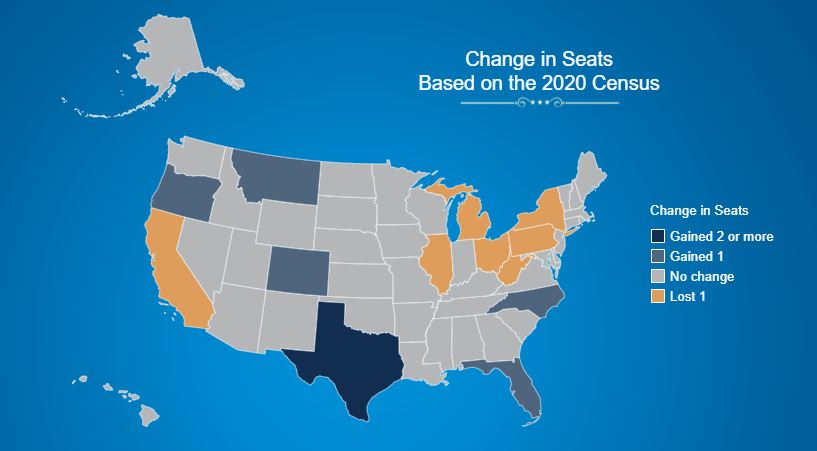

As Doug Mataconis has noted in the Open Forum, the preliminary Census results are due out today and are likely to skew our representation further in the direction of the Republican Party, both because of how those states lean in presidential voting and because states controlled by that party’s politicians will control the resulting redistricting.
The Hill (“Census numbers expected to shift House power to the South, West“):
The U.S. Census Bureau will release the first results of its decennial survey on Monday after a decade of explosive growth in Sun Belt states that will shift power in the House of Representatives.
Acting Census Bureau Director Ron Jarmin will announce state population counts used to apportion House seats on Monday afternoon, the Census Bureau said early Monday.
Those results are likely to show a dramatic shift in population, as more Americans leave northern Rust Belt states in favor of sunnier climes where economic opportunity is more plentiful. Yearly population trends released over the last decade suggest five of the seven states likely to see their U.S. House delegations expand are in the Sun Belt.
Texas is certain to be the big winner this year. The state added at least 4 million new residents in the last decade, more than any other, as residents flocked to Austin, San Antonio, Houston, Dallas and their respective suburbs, many of which were among the fastest growing areas in the country.
Texas’s delegation in Congress is likely to grow by three seats, according to an analysis by the demographer Kimball Brace, who runs the nonpartisan firm Election Data Services.
Florida is also likely to gain two seats after a decade in which its population topped 20 million for the first time. North Carolina, Arizona and Colorado are the other Sun Belt states set to add one seat each to their delegations.
Residents moving to the West Coast will add two seats to Western state delegations, too: Both Oregon and Montana are expected to add seats to their delegations.
Population growth in the South and West is offset by continued stagnation in the Northeast and Midwest. New York, Pennsylvania, Ohio and Illinois are all expected to lose at least one seat each, continuing a losing streak those states started in the middle of the 20th century. West Virginia, Rhode Island, Michigan and Minnesota are expected to lose a seat each, as is Alabama, the only Southern state to see its delegation contract.
The major outlier, for the first time in the nation’s history, is California, which appears set to lose a seat in the House for the first time since it joined the Union in 1850. America’s most populous state added about 2.5 million residents in the last decade, but that growth will not be sufficient to maintain the state’s 53 seats in Congress.
Given the fixed size of the House, set in law at 435 seats back in 1929, all changes are zero-sum. Of the gaining states, only Oregon is reliably Democratic. This means the party’s chances of holding on to its slim majority next November, already difficult given the historic propensity of the President’s party to lose seats in the midterms, will get a whole lot harder.
Further, while the Census only directly impacts the House (each state gets two Senators regardless of population), it also impacts the Electoral College, since the formula there is that each state gets the same number of Electors as it does Representatives (again, a fluctuating number with a floor of 1) and Senators (again, fixed at 2).
Granted, these things can change over time. I’m old enough to remember when California was a rock-solid Republican state, having voted Democrat only once (the 1964 Goldwater massacre) between 1952 and 1988; it’s since voted blue in eight straight. Even more recently, North Carolina and my home state of Virginia have shifted from bright red to light blue. And even Georgia seems to be shifting into the Democratic column. While predictions of Texas following suit in 2020 were vastly overblown, it’s not inconceivable that the shift will materialize during the decennial in which this apportionment prevails.
Commenter @Scott wonders if the various attempts by the Trump administration to skew the Census results will be challenged in court. I’d just about guarantee it. I am highly skeptical, though, of any ruling against the ruling sticking though, and not just because the Supreme Court includes three Trump appointees. It’s going to be really difficult to prove harm and it’s not at all obvious what the remedy would be, anyway. The Constitution mandates the Census take place in years ending in 0 and, well, we’re now well into one ending in 1.
UPDATE: The press conference began at 3pm Eastern and this appears to be the breakdown:
- States that will GAIN a seat in Congress – MT – OR – CO – TX (2) – NC – FL
- States that will LOSE a seat: WV – PA – NY – OH – MI – CA – IL
While, again, this could change over time, it’s mostly good news for the GOP. It would seem a net gain of roughly four.
UPDATE 2: The Census has updated their site now and provided this graphic illustration:









