
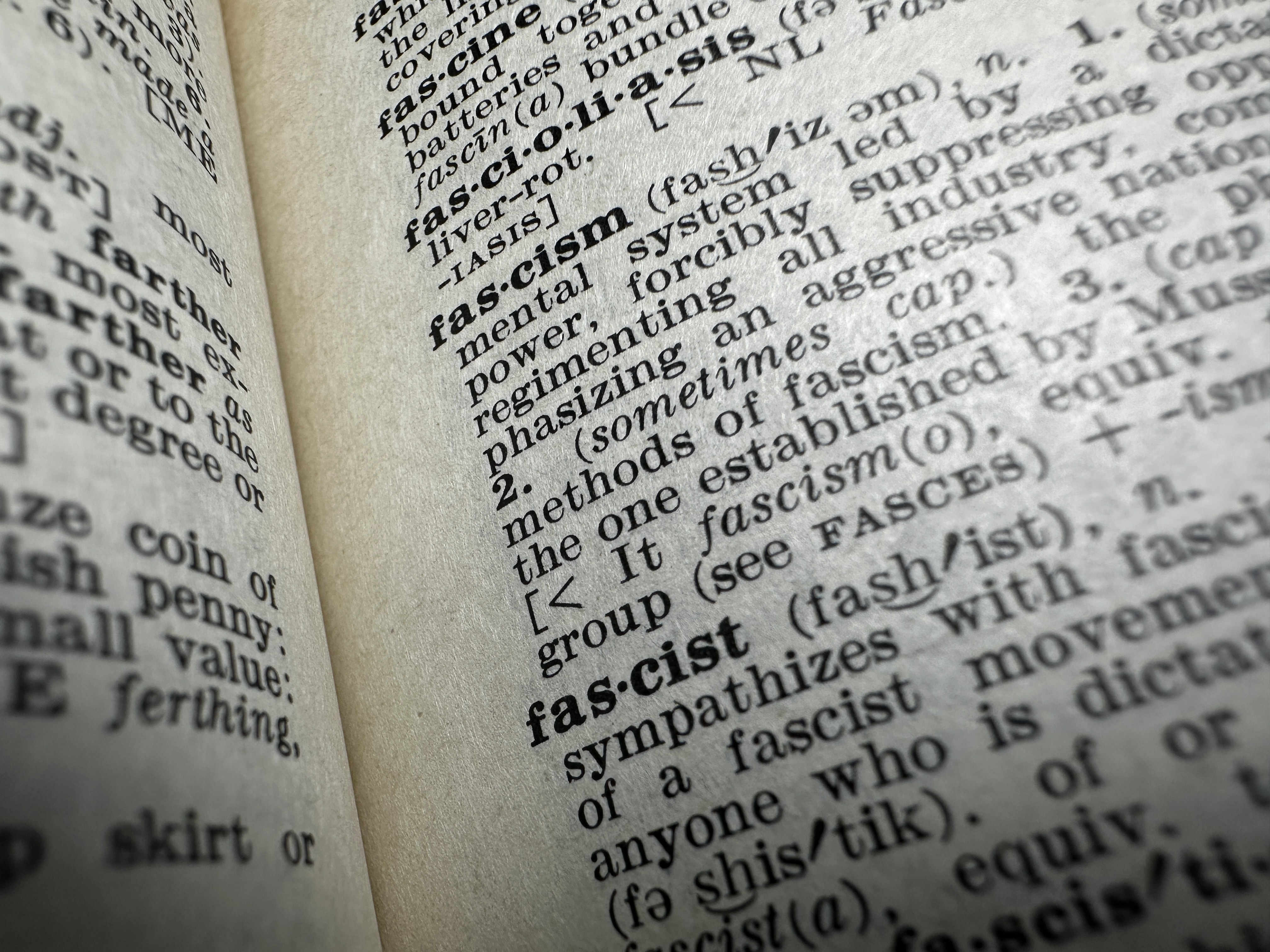
For the last several months, it has been clear that it is impossible to escape the fact that the Trump administration is properly categorized as fascist. This is not the only way it can be categorized, to be sure (other appropriate terms include kakistocracy and kleptocracy as well as more general terms like authoritarian, incompetent, and oligarchic). Still, I am reminded almost daily of this fact, and a recent visit to Nuremberg, Germany only further focused my mind on this topic. I felt the need for a deeper discussion of the topic, so I have returned to the topic of definitions. It is part of a number of attempts to organize my thoughts on this administration and its significance (at least one other should be showing up here shortly).
One of the handicaps of trying to be intellectually honest about these kinds of descriptions, alongside the occupational hazard of wishing to explain rather than assert, is that it takes time before one is fully confidence it hanging such a heavy label on anyone (although to be clear, I did so a while ago). I am fully confident in calling Trump a fascist and saying that there are ways in which Hitler comparisons are fully warranted. The ongoing deployment of ICE agents to send people to internment camps before they can be deported to often unsafe locations, whether in their country of origin or elsewhere, is a pretty straightforward example. His increasing assertions of appetite for territorial acquisitions (the Strait of Hormuz, Canada, Greenland, and Venezuela), even if they are rhetorical, also fit the bill.
There is also a seriousness to which one should approach the deployment of divisive and derisive descriptors against fellow citizens. If I am going to call someone a fascist, I should be able to back that up. I would contrast such a position with the way in which many politicians thoughtlessly fling terms around (e.g., socialist, communist, jihadist, sharia law, etc.).
I think this conversation is worth having not only because of my long-stated preference for proper classification of the political phenomenon I write about, but also because I think it helps us (even those who are prone to agree with me) understand how deep the problem is that we are facing. (There is also the wishful thinking that someone, somewhere, will be persuaded.)
On that latter score, it has to be recognized and understood that the fascist politics of which I am concerned are not the sole domain of Donald J. Trump, but infuse a substantial chunk of contemporary American politics (and also have some resonances globally). The increase, for example, in deep nationalism linked to imagined boundaries of culture and race is part of this picture. There is a very real, and very concerning, illiberal movement in the world that wants desperately to impose its vision of “normal” on others, even if force is necessary. It is inherent to what Jason Stanley correctly identifies as “the politics of us v. them” (as I have discussed before, and plan to again).
Indeed, if anything, for my own mental organization, and to allow a structured classification of certain actions by this administration and its allies (e.g., the way it deals with the trans issue or why I find certain elements of Christian nationalism so disturbing), I have decided to post about several attempts to define fascism as a political enterprise even more thoroughly than I have already done. Indeed, as the title of the post notes, this is my third such specific entry (although not my only post on this subject).
- Defining and Discussing Fascism (Part I)
- Defining and Discussing Fascism, Part II: Hitler comparisons.
In this post, I want to discuss an essay by Umberto Eco from The New York Review from 1995, “Ur-Fascism.”
Eco was a writer, cultural critic, and student of philosophy who was a child during Mussolini’s reign. His essay was part remembrance of his childhood and Italy’s liberation at the end of WWII, but it is chiefly about what fascism is in its core, prototypical state (hence “ur”). He notes, for example, an issue I have discussed here at OTB: the fact that we all tend to so associate fascism with Nazism and Hitler that it makes it hard for modern minds to accept the concept of fascism without there having to be perfect parallels (I wrote about this rather extensively last year: How WWII Affects Contemporary Thinking).
Let’s dive a bit into the essay.
Eco on What Fascism Is Not
I think it is important to note that Eco correctly identifies some things that fascism is not (or, at least, incomplete views of the subject).
It is not a specific form of totalitarian governance (i.e., that it manifests identically in each case). See my highlighted portions below.
Nevertheless, historical priority does not seem to me a sufficient reason to explain why the word fascism became a synecdoche, that is, a word that could be used for different totalitarian movements. This is not because fascism contained in itself, so to speak in their quintessential state, all the elements of any later form of totalitarianism. On the contrary, fascism had no quintessence. Fascism was a fuzzy totalitarianism, a collage of different philosophical and political ideas, a beehive of contradictions. Can one conceive of a truly totalitarian movement that was able to combine monarchy with revolution, the Royal Army with Mussolini’s personal milizia, the grant of privileges to the Church with state education extolling violence, absolute state control with a free market? The Fascist Party was born boasting that it brought a revolutionary new order; but it was financed by the most conservative among the landowners who expected from it a counter-revolution. At its beginning fascism was republican. Yet it survived for twenty years proclaiming its loyalty to the royal family, while the Duce (the unchallenged Maximal Leader) was arm-in-arm with the King, to whom he also offered the title of Emperor. But when the King fired Mussolini in 1943, the party reappeared two months later, with German support, under the standard of a “social” republic, recycling its old revolutionary script, now enriched with almost Jacobin overtones.
It is also not simply Nazism. As I have argued before, Nazism was a subset of fascism, not the other way around.
There was only one Nazism. We cannot label Franco’s hyper-Catholic Falangism as Nazism, since Nazism is fundamentally pagan, polytheistic, and anti-Christian. But the fascist game can be played in many forms, and the name of the game does not change.
There are variances that are important to remember. Hitler’s regime was not identical to Mussolini’s, which, in turn, was not the same as Franco’s, etc.
Fascism became an all-purpose term because one can eliminate from a fascist regime one or more features, and it will still be recognizable as fascist. Take away imperialism from fascism and you still have Franco and Salazar. Take away colonialism and you still have the Balkan fascism of the Ustashes. Add to the Italian fascism a radical anti-capitalism (which never much fascinated Mussolini) and you have Ezra Pound. Add a cult of Celtic mythology and the Grail mysticism (completely alien to official fascism) and you have one of the most respected fascist gurus, Julius Evola.
Eco on What Fascism Is
Eco states that “it is possible to outline a list of features that are typical of what I would like to call Ur-Fascism, or Eternal Fascism.” He provides 14 elements.
I would note that, like all attempts at a definition, there are places here that could be criticized or tweaked. I am not saying that this is some ideal type that is unassailable. I would even note that Eco’s approach is not as political sciencey (so to speak) as I would like it to be for my tastes. Still, it captures some important points of discussion.
I will readily allow that not all of these elements are equally or intensely present in the Trump administration/MAGA Republicanism. But I do think they are all at least identifiable to one degree or another, and some are unassailably present.
My ultimate goal is to provide this (and in the next parts of this series) as a guide for the reader and a place for me to reference back to specific instantiations of fascism in broader American politics. And I would stress, unfortunately, that I am by no means simply assigning this conversation to Trump alone. This is a broader problem for contemporary American politics (and, indeed, even global politics). We cannot ignore the degree to which it infuses significant parts of the Republican Party.
My annotations below are intended to help provide my understanding of Eco’s writing as well as contemporary examples by way of illustration. None of this is to be considered comprehensive or complete. I expect that I will be revisiting many of the below over time in my specific applications.
- A cult of tradition that is syncretic. Eco’s description here could be clearer in my view, but he is basically saying that ur-fascism both appeals to the past but also includes in it some notion of hidden revelation that combines in different forms of belief. The following made me think of RFK, Jr’s weirdness as an illustration of this notion: “If you browse in the shelves that, in American bookstores, are labeled as New Age, you can find there even Saint Augustine who, as far as I know, was not a fascist. But combining Saint Augustine and Stonehenge—that is a symptom of Ur-Fascism.”
- Rejection of modernism. This is not rejection of technology, but instead a rejection of modern views of society and an embrace of blood and soil traditionalism. It is a rejection of the revolutionary notions of 1776 and 1789, the US and French Revolutions, that were Enlightenment projects that asserted reason could be used to make new nations. Think, for example, the way JD Vance explicitly rejected the notion that believing in the ideals of the Declaration could make a person American. No, one had to have been here since at least the Civil War. It is the whole idea of “heritage Americans.”
- Values action over reason. In describing this element, Eco wrote the following roughly 30 years ago, but I expect it will sound all too familiar and contemporary: “The official Fascist intellectuals were mainly engaged in attacking modern culture and the liberal intelligentsia for having betrayed traditional values.”
- Disagreement is Treason. Eco again, “In modern culture the scientific community praises disagreement as a way to improve knowledge. For Ur-Fascism, disagreement is treason.” I would point the reader to RFK, Jr. and his views on experts as well as to a story just this week as reported by The Hill: Trump promises NBC’s Welker will be reported to FCC ‘for rebuke or punishment’.
- Fear of Difference. Eco: “The first appeal of a fascist or prematurely fascist movement is an appeal against the intruders. Thus Ur-Fascism is racist by definition.” See just about anything Stephen Miller has ever said. See Vance and his slurs against Haitians. See my post about Trump’s rhetoric as compared to Hitler’s.
- Appeal to a Frustrated Middle Class. Trump’s appeals on the economy, on crime, and on the border all fit.
- Obsession with a plot (possibly an international one). Trump has made any number of claims about how we are all being ripped off by the rest of the world, as well as the notion that places like Venezuela purposefully emptied their prisons and sent criminals to the US. We also see Great Replacement Theory rhetoric about immigrants from Trump and his allies.
- Enemies are at the same time too strong and too weak. This element is a bit vague, and Eco doesn’t give it a label the way he does most of the others. This element is weaker in the American context than many of the others, but not entirely. Trump does talk like the US has been beaten down by outside forces in terms of economics. He has repeatedly asserted that the rest of the world was laughing at us and we need to return to a previous state of greatness by stopping the rest of the world from exploiting us, even though we are also the Most Powerful. There are also echoes of this in the Iran war, wherein Iran is a massive threat that has been at war with us for 47 years and yet also we have utterly destroyed them.
- Life is permanent warfare. On the one hand, Trump has talked about avoiding the wars of his predecessors, yet also clearly loves using the power of the US military. The following from Eco does resonate about Trump, especially as it pertains this trade wars (which are easy to win!) and his confrontational style with our ostensible friends: “Since enemies have to be defeated, there must be a final battle, after which the movement will have control of the world. But such a “final solution” implies a further era of peace, a Golden Age, which contradicts the principle of permanent war.” I will allow that Trump is neither Hitler nor Mussolini on this front, but he also clearly revels in confrontation and does act as if he can bully the world into submission.
- Popular Elitism. This is a rejection of liberal democracy while also speaking like “the people” matter (with a specific definition of who the “real” people are). “Every citizen belongs to the best people of the world, the members of the party are the best among the citizens, every citizen can (or ought to) become a member of the party.” Sound familiar? Just think about how he talks about Democrats. There is also this: “Since the group is hierarchically organized (according to a military model), every subordinate leader despises his own underlings, and each of them despises his inferiors. This reinforces the sense of mass elitism.”
- Everybody is educated to become a hero. This is perhaps the one that I see the least of in the Trumpist view: “the Ur-Fascist hero craves heroic death, advertised as the best reward for a heroic life. The Ur-Fascist hero is impatient to die. In his impatience, he more frequently sends other people to death.” I think some connections of this could be made to Hegseth’s obsession with lethality, but I don’t think it fits Eco’s model very well.
- Machismo. This one, however, is present in spades. Eco describes this as “both disdain for women and intolerance and condemnation of nonstandard sexual habits” and further notes that “even sex is a difficult game to play, the Ur-Fascist hero tends to play with weapons—doing so becomes an ersatz phallic exercise.” The panic over trans persons and the overt misogyny in this crew are off the charts. See also the Christian Nationalism of people like Doug Wilson who want to take the vote away from women.
- Selective populism. “In a democracy, the citizens have individual rights, but the citizens in their entirety have a political impact only from a quantitative point of view—one follows the decisions of the majority. For Ur-Fascism, however, individuals as individuals have no rights, and the People is conceived as a quality, a monolithic entity expressing the Common Will. Since no large quantity of human beings can have a common will, the Leader pretends to be their interpreter. ” This may not fully encapsulate Trumpism the way it did either Hitler or Mussolini, but I would note that Trump has largely ignored the legislature and treats the government as if it belongs to him, all the while speaking in the language of populism to his base. Eco makes an especially telling prediction, especially given the pre-social era in which he wrote, “There is in our future a TV or Internet populism, in which the emotional response of a selected group of citizens can be presented and accepted as the Voice of the People.”
- Ur-Fascism speaks Newspeak. The following sound a bit too close for my comfort as to what we are seeing in some states as it pertains to education, or to Trump’s treatment of national historic sites: “All the Nazi or Fascist schoolbooks made use of an impoverished vocabulary, and an elementary syntax, in order to limit the instruments for complex and critical reasoning.” And the following is even more salient in an era of social media, a fragmented cable news environment, and the various realms of influencers: “we must be ready to identify other kinds of Newspeak, even if they take the apparently innocent form of a popular talk show.”
And for anyone who wants to note that there may not be the same level of intensity of a given element in Trumpism, it is hard to deny the presence, to one degree or another, of all fourteen, which should be disturbing (if anyone wasn’t already disturbed).
Let me stop with this from his conclusion (emphasis mine):
We must keep alert, so that the sense of these words will not be forgotten again. Ur-Fascism is still around us, sometimes in plainclothes. It would be so much easier, for us, if there appeared on the world scene somebody saying, “I want to reopen Auschwitz, I want the Black Shirts to parade again in the Italian squares.” Life is not that simple. Ur-Fascism can come back under the most innocent of disguises. Our duty is to uncover it and to point our finger at any of its new instances—every day, in every part of the world. Franklin Roosevelt’s words of November 4, 1938, are worth recalling: “I venture the challenging statement that if American democracy ceases to move forward as a living force, seeking day and night by peaceful means to better the lot of our citizens, fascism will grow in strength in our land.” Freedom and liberation are an unending task.
More to come.
Side note: this quote struck me because it evoked the tech bro’s and their technofuturism and their ethos of moving fast and breaking things. And I can’t help but notice that they are often fascist-curious (if not worst).
But the early Italian Futurists were nationalist; they favored Italian participation in the First World War for aesthetic reasons; they celebrated speed, violence, and risk, all of which somehow seemed to connect with the fascist cult of youth. While fascism identified itself with the Roman Empire and rediscovered rural traditions, Marinetti (who proclaimed that a car was more beautiful than the Victory of Samothrace, and wanted to kill even the moonlight) was nevertheless appointed as a member of the Italian Academy, which treated moonlight with great respect.









