
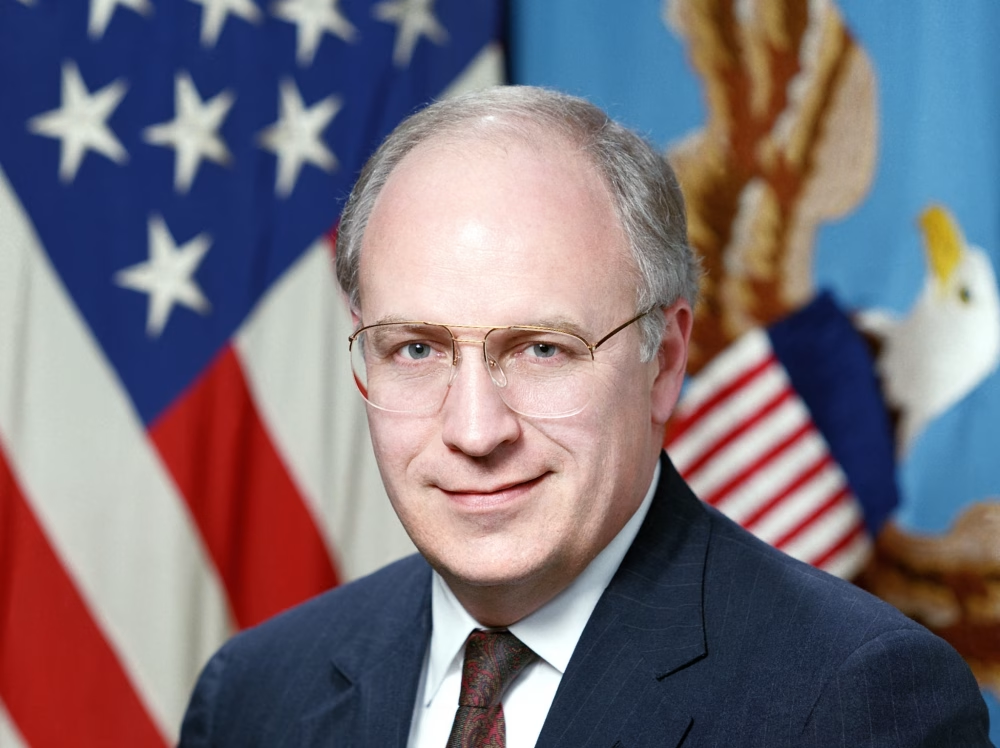

Associated Press, “Dick Cheney, one of the most powerful and polarizing vice presidents in US history, dies at 84“
Dick Cheney, the hard-charging conservative who became one of the most powerful and polarizing vice presidents in U.S. history and a leading advocate for the invasion of Iraq, has died at age 84.
Cheney died Monday night due to complications of pneumonia and cardiac and vascular disease, his family said in a statement.
“For decades, Dick Cheney served our nation, including as White House Chief of Staff, Wyoming’s Congressman, Secretary of Defense, and Vice President of the United States,” the statement said. ““Dick Cheney was a great and good man who taught his children and grandchildren to love our country, and to live lives of courage, honor, love, kindness, and fly fishing. We are grateful beyond measure for all Dick Cheney did for our country. And we are blessed beyond measure to have loved and been loved by this noble giant of a man.”
The quietly forceful Cheney served father and son presidents, leading the armed forces as defense chief during the Persian Gulf War under President George H.W. Bush before returning to public life as vice president under Bush’s son George W. Bush.
Cheney was, in effect, the chief operating officer of the younger Bush’s presidency. He had a hand, often a commanding one, in implementing decisions most important to the president and some of surpassing interest to himself — all while living with decades of heart disease and, post-administration, a heart transplant. Cheney consistently defended the extraordinary tools of surveillance, detention and inquisition employed in response to the terrorist attacks of Sept. 11, 2001.
Years after leaving office, he became a target of President Donald Trump, especially after his daughter Liz Cheney became the leading Republican critic and examiner of Trump’s desperate attempts to stay in power after his election defeat and his actions in the Jan. 6, 2021, riot at the Capitol.
“In our nation’s 246-year history, there has never been an individual who was a greater threat to our republic than Donald Trump,” Cheney said in a television ad for his daughter. “He tried to steal the last election using lies and violence to keep himself in power after the voters had rejected him. He is a coward.”
In a twist the Democrats of his era could never have imagined, Dick Cheney said last year he was voting for their candidate, Kamala Harris, for president against Trump.
A survivor of five heart attacks, Cheney long thought he was living on borrowed time and declared in 2013 he now awoke each morning “with a smile on my face, thankful for the gift of another day,” an odd image for a figure who always seemed to be manning the ramparts.
[…]
From the beginning, Cheney and Bush struck an odd bargain, unspoken but well understood. Shelving any ambitions he might have had to succeed Bush, Cheney was accorded power comparable in some ways to the presidency itself.
That bargain largely held up.
“He is constituted in a way to be the ultimate No. 2 guy,” Dave Gribbin, a friend who grew up with Cheney in Casper, Wyoming, and worked with him in Washington, once said. “He is congenitally discreet. He is remarkably loyal.”
As Cheney put it: “I made the decision when I signed on with the president that the only agenda I would have would be his agenda, that I was not going to be like most vice presidents — and that was angling, trying to figure out how I was going to be elected president when his term was over with.”
New York Times, “Dick Cheney, Powerful Vice President and Washington Insider, Dies at 84“
Dick Cheney, widely regarded as the most powerful vice president in American history, who was George W. Bush’s running mate in two successful campaigns for the presidency and his most influential White House adviser in an era of terrorism, war and economic change, died Monday. He was 84.
[…]
As vice presidents go, Mr. Cheney was a singular figure: more powerful and less ambitious for higher office than any vice president in modern times. A 10-year member of the House of Representatives, the youngest White House chief of staff in history, the defense secretary from 1989 to 1993, a confidant of presidents and lawmakers, Mr. Cheney had impeccable credentials and contacts and was a master in the art of getting things done, preferably without fanfare.
In many ways an inscrutable personality, he had no patience for small talk, almost never spoke about himself and rarely gave interviews or held news conferences, although he sometimes went on television to promote administration policies and was often in the news. He preferred the backstage to the spotlight.
A consummate Washington insider, Mr. Cheney was an architect and executor of President Bush’s major initiatives: deploying military power to advance the cause of democracy abroad, championing tax cuts and a robust economy at home, and strengthening the powers of a presidency that, as both men saw it, had been unjustifiably restrained by Congress and the courts in the aftermath of the Vietnam War and the Watergate scandal.
As Mr. Bush’s most trusted and valued counselor, Mr. Cheney foraged at will over fields of international and domestic policy. Like a super-cabinet official with an unlimited portfolio, he used his authority to make the case for war, propose or kill legislation, recommend Supreme Court candidates, tip the balance for a tax cut, promote the interests of allies and parry opponents.
Early in Mr. Bush’s first term, many Democrats and even some fellow Republicans wondered if Mr. Cheney might be the real power in a White House occupied by an untested president whose qualifications had been questioned. While Mr. Bush eventually asserted his authority and Mr. Cheney’s influence declined by the second term, the image of him as a Machiavellian paterfamilias was never quite dispelled.
Even Mr. Bush worried about that perception, as he noted in his 2010 memoir, “Decision Points.” He wrote that Mr. Cheney offered to withdraw from the ticket for the 2004 presidential election, having become “the Darth Vader of the administration.” Mr. Bush considered the offer, aware that accepting it “would be one way to demonstrate that I was in charge.” But he ultimately kept his running mate, saying he valued the vice president’s steadiness and friendship.
There was no question about Mr. Cheney’s steadiness.
[…]
Six weeks after the attacks, Mr. Cheney helped engineer a swift, lopsided passage of the USA Patriot Act, a sweeping law that greatly expanded the government’s powers of investigation, surveillance and detention to fight terrorism. With the wounded nation still seething over Sept. 11, public opposition to the law was muted, though civil libertarians warned that it authorized the government to spy on ordinary Americans.
Later, it became clear that the act was being used to underpin secret courts, wiretaps without warrants, the unlimited detention of suspects without hearings or charges, and interrogation methods that skirted bans on torture in the Geneva Conventions. There were wide protests and even constitutional challenges. But Mr. Cheney strongly defended the law and its expansion of presidential power, and it remained in force.
Mr. Cheney also strongly influenced Mr. Bush’s decision to invade Afghanistan to hunt for Osama bin Laden, the Qaeda leader who masterminded the Sept. 11 attacks, and to suppress a fanatical Taliban regime that had sheltered terrorists and imposed a brutal theocracy on the Afghan people.
And it was Mr. Cheney who was a dominant voice behind Mr. Bush’s decision to invade Iraq in 2003 and then to justify the war. He insisted that Iraq’s president, Saddam Hussein, had ties to Qaeda terrorists, possessed weapons of mass destruction and would threaten America and its allies with nuclear blackmail.
What began as a one-month combat operation in Iraq gave way to a nearly nine-year occupation, a struggle against Iraqi insurgents and internecine warfare that would claim nearly 4,500 American lives and cost more than $2 trillion, according to some estimates.
Washington Post, “Dick Cheney, powerful vice president during war on terrorism, dies at 84“
Former vice president Dick Cheney, who recast an understudy’s job into an engine of White House power, becoming chief architect of a post-9/11 war on terrorism that involved bypassing restrictions against torture and domestic espionage, died Monday night. He was 84.
[…]
After the catastrophic attacks of Sept. 11, 2001, on the World Trade Center and the Pentagon, Mr. Cheney, the nation’s 46th vice president, took on the role of primary strategist in all-out military deployments in Afghanistan and, later, Iraq. As part of this multitrillion-dollar campaign, intelligence officers were dispatched to use “any means at our disposal,” as Mr. Cheney put it, to find and kill terrorists and those who aided them.
Mr. Cheney and his senior lieutenants, Chief of Staff I. Lewis Libby and legal counsel David Addington, worked in strict secrecy to circumvent or reinterpret legal prohibitions against torture, domestic espionage and clandestine imprisonment without charge. Mr. Cheney said in 2008 that “it would have been unethical or immoral for us not to do everything we could in order to protect the nation.” A 9/11-style attack, he said, “wasn’t going to happen again on our watch.”
[…]
Mr. Cheney’s core beliefs — in unfettered markets and expansive presidential authority — defined Bush’s first-term action plan on taxes, spending, personnel appointments, freedom of information, environmental regulation and ballistic missile defense.
He also pushed for an aggressive new stance against Iran, Syria, North Korea and the Palestinian Authority — in addition to shaping the global war on terror.
“He has been pretty damn good at accumulating power, extraordinarily effective and adept at exercising power,” James A. Baker III a former secretary of state and treasury secretary, said of Mr. Cheney in 2007, looking back on more than 30 years of friendship and rivalry.
Mr. Cheney’s role as the Bush administration’s leading advocate of an expansive, aggressive war on terrorism reflected his conviction that the 9/11 attack was a grave threat to the United States and his long-held belief that the power of the presidency was paramount and needed to be reasserted after decades of diminution by Congress and other forces in American society.
But in his later years, in defense of his daughter Liz, then a congresswoman from Wyoming who was one of only two Republicans on a House committee investigating President Donald Trump’s role in fomenting the Jan. 6, 2021, attack on the U.S. Capitol, Mr. Cheney spoke out against the abuse of presidential power by Trump when he pushed to overturn the results of the 2020 election.
Serving at the highest levels of three administrations, with a stint as House Republican Whip in between, Cheney is arguably the most important non-president in modern American political history. Baker’s assessment—“He has been pretty damn good at accumulating power, extraordinarily effective and adept at exercising power”—is spot on.
He was, by all accounts, a damn good Secretary of Defense. He effectively managed the Panama operation, the Gulf War, and he end of the Cold War. There was, of course, plenty of credit to go around. The George H.W. Bush national security team, comprising Secretary of State Baker, National Security Advisor Brent Scowcroft, and Chairman of the Joint Chiefs Colin Powell in addition to Cheney, remains the gold standard.
The degree to which he dictated policy in the George W. Bush administration is overstated. It’s not like Condoleeza Rice, Powell (now Secretary of State), and Donald Rumsfeld were shrinking violets. Ultimately, Bush was “the Decider” that he claimed to be. But, certainly, Cheney was accorded considerable respect and latitude by the President.
Some of the policies Cheney pushed for (torture, extraordinary rendition, wiretapping, and the PATRIOT Act), I opposed at the time. And, while I came to support the Iraq invasion near the end of 2002 after over a year of skepticism, it soon became apparent that some of its premises were oversold, if not downright false.
There’s plenty of blame for that to go around, and certainly Cheney deserves a fair share of it. While Karl Rove and others certainly used the climate of fear after the 9/11 attacks for domestic political leverage, I continue to believe that Cheney, like Bush and Rumsfeld,* thought he was doing the right thing for his country. The fear created by the attacks was powerful, if obviously overblown in hindsight, and it was easy to justify extraordinary measures to prevent a recurrence.
Powerful men convinced that they are right are often, if not usually, willing to circumvent norms, even laws, to carry out their agenda. Toward the end of his life, he came to appreciate that the same logic could be applied to agendas he found unconscionable.
*It seems pretty clear that Rice and, especially, Powell were outvoted on much of this.









