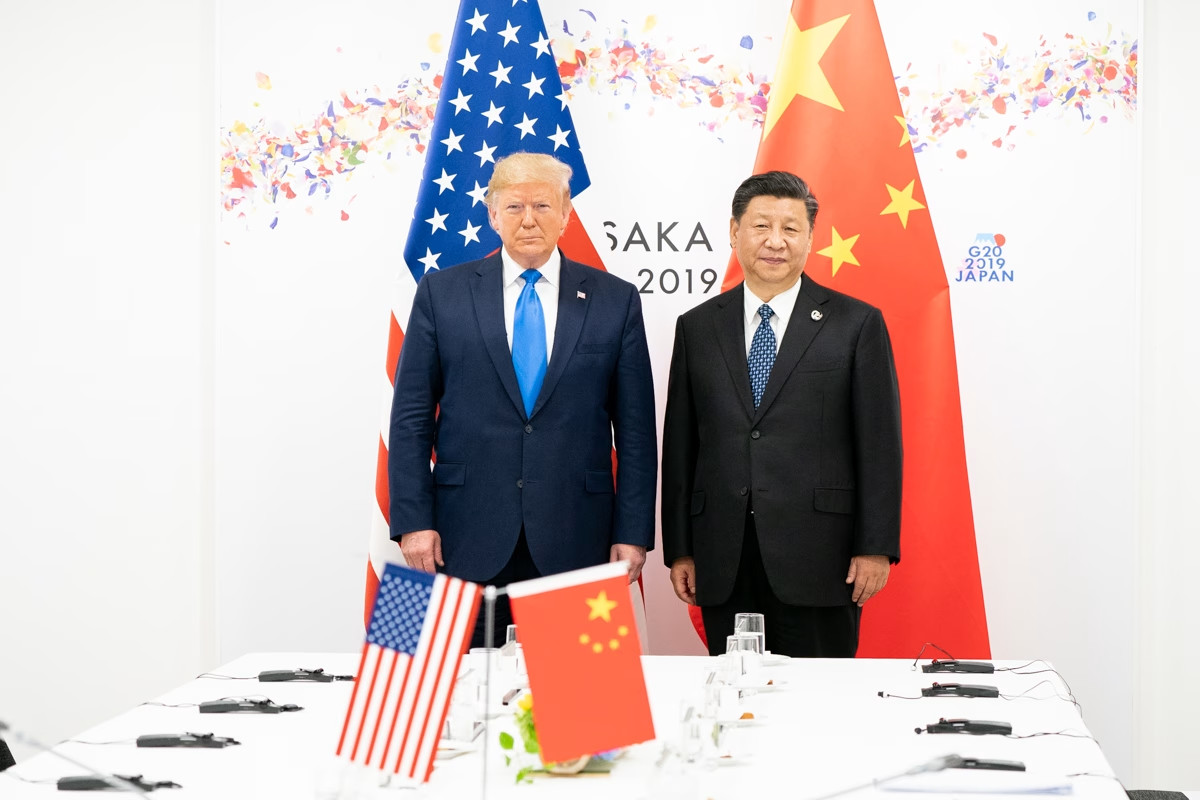
Trump: Chinese restaurants in America today outnumber the five largest fast food chains in the United States all combined. That’s a pretty big statement.
Trump: Chinese restaurants in America today outnumber the five largest fast food chains in the United States all combined. That's a pretty big statement. pic.twitter.com/e8MyLabKHX
Steven L. Taylor is a Professor Emeritus of Political Science and former College of Arts and Sciences Dean. His main areas of expertise include parties, elections, and the institutional design of democracies. His most recent book is the co-authored A Different Democracy: American Government in a 31-Country Perspective. He earned his Ph.D. from the University of Texas and his BA from the University of California, Irvine. He has been blogging since 2003 (originally at the now defunct Poliblog).
Follow Steven on Twitter and/or BlueSky.
In the mid 80s, when we first started opening up business with China, I was working for a small machine tool company. A mainland Chinese company bought a machine from us. I helped host a small party that came over to acceptance test the machine. We knew they were tight, so we booked them into the cheapest motel in town and tried to host them for all their meals. I tried to talk the sales guy out of it, but we took them to an American Chinese restaurant. They were completely baffled by it.
While we were there another party came in, presumably a similar party from another company, with a couple of Japanese in tow. Our Chinese guests physically recoiled on seeing them. I mean pushed chairs away with facial expressions just short of snarling.
A week or so later I got a call from the FBI following up to see if the Chinese had tried to steal any of our secrets. We were a dying machine tool company with an obsolete product line, I explained we didn’t really have any secrets.
@gVOR10: There is a sizable population of Chinese immigrants here where I live now. This has meant the demise of “Chinese” restaurants – including ones which were run by Chinese immigrants – and the rise of Chinese restaurants, which feature menus in Chinese only and waiters that don’t or won’t speak English. Or maybe they do, I don’t know. I would not go in to one without someone who speaks Mandarin. The good news is that I know a couple of people who speak Mandarin.
Like any other group that came here, such as the Pilgrims or my people, the Germans of 1848, they are a mixed blessing. (German is still the third most common language spoken in North Dakota, where the Gischers landed in the US, after English and Spanish).
Another data point: I toured China in 2002 or so. It was through my daughter’s school. It was lovely. The food did not strike me as all that different from what I might get in a “Chinese” restaurant, but it is entirely possible that it was curated for us, since it was all part of the tour package.
This included the simple noodle soup we got at the Terracotta Warriors site. It was fantastic. Not different from what you might get here, just better. Though maybe with more MSG. I saw a construction worker on his lunch break in Chungching with a rice bowl with stuff mixed in. Again, not all that different.
Frankly, the tour we took of Japan the year after that featured food that was more unfamiliar.
Today, there are estimated to be only about 5,000 (0.017%) speakers left, the vast majority of whom are in their 70s or older. Texas German is expected to die out by 2035.
@Jay L. Gischer: My experience was very, very different! I lived in China for four years and for a long time was the only Westerner in my office. I ate Chinese cooking all the time and the only thing I ever had that closely matched American Chinese was (of all things) Sweet and Sour Pork. This thread got me thinking of a tofu dish I used to get in our mostly awful cafeteria. It was a very firm tofu, thick textured sheets cut into strands, and then tied into knots. Man, I wish I could find it somewhere here in Baltimore. My wife still makes “Ants Climbing A Hill” once a month or so. I also wish I could get “Buddha Jumps Over the Wall” without the shark fin, like I could in Shanghai.
@MarkedMan: I took my Viet Nam R&R in Taipei which had restaurants specializing in the regional cuisines of mainland China. You are quite right, the only food similar to Chinese restaurants stateside was Cantonese Sweet and Sour. Another that was close was Mongolian grill with steamed buns but the flavor was so much better. What is Ants Climbing A Hill?
According to Perplexity.pro: “There isn’t one universally agreed number, but a solid current estimate is about 25,000 Chinese restaurants in the U.S. in 2025. That figure comes from IBISWorld’s industry count for Chinese restaurants in the U.S.”
From the same source, “The five largest fast-food chains in the U.S. by location count are Subway, Starbucks, McDonald’s, Hunt Brothers Pizza, and Dunkin’. Using 2026 location counts, they have about 20,054 + 16,868 + 13,836 + 10,489 + 10,026 = 61,273 outlets in America.”
In the mid 80s, when we first started opening up business with China, I was working for a small machine tool company. A mainland Chinese company bought a machine from us. I helped host a small party that came over to acceptance test the machine. We knew they were tight, so we booked them into the cheapest motel in town and tried to host them for all their meals. I tried to talk the sales guy out of it, but we took them to an American Chinese restaurant. They were completely baffled by it.
While we were there another party came in, presumably a similar party from another company, with a couple of Japanese in tow. Our Chinese guests physically recoiled on seeing them. I mean pushed chairs away with facial expressions just short of snarling.
A week or so later I got a call from the FBI following up to see if the Chinese had tried to steal any of our secrets. We were a dying machine tool company with an obsolete product line, I explained we didn’t really have any secrets.
@gVOR10: There is a sizable population of Chinese immigrants here where I live now. This has meant the demise of “Chinese” restaurants – including ones which were run by Chinese immigrants – and the rise of Chinese restaurants, which feature menus in Chinese only and waiters that don’t or won’t speak English. Or maybe they do, I don’t know. I would not go in to one without someone who speaks Mandarin. The good news is that I know a couple of people who speak Mandarin.
Like any other group that came here, such as the Pilgrims or my people, the Germans of 1848, they are a mixed blessing. (German is still the third most common language spoken in North Dakota, where the Gischers landed in the US, after English and Spanish).
Another data point: I toured China in 2002 or so. It was through my daughter’s school. It was lovely. The food did not strike me as all that different from what I might get in a “Chinese” restaurant, but it is entirely possible that it was curated for us, since it was all part of the tour package.
This included the simple noodle soup we got at the Terracotta Warriors site. It was fantastic. Not different from what you might get here, just better. Though maybe with more MSG. I saw a construction worker on his lunch break in Chungching with a rice bowl with stuff mixed in. Again, not all that different.
Frankly, the tour we took of Japan the year after that featured food that was more unfamiliar.
@Jay L. Gischer: It’s sad but the Texas German speakers have been slowly, literally, dying out.
@Scott: I expect the ND strain of German speakers are on the same pathway, just not as far along it.
@Jay L. Gischer: My experience was very, very different! I lived in China for four years and for a long time was the only Westerner in my office. I ate Chinese cooking all the time and the only thing I ever had that closely matched American Chinese was (of all things) Sweet and Sour Pork. This thread got me thinking of a tofu dish I used to get in our mostly awful cafeteria. It was a very firm tofu, thick textured sheets cut into strands, and then tied into knots. Man, I wish I could find it somewhere here in Baltimore. My wife still makes “Ants Climbing A Hill” once a month or so. I also wish I could get “Buddha Jumps Over the Wall” without the shark fin, like I could in Shanghai.
@MarkedMan: I took my Viet Nam R&R in Taipei which had restaurants specializing in the regional cuisines of mainland China. You are quite right, the only food similar to Chinese restaurants stateside was Cantonese Sweet and Sour. Another that was close was Mongolian grill with steamed buns but the flavor was so much better. What is Ants Climbing A Hill?
It’s also a ridiculously untrue statement.
According to Perplexity.pro: “There isn’t one universally agreed number, but a solid current estimate is about 25,000 Chinese restaurants in the U.S. in 2025. That figure comes from IBISWorld’s industry count for Chinese restaurants in the U.S.”
From the same source, “The five largest fast-food chains in the U.S. by location count are Subway, Starbucks, McDonald’s, Hunt Brothers Pizza, and Dunkin’. Using 2026 location counts, they have about 20,054 + 16,868 + 13,836 + 10,489 + 10,026 = 61,273 outlets in America.”






