
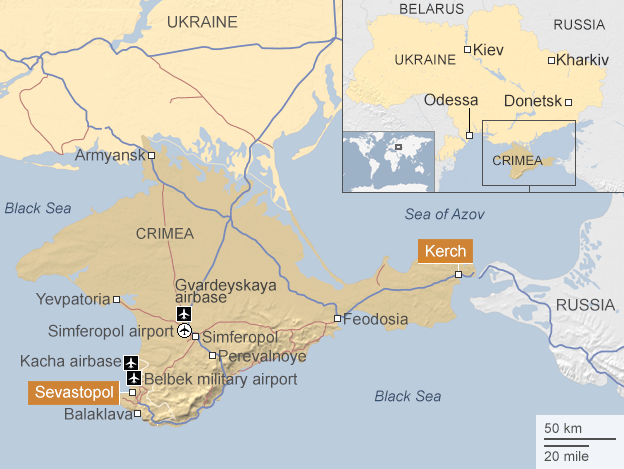
 Via the BBC: Crimean’s loyalties split despite leaders’ certainties.
The current leadership:
The law was rushed through the autonomous province’s parliament, with 79 of 81 MPs backing the proposal to leave Ukraine.
[…]
Crimea’s First Deputy Prime Minister Rustam Temirgaliev told me he was certain of victory.
“Ukrainians will become Russian citizens here”, he said. “We will win this vote with 70 or 75%. The referendum is legitimate.”
The more complex reality:
Crimean Russians are split, perhaps by generation. Lena’s mother, Irina, remembers 1954, when Crimea was given to Ukraine by the former Soviet leader Khruschev in a move that many here still resent. “I would vote yes in a referendum”, she says. “Crimea has always been a Russian land and I don’t have any emotional bonds with Ukraine.”
Aside from the Russians, there is a sizeable community of ethnic Ukrainians and Crimean Tatars, who together make up around 40% of the population. They would both certainly reject changing nationality.
The Tatars were deported by Stalin to Central Asia in 1944, as punishment for alleged collaboration with the Nazis by some. Many died, and even after some eventually returned, they remained fiercely anti-Russian.
And that is the problem here. Within this small, rugged peninsula, the divisions are so deep that nothing can satisfy everyone.
All of this sums to the fact that if this referendum is overwhelmingly in favor of joining Russia that there is no way that such numbers could reflect a democratic reality on the ground. But, of course, the only way an argument can be made that the referendum has any legitimacy is if it shows a truly overwhelming majority in favor.
As such, it seems unlikely that the referendum will actually provide any kind of real resolution. (Unless, I suppose, it is held and leaving Ukraine fails, but I have a hard time seeing the Russians allowing that to happen).
Of course, the reason that the current leadership is speaking as it is is because it is not a legitimate, representative government, but is instead puppets of an occupying force.
Via USAT: Analysts call Crimea’s Parliament a fake government
“This (Crimea government) is a fake parliament because it was not elected and it was proclaimed under the Russian occupation — the democratic procedure under the guns of a foreign army does not work,” said Yaroslav Pylynskyi, director of the Kennan Institute at the Wilson Center, a policy research institute in Kiev.
“The fact is that the procedure of the change of the government and the parliament in Crimea was under the guns of a foreign army so a fake parliament adopted a fake government,” he said.
Specifically:
Armed men assumed to be Russian troops or pro-Russian militia stormed the Crimea Parliament building and locked it down. Anatoly Mogiliov, the president of Crimea, who is a member of Yanukovych’s Party of Regions, was ordered out.
In a session not open to the public, the Crimea parliament allegedly appointed Sergei Askyonov as prime minister of Crimea. Askyonov is a member of a small, obscure political group called from the Russian Unity Party, which won too few votes in parliamentary elections in 2012 to win even one seat in Kiev.
Businessman Alexei Chaly announced he was mayor of Sevastopol, elected he said in a rally Feb. 23 and named chairman of Sevastopol’s executive committee, which did not exist in the city previously. He is running the city and said he is backed by Moscow.
As such, it is impossible to argue that the current “government” in Crimea has any legitimacy (or is legal, for that matter).









