
As the world mobilizes support for earthquake-stricken Haiti, aid organizations are running into some snags:
Amid looting of United Nations and other food stocks in Haiti, international relief agencies struggled Friday to find alternative routes for aid in the face of survivors’ angry criticism that no help was getting through, threatening them with a second catastrophe after Tuesday’s earthquake.
With relief flights snarled at Port-au-Prince airport, officials at international aid organizations in Geneva and Rome said in telephone interviews that the likely alternatives included a land-and-air bridge between Port-au-Prince and Santo Domingo in the neighboring Dominican Republic and the deployment of roll-on, roll-off vessels capable of unloading supplies at the badly damaged port in the Haitian capital.
Much of Haiti’s civil infrastructure, fragile to start out with, has been damaged by the earthquake. Aid workers on site at the time of the quake are themselves its victims. Aid workers attempting to get in are running into obstacles presented by the lack of functioning transport systems. Regardless of the need The Haitian government has stopped accepting flights:
The Haitian government stopped accepting flights Thursday because ramp space at the airport was saturated and no fuel was available, said Federal Aviation Administration spokeswoman Laura Brown.
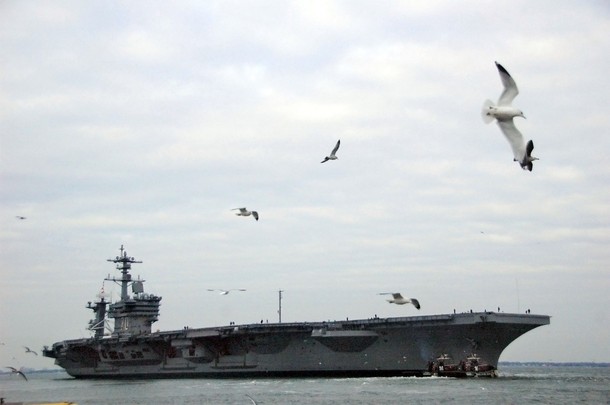
There’s only one institution in the world that is capable on short notice of bringing an airport, a water purification plant, a major hospital, and workers complete with the facilities to support themselves to the site. The institution is the U. S. Navy and the name of the airport and water purification plant is the USS Carl Vinson:
USS CARL VINSON, At sea (NNS) — The Nimitz-class aircraft carrier USS Carl Vinson (CVN 70) arrived off the coast of Port-Au-Prince, Haiti Jan. 15 to commence humanitarian assistance and disaster relief operations.
Carl Vinson received orders from U.S. Southern Command to deliver assistance to the Caribbean nation following a 7.3 magnitude earthquake which caused catastrophic damage within the capital city Jan. 12. The aircraft carrier’s speed, flexibility and sustainability make it an ideal platform to carry out relief operations.
“Our initial focus is to concentrate on saving lives while providing first responder support to the people of Haiti. Our assistance here reflects our nation’s compassion and commitment to those impacted by this tragedy,” said Rear. Adm. Ted Branch, commander of the Carl Vinson Carrier Strike Group and the U.S. Navy’s sea-based humanitarian support mission of Haiti.
The carrier arrived on station with a robust airlift capability, picking up extra helicopters while in transit that will will prove essential during the mission.
The name of the hospital is the USNS Comfort.
Within hours of the earthquake a Coast Guard C-130 had already landed in Port-au-Prince, bringing the equipment to set up field hospitals and communications centers. Four large Coast Guard ships are already in Haiti.
This is not an isolated instance. Following the Indonesian tsunami in 2004 American aircraft carriers were among the earliest to arrive on the scene. In the aftermath of the earthquake in Pakistan in 2005 the U. S. Navy became the largest healthcare provider in the country for more than a year.
The ability to project force also gives us the ability to project aid. Europe’s wealthy nations in eschewing the ability to project force have not substituted a commensurate capability of projecting aid.
I have been consistently critical of our large military expenditures and I remain so. It is simply unconscionable that we spend so much on our military. However, the reason that we spend nearly as much as the rest of the world combined may be that our European allies aren’t spending enough.
I will continue to be critical of our large military expenditures but in circumstances like these I can only say thank God for the U. S. Navy. And thank God for the Coast Guard.