
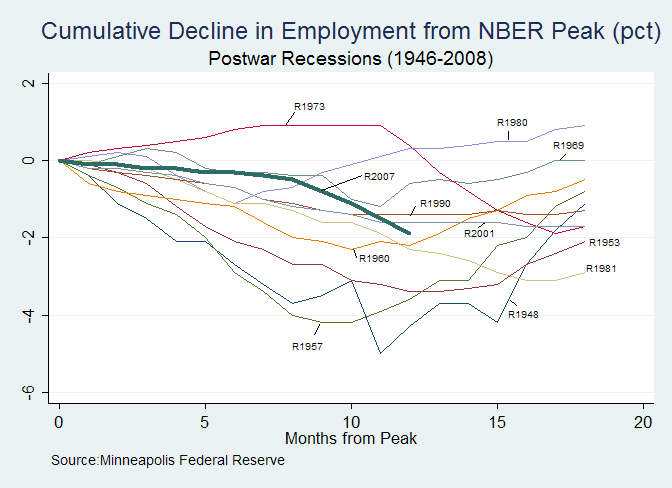
I noted recently that Personal Consumption Expenditures (PCE) have been declining for the past 3 months and that when taken in conjunction with the two previous quarters of low GDP numbers this does not bode well for the economy. Since PCE is over 70% of GDP it is more likely that we will see negative growth for GDP in the third quarter if the trend persists, and it is also possible that the second quarter GDP is revised down and even negative. Basically, the economy is very weak and could be on the verge of another recession.
Well, this article over at Huffington Post lists additional reasons to be worried about the economy and on a global scale.
_ A survey by the Federal Reserve Bank of Philadelphia shows that manufacturing in the mid-Atlantic region contracted in August by the most in more than two years. The steep drop, on top of a smaller decline in a New York Fed survey this week, means U.S. manufacturing probably contracted in August, economists said.
_ U.S. home sales fell in July for the third time in four months, the National Association of Realtors said. Sales dropped 3.5 percent to a seasonally adjusted annual rate of 4.67 million homes. That’s far below the 6 million homes that economists say must be sold to sustain a healthy housing market.
_ In Asia, Japan’s exports fell for a fifth straight month. The world’s No. 3 economy has fallen into a recession since its earthquake and tsunami in March. Its weakness is contributing to the global slowdown.
_ Consumer prices rose 0.5 percent in July, mostly due to more expensive gas and food. The “core” price index, which excludes volatile food and energy prices, rose 0.2 percent. The higher prices add to the burdens for Americans already squeezed by stagnant pay, though economists don’t expect prices to rise much further. And gasoline has fallen this month.
Also Europe is having its own struggle with debt,
Investors are also growing more anxious about Europe’s sputtering economy and its leaders’ ability to resolve the debt crisis. European bank stocks accelerated their fall Thursday.
European banks are being forced to pay more for the short-term loans they need to finance day-to-day operations. Some with heavy exposure to the debts of Greece and other weak countries are relying on loans from the European Central Bank because other private banks are reluctant to do business with them.
The ECB said Thursday that one bank had borrowed $500 million a day for seven days through the ECB’s dollar lending program. It was the first time since February that a bank had used the program. The bank wasn’t identified.
And Morgan Stanley sees the risk of recession as 1 in 3.
Morgan Stanley’s calculation of a one-in-three risk of a new recession hinges, in part, on its expectation that Congress will let a Social Security tax cut, a business tax credit and extended unemployment benefits expire at year’s end. It calculates that the expiration of those measures would reduce U.S. growth by 0.5 to 1 percentage point in 2012
And James Hamilton over at Econbrowser also notes the decline in consumer confidence and the stock market behavior as bad news. Of course Hamilton doesn’t see these events as being sufficient to be more worried. However, in looking at his chart on events driving decreases in consumer confidence I see several where PCE declined. Well, we have had real PCE declines since March – June (FRED doesn’t have July yet), or three months. So how can we be sure that the decline in consumer confidence is simply due to the debt ceiling debate? So I’m not so sanguine about the drop in consumer confidence. I hope it was all related to the debt ceiling, but I’m skeptical.
And given all this negative data, and keeping in mind how high unemployment is and that in the last recession we add 4-5 percentage points to unemployment another recession could see unemployment climbing to 14-15% possibly even higher.









