
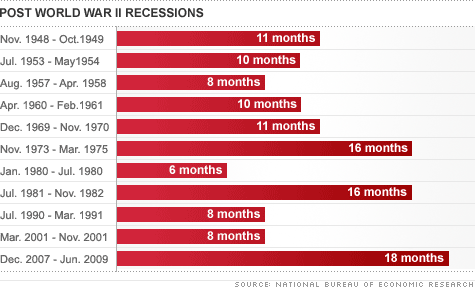

Great news, everybody: The biggest economic calamity since the Great Depression has been over for well over a year.
The Great Recession ended in June 2009, according to the body charged with dating when economic downturns begin and end. But the news comes amid rising fears of a double-dip recession.
The National Bureau of Economic Research, an independent group of economists, released a statement Monday saying economic data now clearly points to the economy turning higher last summer.
That makes the 18-month recession that started in December 2007 the longest and deepest downturn for the U.S. economy since the Great Depression.
The NBER acknowledged the risk of double-dip recession in its statement, but said “The committee decided that any future downturn of the economy would be a new recession and not a continuation of the recession that began in December 2007. The basis for this decision was the length and strength of the recovery to date.”
The committee that made the finding said it “did not conclude that economic conditions since that month have been favorable or that the economy has returned to operating at normal capacity.” Rather, it decided that June was when the economy hit bottom, and that it has been slowly but steadily growing since then.
“Economic activity is typically below normal in the early stages of an expansion, and it sometimes remains so well into the expansion,” said the NBER.
Most economists have been saying for months that the recession likely ended in the summer of 2009.
“No, we are not still in a recession as some people have asserted,” said Barry Ritholtz, CEO of Fusion IQ, a research firm based in New York. “No, it’s not a depression. The wheel has turned, the trough is more than a year behind us. This is not a robust recovery, but the economy is now expanding, not contracting.”
See the full NBER report here. Ritholz has some more charts and insights at The Big Picture.
This isn’t exactly news, in that we’ve been pretty confident for some time that the technical end of the recession happened last summer. And, frankly, the announcement is likely to be met with sneers from the general public, what with the flatness of the recovery and the fact that the miserable jobs picture isn’t clearing up anytime soon.
The prospect of a “double dip” is particularly unwelcome. Ritholtz places the risk in the 20% to 30% range and the most pessimistic put it in the 40% range.
As to whether “the economy has returned to operating at normal capacity,” there’s a very real chance, sadly, that it has. As Dave Schuler has said repeatedly: This may well be the recovery. A lot of the jobs that went away during this crisis are simply not coming back. And it’s not clear what’s going to replace them in the short- or medium-term.
Update (Steve Verdon):
I don’t find this announcement all that surprising given the growth we’ve been seeing in GDP. However, as James has already mentioned there is concern for a double dip recession as GDP growth has become rather phlegmatic. James Hamilton’s Econbroswer Emoticon has been neutral since August, but he does point out that by itself this does not mean the recession is over. However, he does have another measure that does signify when recessions have begun and ended (note this tool is not predictive, but retrospective), The Econbrowser Recession Indicator Index this indicator put the end of the recession in the second quarter of 2009–i.e. it is consistent with the NBER’s end date of June 2009. As for concerns of a double dip here is James’ post on that.
What I’m still seeing is what I had been expecting and what I continue to expect for the rest of this year– weak growth, but growth nonetheless.
I don’t think this is out of line with Ritholz either. While the above is Prof. Hamilton’s expectations I certainly wouldn’t read that as to preclude the economy slipping back into recession.








