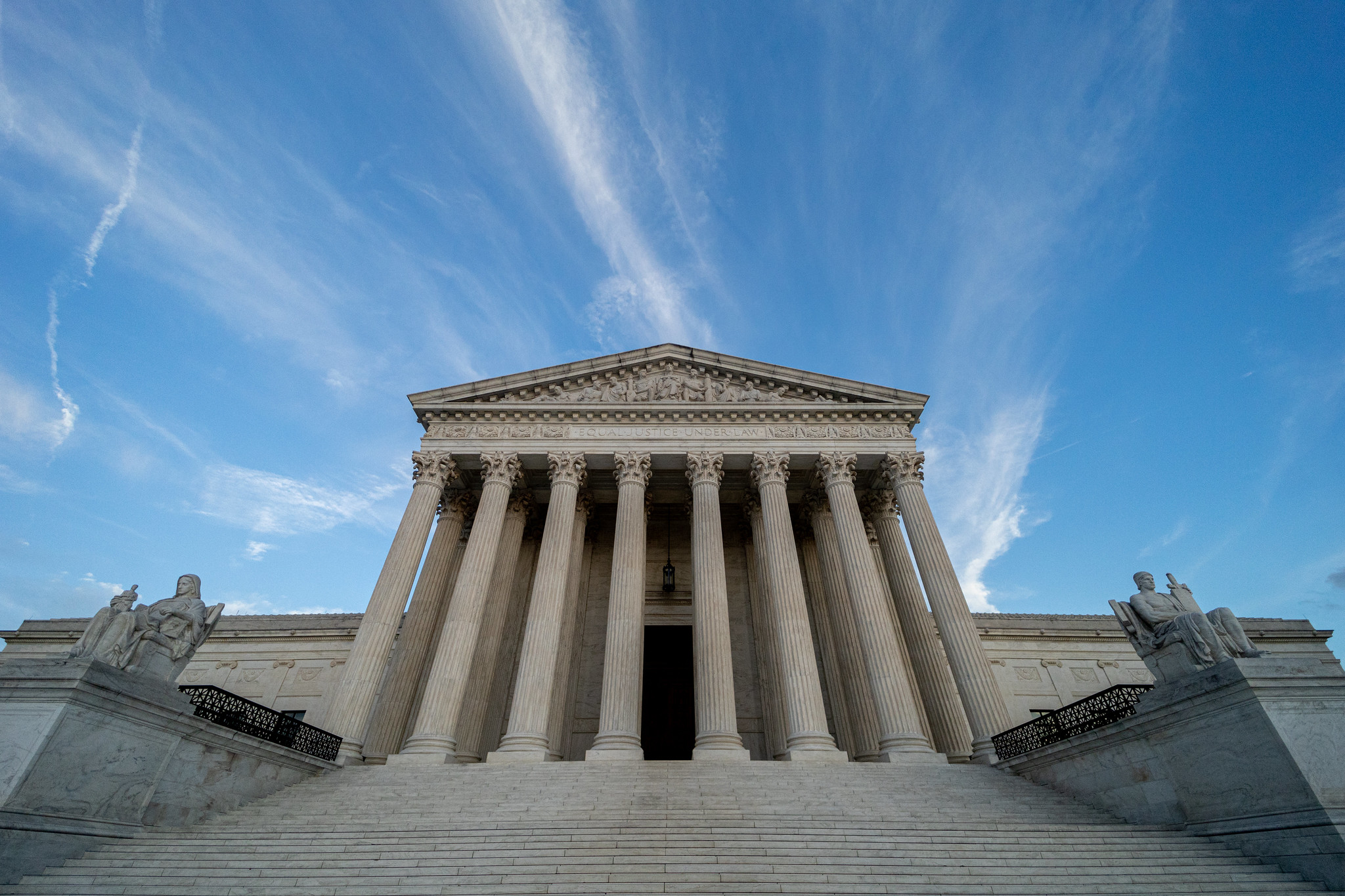

First, the good news via the NYT, Supreme Court Rejects Theory That Would Have Transformed American Elections.
The Supreme Court on Tuesday rejected a legal theory that would have radically reshaped how federal elections are conducted by giving state legislatures largely unchecked power to set rules for federal elections and to draw congressional maps warped by partisan gerrymandering.
The vote was 6 to 3, with Chief Justice John G. Roberts Jr. writing the majority opinion. The Constitution, he said, “does not exempt state legislatures from the ordinary constraints imposed by state law.”
Justices Clarence Thomas, Samuel A. Alito Jr. and Neil M. Gorsuch dissented.
The case concerned the “independent state legislature” theory. It is based on a reading of the Constitution’s Elections Clause, which says, “The times, places and manner of holding elections for senators and representatives shall be prescribed in each state by the legislature thereof.”
Proponents of the strongest form of the theory say this means that no other organs of state government — not courts, not governors, not election administrators, not independent commissions — can alter a legislature’s actions on federal elections.
That three Justices thought otherwise is more than a tad concerning. The notion that state courts would have no ability to review state elections laws and their application is simply absurd and frightening.
The ruling soundly dismissed the theory, one that an unusually diverse array of lawyers, judges and scholars across the ideological spectrum viewed as extreme and dangerous.
So, good.
But here’s the caveat:
But election law specialists cautioned that Tuesday’s decision elevated the power of federal courts in the process, allowing them to second-guess at least some rulings of state courts based on state law.
As Chief Justice Roberts put it, “state courts do not have free rein” and are subject to oversight by federal courts in cases involving federal elections. But he said quite little about the nature and extent of that oversight.
“The questions presented in this area are complex and context-specific,” the chief justice wrote. “We hold only that state courts may not transgress the ordinary bounds of judicial review such that they arrogate to themselves the power vested in state legislatures to regulate federal elections.”
Along those lines, I recommend this piece from Slate by law professor (and elections law expert), Rich Haden, There’s a Time Bomb in Progressives’ Big Supreme Court Voting Case Win.
But Moore is not all good news. In the last part of his majority opinion for the court, the chief justice got the liberal justices to sign onto a version of judicial review that is going to give the federal courts, and especially the Supreme Court itself, the last word in election disputes. The court held that “state courts may not transgress the ordinary bounds of judicial review such that they arrogate to themselves the power vested in state legislatures to regulate federal elections.”
To understand these dense words, we need to go back to the last time the Supreme Court decided a major election case, the 2000 Bush v. Gore decision (a case cited in Moore for the first time ever in a majority opinion in the 23 years since that decision). In Bush, the Florida Supreme Court had ordered a recount of only certain ballots in Florida to determine if Democrat Al Gore or Republican George W. Bush had won the state’s electoral college votes and therefore the presidency. At the time, Bush was ahead by only hundreds of votes out of millions cast.
After the Florida court ordered the recount, Bush appealed to the U.S. Supreme Court. A majority held that the recount ordered by the Florida court violated the Equal Protection Clause because there was no guarantee that uniform standards were used or could be used to conduct it. But three justices—Chief Justice William Rehnquist, joined by Justices Antonin Scalia and Thomas—adopted this milder version of the independent state legislature theory at the time. In essence they argued that the Florida court’s interpretation of the Florida election statutes to allow this recount was so far from ordinary statutory interpretation that the Florida court was essentially making up the law for itself, and taking away the legislature’s power to decide the rules for conducting federal elections in the first instance.
It is this milder version of the independent state legislature theory that the court embraced in Moore. It did not spell out its contours, and whether to adopt the Rehnquist Bush approach or some other approach. But Justice Kavanaugh, in a concurrence, endorsed the Rehnquist approach and said that in engaging in this second guessing, federal courts need to compare election law in the state in earlier decisions. The greater the deviation, the more likely to find a violation of the independent state legislature theory.
I would recommend the whole piece.