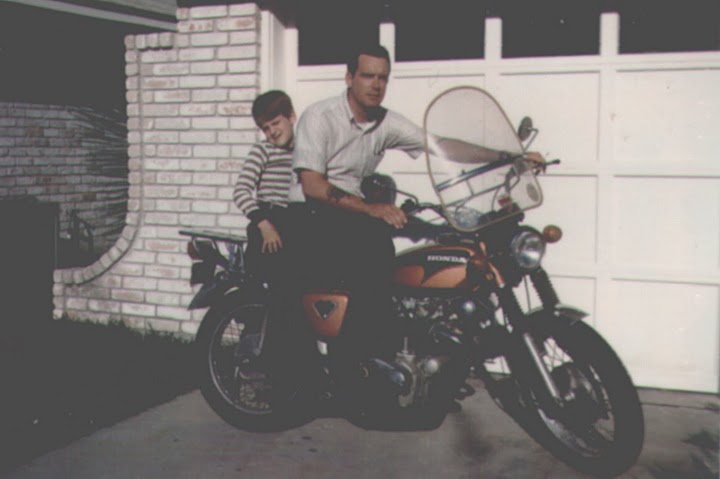
My father and namesake, James Harvey Joyner, died yesterday morning from idiopathic pulmonary fibrosis. He was 66.

He was diagnosed with the degenerative lung disease six years ago and told he likely had three to five years. He was hospitalized with pneumonia three weeks ago and I went down and spent a few days with him. But while the doctors gave him hope that he’d recover and go home, we both knew there was a pretty fair chance he wouldn’t. So, when I got the call that his condition was deteriorating rapidly and I should come back down, while I wasn’t ready, I was prepared.
But, then, he’d spent my whole life preparing me.
During my last trip down, I took the evening shift at the hospital, since my mother doesn’t like to drive in the dark anymore. The first night we were alone, he made it clear that he didn’t want to be put on a respirator and have his life prolonged indefinitely with no hope of ever going home. Nor did he want to be released from the hospital unable to take care of himself and therefore be a burden on my mother. Having known him for 44 years, I knew these things instinctively but having him articulate them made it easier to make the decisions that had to be made. More importantly, it meant that I could relieve my mother of the burden of having to make them.
My dad was born August 26, 1943 into a world I can only imagine. Neither of his parents finished elementary school. His mother was married at an age that seems absurd now — I believe she was 13 — and had the first of five children a year or so later. His father was a semi-skilled laborer, doing seasonal light carpentry and painting. Needless to say, there wasn’t a lot of money.
Dad seemed destined to live a similar life. He dropped out of school at 16 and did various odd jobs until enlisting in the Army just shy of his 19th birthday in July 1962. After finishing his initial training, he shipped off to Germany where he met my mother. They married in September 1964 and she followed him back stateside for his next assignment.
I was born in November of the next year, at Fort Monroe, Virginia near where he grew up.
The combination of a new family and a steady paycheck made staying in the Army look pretty good and what started as a three year hitch became a twenty year career. The combination of an above-average IQ and a very strong work ethic made it one for which he was well suited. He rose through the ranks quickly, spending the majority of his career in the senior NCO ranks. He ultimately retired as a First Sergeant.
Along the way, he finished his GED and the Army sent him to get his associate’s degree in police science on to way to becoming an agent in the Criminal Investigation Division. He was offered a chance to become a warrant officer but felt starting over at a rank that some kid coming out of school could hold was a step down from the exalted status of senior NCO and passed. He’d regret that decision in later years but it’s understandable given the Army’s culture.
His last duty assignment in uniform was as a chief instructor at the Military Police school, a major’s billet. When he retired, though, and applied for a mere instructor’s job in the civil service at the same school, he was passed over because his lack of a four year degree made him “unqualified.”
He worked briefly as a retail manager, first at a regional drug store chain and then at an electronics store. He had more than doubled sales at the latter in a little over a year and became general manager when a second store opened, so he was shocked to be fired when the owners decided that they wanted to take over and run it themselves. That turned out to be a bad move by the owners, as they failed miserably. But my dad used the opportunity to go back to school on the GI Bill and finish his four year degree.
I was eight months ahead of him. While we were probably in the lower middle class when I was growing up (military pay was horrendous until the Reagan administration, so my dad was quickly making more in retired pay than he did on active duty) it had never really occurred to me that I wouldn’t finish high school and go on to college and a decent career. Indeed, I had already been commissioned a second lieutenant by the time my dad got his BA and would finish my masters four months later.
Ironically, he was the better student. While I’m more academically talented than he was, mostly because I was a lot better at math, he cared more about learning for its own sake and worked harder. Partly because academics came easy to me and partly because I saw school as a ticket to be punched to get the jobs I wanted, I didn’t throw myself in to it in the way he did.
At any rate, he managed to land back out at Fort McClellan in the civil service, although he had to take an insulting step down, entering as a GS-7, to do it. But he quickly worked his way to GS-12 and a division chief position, from which he medically retired some years back. From the perspective of the DC area, where GS-15s are a dime a dozen, that may not be too impressive. But outside the National Capital Region, GS-13 is about as high as you can go.
I didn’t fully appreciate my dad when I was a kid. My mom stayed home and took care of me, while Dad went off to work — sometimes very long hours, including lots of weekends. It wasn’t until I got out in the world that I understood how big a deal just getting out of bed every day, putting in your best effort on the job, and then bringing the check home to the family was. It was just something dads did, after all. I was into my twenties before I really understood how many dads didn’t.
Because of his example and the head start that his sacrifices gave me, I’ve lived a life that he couldn’t have even imagined growing up. I was the first in the family to get a four-year degree (and he the second) and then went on to get a doctorate. While I’m by no means rich, we live a comfortable, upper-middle class lifestyle and it’s inconceivable that our little girl won’t be able to be whatever her talents and desires lead her to be.
Like my dad, my career has taken me far from home, although I’ve done a much better job of staying in touch than he did. When he was my age, he’d been married 21 years and his son was two months from finishing college and starting work on his master’s degree. I’ve been married four years and Katie is still in diapers.
It’s now up to me to carry on and do what my dad trained me to do: Take care of my mother and my family. There’s a lot to do over the next few days. And with a toddler to love, not much time to be maudlin.