Josh Marshall, who “of course” smoked marijuana in his youth, is queasy about legalizing it now that he’s older and wiser.
I just don’t know if I think marijuana should be legalized at all. Maybe it’s that I’m getting into my 40s. And maybe I’m a hypocrite. I of course know people who smoke grass. And I don’t have any problem with it. Decriminalized? Yes, I think probably so. But that’s not the same as legalization. It’s very different actually.
Jacob Sullum pushes back:
Marshall’s inarticulate resistance to legalization is especially maddening became he claims to agree that “our drug laws are catastrophic,” leading to black market violence and unjust incarceration. Neither of those problems can be solved through “decriminalization,” which in the U.S. typically means letting users off with a modest fine instead of jail time. As long as supplying users with the drugs they want remains illegal, the violence and incarceration will continue. And under what moral theory do people who smoke pot deserve little or no punishment, while people who merely help them do so deserve to spend years in prison? I cannot fathom how anyone, let alone a self-identified critic of the war on drugs, can suggest that such an outrageous violation of liberty is justified to guard people’s sensibilities by keeping “public usage in check.” And I’m in my 40s too, so I’m not accepting that excuse.
Marshall’s complacency may stem from a sense that marijuana basically has been decriminalized already. After all, his friends aren’t getting busted for pot. Yet last year more than 858,000 Americans were, and they were disproportionately members of minority groups—the sort of unequal legal treatment that usually bothers progressives.
Andrew Sullivan second that:
What Josh seems to be saying is that he wants pot de facto legal but closeted. But like most closets, this one requires a shame that simply isn’t there any more – and has not been for decades now. And any illegality is bound to end up hurting the poor and minorities to a disproportionate extent. It’s not unenforced. It’s enforced brutally upon hundreds of thousands of people. It’s okay to sit there mulling how uncomfortable fully legal pot makes you, as long as none of your friends is thrown into jail, or forever barred from employment, or fired for no reason related to work performance.
Ultimately, while I share Josh’s queasiness about legalization — the addition of large numbers of people spending their time stoned is likely not a net plus — I’ve reluctantly embraced it for largely the reasons Andrew and Jacob give. The costs of enforcing our drug laws outweigh the benefits. And, yes, the toll is mostly paid by those at the bottom of the social scale. Affluent members of the creative class can generally get away with recreational drug use without fear of being hassled, much less arrested.
Andrew goes beyond practicality, though, and makes a fetish of it:
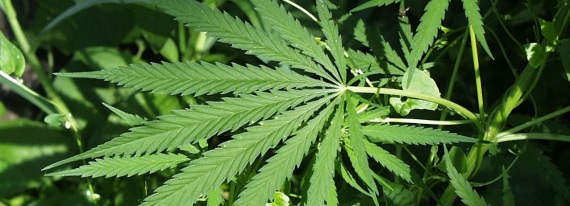
My view – regardless of the arguments back and forth about the effects of marijuana – is simply that it is absurd for any government to prevent people from growing a naturally-occurring plant that requires no processing to provide humans with pleasure. It’s pretty basic, actually. This is a core freedom for human beings and requires an insane apparatus of state control and police power to prevent it from occurring. All you have to do is burn a plant and inhale the smoke. If humans are not free to do this in the natural world in which they were born, what on earth are they free to do? My premise is freedom; Josh’s is not.
Should we ban roses because they give us pleasure with their beauty and their scent? Should we ban herbs, like rosemary or thyme, because they give us pleasure and encourage us to eat more? Should we ban lawn-grass because maintaining it consumes too many people’s weekend afternoons? Should we cut down trees because the beauty of them can sometimes distract someone from the road? I could go on.
A core freedom?! Right up there with free speech and habeas corpus, eh? Odd that it never got the same treatment in political philosophy.
The comparisons with roses and useful herbs are rather silly. The negative effects of smelling and tasting them are nonexistent. But plenty of naturally occurring plants are poisonous. For that matter, there’s all manner of regulation on the sale and transport of even such things as roses and rosemary. You’re not allowed to transport them across borders, for instance. Hell, in many localities, government bans the burning of leaves in one’s backyard.
Beyond that, I’m not sure why “naturally-occurring” is some magical bar to government action. It seems, to say the least, arbitrary. Heroin is derived from opium, which is derived from naturally growing poppy plants. Can government regulate it because processing beyond setting it afire is required? Or does the fact that the essential ingredient comes from a plant encircle it with a magical cone of government exclusion?
Further, under Andrew’s standard, it would be legal to grow pot and smoke it but not to buy it or sell it. Or, for that matter, extracting the THC and consuming it in a different form. What sense does that make?
Isn’t it easier to just work from the Harm Principle?
That principle is, that the sole end for which mankind are warranted, individually or collectively, in interfering with the liberty of action of any of their number, is self-protection. That the only purpose for which power can be rightfully exercised over any member of a civilized community, against his will, is to prevent harm to others. His own good, either physical or moral, is not sufficient warrant. He cannot rightfully be compelled to do or forbear because it will be better for him to do so, because it will make him happier, because, in the opinion of others, to do so would be wise, or even right… The only part of the conduct of anyone, for which he is amenable to society, is that which concerns others. In the part which merely concerns himself, his independence is, of right, absolute. Over himself, over his own body and mind, the individual is sovereign.
I’m just sayin’.