A Republican Congressman known only for his opposition to Donald Trump has announced that he’s leaving the Republican Party—because both parties suck.
He starts off well:
When my dad was 16, America welcomed him as a Palestinian refugee. It wasn’t easy moving to a new country, but it was the greatest blessing of his life.
Throughout my childhood, my dad would remind my brothers and me of the challenges he faced before coming here and how fortunate we were to be Americans. In this country, he told us, everyone has an opportunity to succeed regardless of background.
Growing up, I thought a lot about the brilliance of America. Our country’s founders established a constitutional republic uniquely dedicated to securing the rights of the people. In fact, they designed a political system so ordered around liberty that, in succeeding generations, the Constitution itself would strike back against the biases and blind spots of its authors.
My parents, both immigrants, were Republicans. I supported Republican candidates throughout my early adult life and then successfully ran for office as a Republican. The Republican Party, I believed, stood for limited government, economic freedom and individual liberty — principles that had made the American Dream possible for my family.
—WaPo, “Justin Amash: Our politics is in a partisan death spiral. That’s why I’m leaving the GOP.“
In recent years, though, I’ve become disenchanted with party politics and frightened by what I see from it. The two-party system has evolved into an existential threat to American principles and institutions.
[Insert needle screeching off a turntable sound here.]
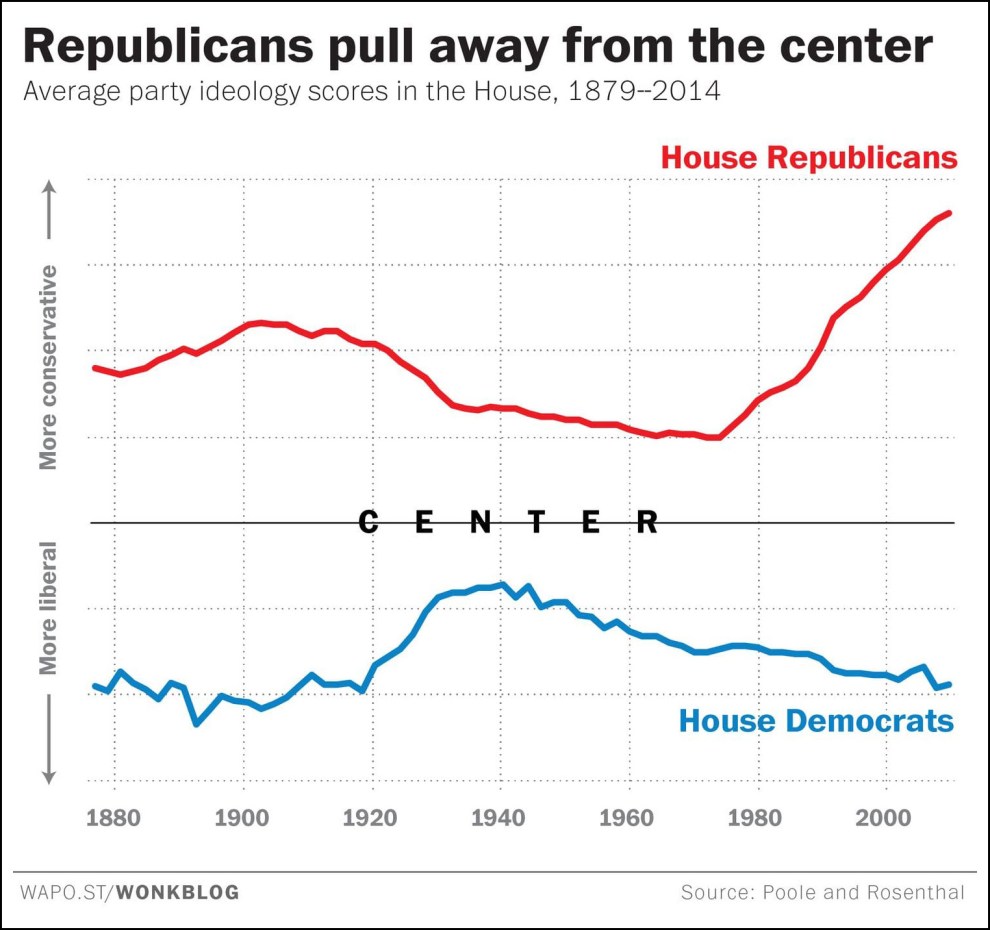
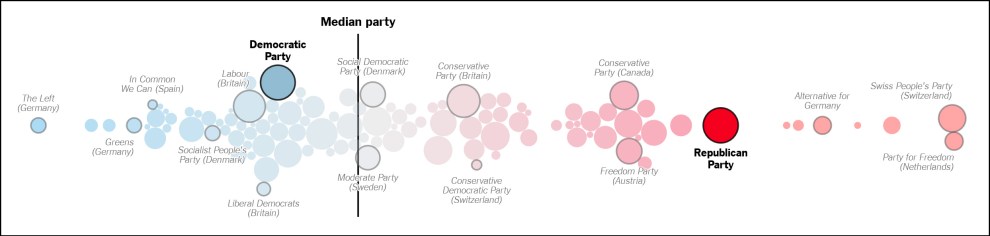
Look, there’s plenty of criticism to be made of both of the major US political parties and of the polarization that has increasingly characterized the system over the last quarter century or so. But, c’mon. The existential threat to American principles and institutions come from President Trump in particular but also from Republican Congressman, Senators, and Supreme Court justices who have enabled him. It’s the party that Amash and I have both left that’s the danger to the Republic, not our two-party system.
Certainly, if one’s driving concern is America’s being welcoming to refugees and immigrants more generally, the change has come from the GOP, not the Democrats. While a handful of more extreme members of that party are effectively open border advocates, their policy preferences make it much easier for future Amashes to pursue the American dream. Amash’s erstwhile party . . . not so much.
Amash tries to persuade us otherwise:
George Washington was so concerned as he watched political parties take shape in America that he dedicated much of his farewell address to warning that partisanship, although “inseparable from our nature,” was the people’s “worst enemy.” He observed that it was “the interest and duty of a wise people to discourage and restrain it.”
Washington said of partisanship, in one of America’s most prescient addresses: “The disorders and miseries which result gradually incline the minds of men to seek security and repose in the absolute power of an individual; and sooner or later the chief of some prevailing faction, more able or more fortunate than his competitors, turns this disposition to the purposes of his own elevation, on the ruins of public liberty. …
“It serves always to distract the public councils and enfeeble the public administration. It agitates the community with ill-founded jealousies and false alarms, kindles the animosity of one part against another, foments occasionally riot and insurrection. It opens the door to foreign influence and corruption, which finds a facilitated access to the government itself through the channels of party passions. Thus the policy and the will of one country are subjected to the policy and will of another.”True to Washington’s fears, Americans have allowed government officials, under assertions of expediency and party unity, to ignore the most basic tenets of our constitutional order: separation of powers, federalism and the rule of law. The result has been the consolidation of political power and the near disintegration of representative democracy.
The set of claims in that last paragraphs is squishy and hard to evaluate. But the general trend toward consolidation of power at the national level happened well before Amash, only 39 years of age, was born. Indeed, since they were in evidence by the 1940s if not the 1920s, they predate Amash’s father as well.
These are consequences of a mind-set among the political class that loyalty to party is more important than serving the American people or protecting our governing institutions. The parties value winning for its own sake, and at whatever cost. Instead of acting as an independent branch of government and serving as a check on the executive branch, congressional leaders of both parties expect the House and Senate to act in obedience or opposition to the president and their colleagues on a partisan basis.
Remind me which party spent the entirety of the two terms of the opposition-party President seeking to deny him a single vote on any bill? Who held a Supreme Court seat vacant for well over a year in hopes an intervening election would allow their party to steal it?
In this hyperpartisan environment, congressional leaders use every tool to compel party members to stick with the team, dangling chairmanships, committee assignments, bill sponsorships, endorsements and campaign resources.
Okay, that’s indeed a bipartisan phenomenon. It, too, however, has been in effect since well before Amash was born.
As donors recognize the growing power of party leaders, they supply these officials with ever-increasing funds, which, in turn, further tightens their grip on power.
Actually, party leaders are less powerful than they were decades ago. But, yes, donors have become more powerful as laws seeking to restrain the influence of money on politics have been struck down by the courts. Specifically, by Republican appointees to those courts.
The founders envisioned Congress as a deliberative body in which outcomes are discovered. We are fast approaching the point, however, where Congress exists as little more than a formality to legitimize outcomes dictated by the president, the speaker of the House and the Senate majority leader.
With little genuine debate on policy happening in Congress, party leaders distract and divide the public by exploiting wedge issues and waging pointless messaging wars. These strategies fuel mistrust and anger, leading millions of people to take to social media to express contempt for their political opponents, with the media magnifying the most extreme voices. This all combines to reinforce the us-vs.-them, party-first mind-set of government officials.
So, again, Amash has hit on a genuine shift in American politics. The reasons for it are complicated, including a gradual purifying of the two parties such that almost all moderate-conservative Democrats are now Republicans and all moderate-liberal Republicans are now Democrats. And while bothsides reall do engage in all these practices, they were arguably pioneered by . . . checks notes . . . Newt Gingrich and Congressional Republicans in 1994. When Amash was barely a teenager.
Modern politics is trapped in a partisan death spiral, but there is an escape.
Most Americans are not rigidly partisan and do not feel well represented by either of the two major parties. In fact, the parties have become more partisan in part because they are catering to fewer people, as Americans are rejecting party affiliation in record numbers.
These same independent-minded Americans, however, tend to be less politically engaged than Red Team and Blue Team activists. Many avoid politics to focus on their own lives, while others don’t want to get into the muck with the radical partisans.
But we owe it to future generations to stand up for our constitutional republic so that Americans may continue to live free for centuries to come. Preserving liberty means telling the Republican Party and the Democratic Party that we’ll no longer let them play their partisan game at our expense.
Today, I am declaring my independence and leaving the Republican Party. No matter your circumstance, I’m asking you to join me in rejecting the partisan loyalties and rhetoric that divide and dehumanize us. I’m asking you to believe that we can do better than this two-party system — and to work toward it. If we continue to take America for granted, we will lose it.
So, I’m more-or-less okay with this.
As I wrote recently, while I’m functionally a Democrat these days, having voted for Democrats in general elections in 2016, 2017, 2018, and 2019 and almost certain to vote for the party’s candidate in 2020 to defeat Donald Trump, I don’t consider myself a member of the party. While I’ve certainly moved left on some issues over the years, I’m still much more temperamentally conservative than the Democratic leadership. I’m enthusiastic about restoring sanity and a respect for process and the rule of law to the White House, but not necessarily large parts of the Democratic platform.
But here’s the thing: pretending that the Democrats and Republicans are indistinguishably bad at the moment is dangerous. Amash himself has come out in support of impeaching President Trump. Our erstwhile party is backing him to the hilt, not only making removing him from office impossible but actively working to ensure he remains in office through January 20, 2025.*
Yes, our polarized system is bad for America. Yes, we should seek more moderate alternatives and restore a spirit of seeing those who disagree with us politically as fellow citizens and not enemies. But, no, the blame isn’t evenly spread. One of the parties is geometrically worse right now and it must be defeated at the ballot box.
_____________
*Correction: I originally had this as 2024.