
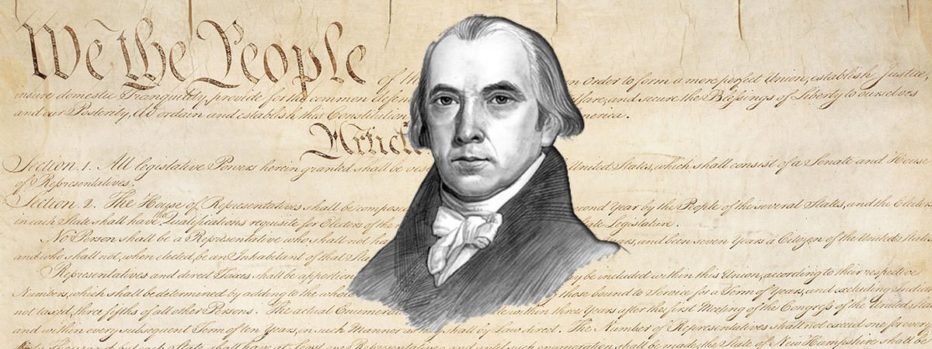

George Will wrote the following a column already discussed here on OTB by James Joyner:
Ryan and many other Republicans have become the president’s poodles, not because James Madison’s system has failed but because today’s abject careerists have failed to be worthy of it. As explained in Federalist 51: “Ambition must be made to counteract ambition. The interest of the man must be connected with the constitutional rights of the place.” Congressional Republicans (congressional Democrats are equally supine toward Democratic presidents) have no higher ambition than to placate this president. By leaving dormant the powers inherent in their institution, they vitiate the Constitution’s vital principle: the separation of powers.
James notes in his post:
Quite right. On the late, likely unlamented, OTB Radio, Dave Schuler frequently noted that we had combined the worst features of separation of powers and parliamentary rigor. Even a decade ago, Congressional Democrats tended to vote lockstep against President George W. Bush and Congressional Republicans tended to vote lockstep with him. The phenomenon got much worse under President Obama and worse still under President Trump. There are a variety of reasons for this, mostly having to do with the purge of moderates from both parties, but the effects have been disastrous.
I started to write a comment on this at the post, but it was getting lengthy and I realized it should be even lengthier, so here we are.
We need to come to grips with the fact that the behavior we are seeing from congressional Republicans is actually what we should expect from our system now that the parties have self-sorted ideologically after the long effects of the Civil War (and Reconstruction specifically) on our parties finally faded in 1990s.* This is exceptionally important as what those of us of a certain age grew up with in terms of congressional party behavior is more the aberration than what should be expected. This seems counter-intuitive, but like the proverbial frog being slowly boiled, it is often hard to understand how our immediate surroundings are not always what they appear to be. Given the fact that the Republican party, in terms of the legislature (and, really, anywhere except the presidency), was largely not competitive in the southeastern United States from roughly the 1870s until the 1990s (with some exceptions) meant that a) the Democrats were a very large party that could muster votes (and controlled the chamber from Truman to Clinton), and b) there was some significant room for compromise between the GOP and Democrats within the chambers and between the legislature and the president. Deal-making and proverbial beer-having were easier in that context.
The last quarter century or so, however, has seen the parties re-sort ideologically and also an intensification of the geographical sorting of voters in terms of their partisan preferences (which is really important in a system in which geography plays an out-sized role in elections). As such, we should expect parties to treat the president as the leader of the party even moreso than in the past, and we are seeing the consequences of a bad leader. Madison, whom I have tremendous respect for, simply did not accurately predict how parties would form and then function in a legislature. It was beyond his experience when he wrote and theorized in the 1780s.
He was right that politicians are motivated by ambition, but the problem is assuming that they will be motivated, as he wrote in Federalist 51 (as quoted by Will above), by the ambition of retaining the power of the congress in face of encroachments by the executive. That may be true under the right kind of attack, but the reality is that a legislator from the same party as the president has every incentive to work with that president. This is because the main ambition that drives legislators is re-election and the secondary one is achieving certain policy goals. The president, as party leader, has a lot (not complete, but a lot) of influence over re-election, because the president can influence nomination. Just ask Mark Sanford. Ask Bobby Bright. And, likewise, the president is key in getting policies passed and enacted.
And yes, the president’s endorsement is not magic, as the Senate special election in Alabama proved, especially at the nominating phase. But it is rather clear that Trump’s popularity with the base means that Republican candidates want Trump’s support at the primary phase. This is a linking of ambition to congressional behavior that Fed 51 never envisioned. So Will’s consternation (and the laments of James and Dave above) that partisans vote with party is what we should expect. It is the way legislative parties work, even in separation of powers systems. Again: the aberration was the previous period. What we see now is what theory and practice would predict.
Will is being romantic in assuming that James Madison’s understanding of how a theoretical congress would function is the correct one However, note that Madison wrote the essay in support of ratification, and therefore its description of congressional politics was wholly hypothetical. We, as Americans, often fall into a similar romanticism because we are told in school about how separation of powers is allegedly supposed to work (I have been guilty of treating Fed 51 like a handbook of how congress is supposed to act in class, rather than as a persuasive essay trying to convinces people how Madison hoped it might act). But let’s focus on that fact that the existence of political parties means that the separation of institutional powers is not complete and total. Parties bridge the gap and create some degree of unity between the president and his co-partisans in congress. This changes what Madison was writing about, as he did not think that permanent groupings of legislators would persist, let along that they would be in clear and durable alliance with the person occupying the executive, but rather than temporary factions would form around specific issues and then dissolve.
Political parties are, therefore, essential institutions for understanding how representative democracies function. I cannot stress enough how much the Framers of the US Constitution did not understand this fact. Hence, one of the things that contemporary theorists of democracy understand, that Madison simply did not, is that institutions have to be structured with an understanding of how they affect party behavior, not just the behavior of individual politicians.
So, yes, we have more disciplined parties now–that is a reality that is going to remain in place. We are not going to return to the pre-Republican Revolution party system. What is worse (in my opinion), the current GOP has increasingly made a turn towards a reactionary approach to politics that has embraced white nationalism. This is an uncomfortable assessment that a lot of people are in denial about, but I don’t see how one can deny this fact, and it is not just about Donald Trump. Maybe this is rectified in 2020, but I have serious doubts at the moment.
But all of this is why Will is correctly arguing that the only options voters who oppose Trump have is to vote against Republicans, even if the voter considers themselves to be Republican. Really he is arguing that they should vote Democratic, but he can’t quite bring himself to say it. But the basic point remains: one cannot separate Trump and the GOP at the moment, even if we have a separation of powers system.
Beyond the politics of the moment, if we want better, more responsive government, there are a variety of things we could do (all of which range from the highly unlikely to the delusional-to-even-suggest, but truth is truth):
- Don’t elect a chief executive via a system wherein the person with less popular support can win the most powerful position in the country (if not the world).
- Expand the size of the House of Representatives so that it can better represent the size of our population. A US Representative is going to have a district of around 750,000 persons after the next census. That is an absurdly unrepresentative ratio or representative to represented.
- Change the way we nominated candidates. Primaries empower relatively small groups of voters and they short-circuit real third-party development. Those who want real third parties should want this.
- Elect the House in a proportional system. I would prefer the Mixed Member Proportional (MMP) system used in Germany and New Zealand. Others have suggested the Single Transferable Vote (STV) as used in the Republic of Ireland. If we want a House of Representatives then we need an electoral system that will produce representation of the population.
- Make it less possible for a minority of Senators, often representing a significant minority of the population, to block legislation.
There are other things I could note, but these are all key. 1 and 2 are unlikely, but maybe possible some day. 3 is unlikely because of the widespread belief that primaries are democratic. 4 is a dream. 5 may happen, but alone may not change all that much (there are further, more significant reform of the Senate I could raise, but they are all highly unlikely, whether they be changing the seat allocations per state or changing what the Senate can vote on–see German federalism for an alternative).
I not advocating simple majority rule. Indeed, the whole purpose of proportional representation is to increase the voices heard in government and to decrease the chances that only one segment of the population has power in policy-making. But the main problem with the US government at the moment is that it empowers a political minority to govern. Our government is insufficiently representative. A better electoral system would go a long way to solving that problem.
I would conclude, however, with pointing out that better institutions are not a panacea. I am not arguing that it solves all our problems, or necessarily produces justice and good public policy. What I am saying, however, is that at a minimum, if we actually believe in democracy in the basic sense of “government of, by, and for the people” we need our institutions to better reflect the panoply of positions in the country and, also, to not allow less that the majority to dictate major policy for the majority.
Democracy is hard.
At a minimum, we need to get over our romantic views of our Framers. We have two and a quarter centuries of data that they did not, both in terms of how the US system does, or does not, function, as well as a large number of other examples of democratic governance from which to draw understanding.
—
*It really is remarkable to see how specific historical events can have incredibly long-lasting effects. The fact that Lincoln was a Republican and, perhaps even more importantly, because the way Republicans in congress handled Reconstruction, there was century-plus affect on the party system. It is also rather noteworthy to recall the degree to which race has shaped our politics, as well as party behavior.









