
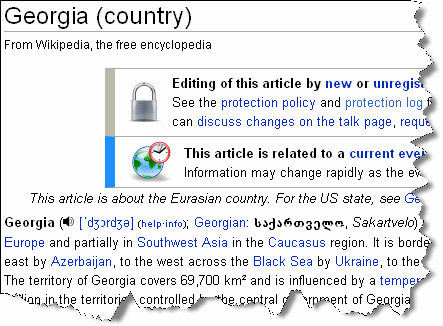
 Today’s Outrage of the Day comes to us from Taegan Goddard, who notes, in a CQ Political Insider piece entitled “Did McCain Plagiarize His Speech on the Georgia Crisis?” that there are “some similarities between Sen. John McCain’s speech today on the crisis in Georgia and the Wikipedia article on the country Georgia.”
Wikipedia and McCain
You can click Goddard’s name to see the examples in full but they’re rather weak. There are three examples where purely fact-based assertions about Georgia are somewhat similar. The first is incredibly short — less than a sentence — and the third involved radically different sentences with overlapping facts. The only interesting example, then, is this one:
After the Russian Revolution of 1917, Georgia had a brief period of independence as a Democratic Republic (1918-1921), which was terminated by the Red Army invasion of Georgia. Georgia became part of the Soviet Union in 1922 and regained its independence in 1991. Early post-Soviet years was marked by a civil unrest and economic crisis. (Wikipedia)
vs.
After a brief period of independence following the Russian revolution, the Red Army forced Georgia to join the Soviet Union in 1922. As the Soviet Union crumbled at the end of the Cold War, Georgia regained its independence in 1991, but its early years were marked by instability, corruption, and economic crises. (McCain)
This one, too, strikes me as thin gruel. The overlap are rather common facts and there’s substantial variation and additional information in the McCain version. As William Beutler observes,
[I]n all three examples, the text is purely expository: none of it expresses any thoughts, feelings, emotions or other content that would be an obvious case of intentional plagiarism. Additionally, it’s worth noting that historical facts cannot be plagiarized, only their expression. If there is any here, it’s probably inadvertent.
Meanwhile, consider that plagiarized text is almost always longer than original text. This is because the original writer is likely to state things in as few words as possible while the plagiarizer is trying to hide the origin, which means more words.
Professors React
My former Troy colleague Steven Taylor, while noting that he doesn’t think it’s a big deal, disagrees.
The passages noted in the post, especially the first two, would suggest rather convincingly that whomever it was that wrote that speech for McCain based a great deal of it on the Wikipedia entry on Georgia with a little bit of poor undergraduate-y word re-arrangement to try and make the new text “original.”
I will say that sans attribution, the examples given are enough for me to have given the speech a zero (and failure of my course) had it been a paper handed in to me (not to mention I take off a letter grade for every cited usage of Wikipedia in a research paper anyway).
Mark Kleiman runs the speech through TurnItIn, a plagiarism detection software for teachers, and pronounces McCain guilty.
It’s not just the facts that are parallel: “brief period of independence,” “regained its independence,” “early years,” “marked by … crisis.” Also the use of “Red Army” to stand for the Soviet state, which makes sense in the Wikipedia entry, since it refers to an invasion, but not in the student paper.
And you notice that there’s no fact in the passage from the student’s paper that wasn’t in the source: not, for example, the name of any Georgian political leader, not the fact that Stalin was a Georgian.
Now you can’t even pretend to believe it’s a coincidence. If the original sentences in question came from different sources, you might give the student the benefit of the doubt, but two unattributed near-quotes from the same source? Plagiarism, beyond reasonable doubt.
I agree that it’s probable that McCain’s speechwriter(s) looked at the Wikipedia entry for basic facts when crafting the historical portion. But that’s hardly “plagiarism.” Or, frankly, even noteworthy. It’s hardly a novel finding that there was a Russian Revolution, that Georgia was annexed in 1922, that the Soviet Union collapsed in 1991, and that Georgia struggled mightily in its early years of independence.
It’s been a while since I’ve graded papers but I can’t imagine that my attention would have been flagged by the recitation of some background facts if the remainder of the essay put together a coherent argument, which, certainly, the McCain speech did. I would probably have expected citation but students are often taught that they’re not required to cite “general knowledge,” which much of the above falls into. So, if the student otherwise cited original thoughts and quotes, I wouldn’t have been overly concerned that he was trying to get away with passing a paraphrase off as an original thought given that there’s no original thought here but rather throat clearing setting up an argument.
Academic Papers vs. Campaign Speeches
More importantly, a political speech isn’t a term paper. For one thing, candidates seldom write them, so they’re almost always passing off others’ work as their own. For another, crediting of sources is incredibly uncommon in speeches yet mandated in academic work. It’s not just minor facts like the year the Red Army invaded Georgia or when the Soviet Union collapsed, either, but big ideas like Leagues of Democracy or Third Ways. Candidates — or, again, their speechwriters — routinely expropriate these things with nary a mention of who came up with them in the first place.
The only time “plagiarism” is an issue with political speeches is when it’s absolutely blatant. The classic case is Joe Biden’s lifting wholesale passages of speeches from Neil Kinnock, including parts of the man’s biography that radically differed from his own life. (In fairness, it should be pointed out — as Biden’s Wikipedia entry notes — that Biden had generally made it clear that he was quoting Kinnock when giving the stump speech but inexplicably failed to do so on the one caught on tape.) Similarly, Barack Obama was tarred with the plagiarism brush for lifting some passages from Deval Patrick’s speeches. That one died pretty quickly since Patrick was an Obama advisor and was happy to share. (And, for the record, I dismissed those charges from the outset.)
The best line on this comes from piscivorous, one of Beutler’s commenters: “Looks like the Senator can use the internet after all!”









