Over at The New York Times, Andrew Higgins and Neil MacFarquhar argue that Vladimir Putin has already come out ahead simply by getting President Trump to meet with him tomorrow:
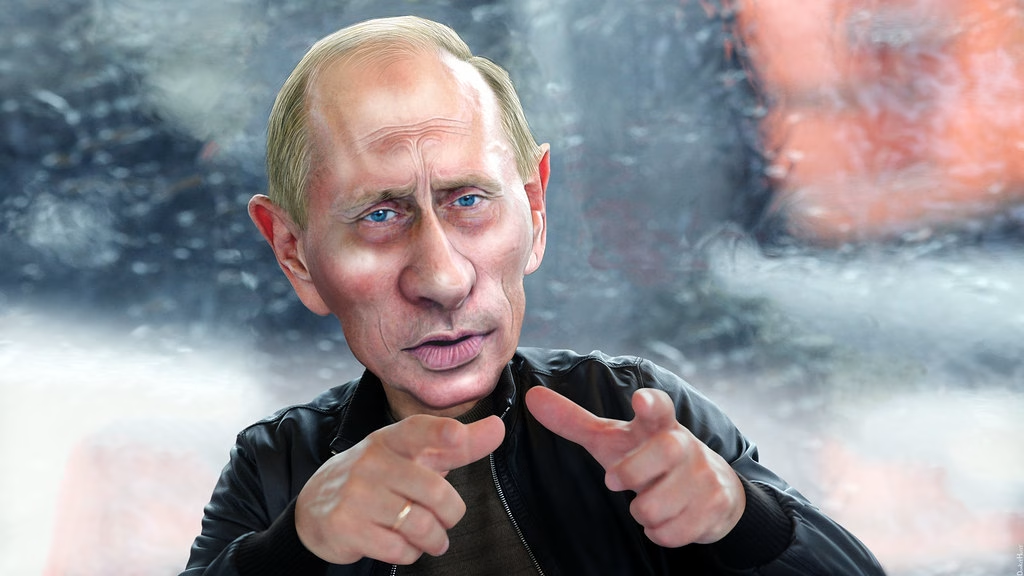
MOSCOW — When President Vladimir V. Putin of Russia sits down with President Trump in Helsinki, Finland, on Monday for a meeting he has long wanted, he will already have accomplished virtually everything he could reasonably hope for.
All he really needs to make his meeting with Mr. Trump a success is for it to take place without any major friction — providing a symbolic end to Western efforts to isolate Russia over its actions against Ukraine in 2014, its meddling in the United States election in 2016 and other examples of what the United States Treasury Department has described as Russia’s “malign activity” around the world.
“If Trump says, ‘Let bygones be bygones because we have a world to run,’ that is essentially what Moscow needs from this,” said Vladimir Frolov, an independent foreign policy analyst in Moscow.
As with any negotiation, timing is everything, and Mr. Putin has been gaining a lot of momentum lately. He will arrive in Helsinki after presiding over the final game of the World Cup soccer tournament in Moscow on Sunday, and will meet an American president who has spent the last week berating his NATO allies and undercutting his host in Britain, Prime Minister Theresa May.
Even the indictment announced on Friday in Washington against 12 Russian military intelligence officers, which prompted some Democrats to demand the cancellation of the Helsinki meeting, could help Mr. Putin by playing into a conspiracy theory long embraced by both the Kremlin and the White House that the “deep state” is determined to sabotage Mr. Trump’s outreach to Russia. Right before the indictments were announced, in fact, Mr. Trump referred to the Russia investigation as a “rigged witch hunt” that “really hurts our relationship with Russia.”
Anything that stokes divisions inside the United States, or between America and its allies, is viewed by Moscow as a victory. Deploying hackers, disinformation campaigns and support for far-right populist forces in Europe, Mr. Putin has long sought to fracture the West and upend the established geopolitical order. But Mr. Trump, who routinely attacks European leaders and has started a trade war with some of America’s closest allies, is now effectively doing the job for him.
Mr. Trump’s persistent tirades on the expense of NATO and his fury at the trade practices of the European Union, which he recently described as “possibly as bad as China, just smaller,“ have startled even Russian pundits who have for years watched as Mr. Putin, like Soviet-era leaders before him, tried in vain to undermine the trans-Atlantic alliance.
“We are witnessing something surprising, something that even the Soviet Union was not able to accomplish: Divide the U.S. and Western Europe. It didn’t work then, but it seems to be working with Mr. Trump now,” Tatyana Parkhalina, president of the Russian Association for Euro-Atlantic Cooperation, said on a recent talk show on state-run television.
The summit meeting offers Mr. Putin a chance to restore what he and Mr. Trump see as the natural order of world affairs, one in which traditional diplomatic alliances are not a given, smaller countries don’t really matter and big powers act in their own self interest, above all else. That order includes Russia playing a central role, instead of being treated like a pariah or a second-rate has-been.
Trump has been effectively doing Putin’s bidding for months now, of course, so in essence he’s already given the Russian leader the victory that he’s been looking for ever since being kicked out of the G-8, now the G-7, in the wake of the annexation of Crimea i 2014. Either wittingly or unwittingly, Trump has helped to advance an agenda that leaders in Moscow have been seeking to advance for decades going to years of the Cold War. Specifically, of course, I am speaking of the dream that Soviet leaders had during the Cold War of driving a wedge between the United States and its European allies. From the start of the Cold War, the Soviets did everything they could to foment division between the United States and Western Europe through the use of methods such as propaganda, the surreptitious funding and support of left-wing political parties throughout Europe, and helping to foment protest movements against the United States inside Europe. On more than one occasion, of course, they were able to do this by exploiting mistakes made by the United States such as the Vietnam War and interventions in nations around the world that led to the installation of authoritarian rulers, both of which led to widespread protests in Europe just as they did in the United States. In the 1980s, we saw these efforts manifested in the form of protests that attempted to block the installation of medium-range nuclear missiles in Europe to counter the threat presented by such weapons previously put in place by the Warsaw Pact. By and large, though, those efforts were unsuccessful. While the relationship between the U.S. and Europe was often strained, such as during the Vietnam War and the Reagan years, the alliance between the U.S, and Western Europe endured notwithstanding all the Soviet efforts to undermine it.
Virtually from the beginning of the Cold War, the Soviet Union did everything it could to foment division between the United States and Western Europe. They did this via propaganda, surreptitiously supporting left-leaning political parties, and helping to foment protest movements in Europe at various times throughout the years between the beginning of the Cold War and the end of the Soviet Union. Often, they were able to do it by exploiting the mistakes that the United States made on the world stage, such as the Vietnam War, which led to as many widespread protests in Europe as it did in the United States. In the 1980s, we saw it manifest itself in the form of protests that attempted to block the installation of medium-range nuclear missiles in Europe to counter a threat already presented by the introduction of such weapons by the Warsaw Pact. Throughout it all, the Soviets tried to do everything they could to undermine the NATO alliance and the ties between the United States and Europe.
As it turns out, of course, those efforts proved to be unsuccessful. Though they have been tested at times, the alliances that the United States developed with Western Europe, Asian nations such as Japan and South Korea, and, of course, our neighbor to the north in Canada proved resilient. Ultimately, those alliances prevailed over a Warsaw Pact that was built and maintained by a combination of dictatorship and fear that the Soviets would act as they did in Hungary in 1956 and Czechoslovakia in 1968 and over the Soviet Union that was held together by essentially the same forces. While many wondered what would happen to this international order after the end of Cold War, it has, if anything, proven to be even more resilient over the years, and that has benefited the United States both economically in the form of international trade and in terms of our national security. As I’ve pointed out before, the number of times that our allies have supported us over the years is incalculable, with perhaps the two greatest examples of that coming during the Persian Gulf War and the response to the terrorist attacks of September 11th.
This has changed with the rise of Donald Trump.
Instead of speaking out against Russia’s efforts to interfere in the 2016 Presidential election, the evidence of which is now vividly apparent thanks to indictments that have been issued by the Office of Special Counsel Robert Mueller both in March and just this past Friday, as well as the acknowledgment of that interference by Trump’s own intelligence advisers, the President has done everything he can to undermine that investigation and to dismiss it as “Fake News.” During his visits to Europe last year, Trump left many of our closest allies wondering just how committed the President was to the alliance and to its collective defense principles notwithstanding later assurances regarding that commitment on his part. Additionally, over the past several months the President has in a number of other actions that have gone further than the Soviets ever could have dreamed in driving a wedge between the United States and its allies. In late May, for example, he imposed tariffs against America’s closest allies on the ridiculous ground on the ridiculous ground that they were a threat to American national security. He followed that up with a performance at the G-7 Summit in Canada during, which he basically blew up and during which he is reported to have made several derogatory comments about NATO itself. All of that has been topped off, of course, over the course of the past several days during which the President continued to trash the other members of NATO for allegedly not meeting their obligations to the organizations while making it clear he has no understanding of what the alliance is about or how it benefits the United States. This was followed up by a largely embarrassing visit to the United Kingdom during which he was derogatory toward his host Prime Minister Theresa May and made comments about internal British politics that are entirely inappropriate for an American President on a diplomatic visit.
All of this brings us to tomorrow’s meeting in Helsinki, the entire point of which seems to be entirely unclear. For several days now, the White House has tried to downplay expectations for the meeting even as the President continues to play it up and guarantee that the American public, and the rest of the world, will expect something to come out of this other than a press release as we saw with the summit in Singapore with North Korean leader Kim Jong Un. However, it seems clear that it’s unlikely that anything major will come out of tomorrow’s meeting. Speaking to CBS News in advance of the meeting, for example, Trump said that he wasn’t even sure if he’d bring up the recent indictments of more than twenty Russian officials by the Office of Special Counsel and also made clear that he’s unlikely to demand that Putin turn those defendants over to the United States for prosecution. In the same interview, the President indicated that he considered the European Union to be more of a foe to the United States than Russia is notwithstanding the evidence of Russian interference in the election. Finally, the President has made it clear that he believes that former President Obama and the Democrats are more to blame for the hacking that lies at the heart of the latest round of indictments than the Russians are. Given all of that, it’s clear that Trump will go into this meeting with no intention whatsoever of putting any pressure at all on the Russian President to either come clean on what happened in 2016, or what the Russians have in mind for the 2018 elections.
Finally, as the article quoted above notes, Trump has already handed Putin a win simply by granting this meeting without any pre-conditions. Just as he did when he met North Korea’s Kim Jong Un last month, the mere fact that the American President is meeting with the President of Russia four years after the nation became something of an international pariah due to its annexation of Crimea and intervention in eastern Ukraine gives Putin an unparalleled diplomatic victory that costs him absolutely nothing. Add into this the fact that the President is meeting with Putin even as the evidence of the extent to which Russia interfered in the American election in an effort to influence the outcome of the election in Trump’s favor, and you have a man who should be isolated, and largely was during the final years of the Obama Administration, being let back into the international club without Russia having to give anything up in return. Even if Putin walks away from Helsinki tomorrow with nothing else other than a handshake and a photograph, he has already won and the United States and its allies have clearly lost. That’s only going to embolden Putin to continue acting in a provocative manner and continue with his so far successful efforts to drive a wedge between the United States and Europe and to undermine public confidence in democratic institutions in both parts of the world.