
The Washington Post is reporting that President Obama is reportedly considering a plan that would leave American troops in Afghanistan longer than currently planned:
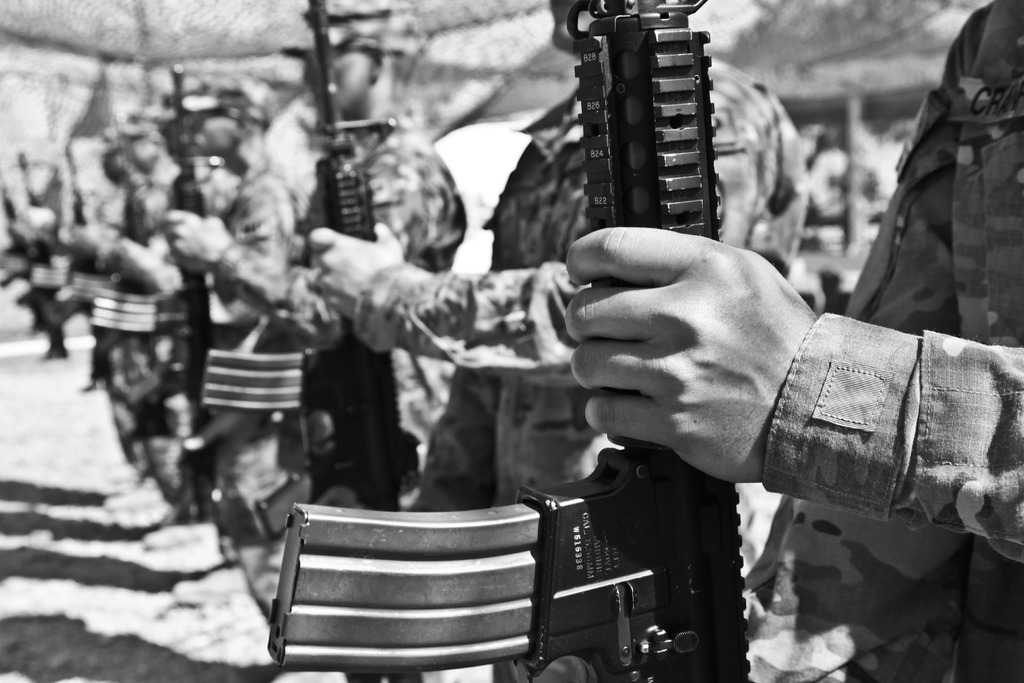
President Obama is seriously weighing a plan to keep as many as 5,000 U.S. troops in Afghanistan beyond 2016, according to senior U.S. officials, a further setback of his goal to end U.S. military involvement there before he leaves office.
The plan presented in August by Gen. Martin E. Dempsey, then-chairman of the Joint Chiefs of Staff, would focus primarily on counterterrorism operations against the Islamic State, al-Qaeda and other direct threats to the United States.
Obama has made no final decision on the proposal, which was developed before the Taliban captured Kunduz last month, the first major Afghan city to fall to the Taliban since the war began in 2001.
Afghan security forces, supported by American planes and combat advisers, have since been able to retake most, if not all, of the city. But the initial collapse of the Afghan forces in Kunduz has fed long-standing worries that Afghan forces lack the necessary air support, logistics and intelligence capabilities to survive on their own after U.S. service members leave the country.
The 3,000 to 5,000 troops envisioned under Dempsey’s proposal would be one part of an emerging plan for a global counterterrorism footprint, developed after the Islamic State’s rampage through much of Iraq and Syria. Gen. John Campbell, the top U.S. commander in Afghanistan, also has developed as many as five options that range from a small embassy force to as many as 7,000 troops.
Dempsey’s plan, however, has been the primary focus of White House debates in recent weeks. Dempsey, who retired as chairman of the Joint Chiefs of Staff last month, fleshed out his initial August proposal before he left office.
His plan envisions the United States maintaining a few bases, perhaps two or three, that could be used as “lily pads” to strike groups that posed a direct threat to the United States, senior defense and administration officials said.
The “lily pad” bases would potentially house American drones and fighter jets as well as elite counterterrorism troops, and could be located at Bagram air base north of Kabul and one or two other airfields, said senior administration officials who spoke on the condition of anonymity to discuss internal planning.
Several U.S. officials said there are tentative plans to make a final decision on the post-2016 force soon — a move that would give the United States’ NATO partners in Afghanistan more time to prepare for their own post-2016 commitments. But other senior officials insisted that no such plans exist and that no announcement or final decision from Obama is imminent. A military official said the White House is expected to make a decision by the end of the year.
The president could choose to dismiss Dempsey’s proposal and stick with his plan to reduce the U.S. footprint in Afghanistan to an embassy-based presence of about 1,000 American service members in Kabul, similar to the presence the United States left behind in Iraq after 2011. The White House already has approved at least two changes to the departure plan Obama announced in May 2014.
After hearing the initial proposal from Dempsey in August, Obama told his commander that he was open to keeping more troops in Afghanistan but wanted Dempsey to bring him a more detailed proposal, senior administration and defense officials said. Obama asked his military commanders to work with intelligence officials to give him a better sense of the potential threat the Islamic State and al-Qaeda posed in the region over the coming years. The president also wanted a more detailed assessment of the cost of Dempsey’s proposal and the number of troops necessary to support it.
One big concern for Obama was how many U.S. troops it would take to protect the relatively small “lily pad” bases from a major Taliban attack. The Taliban’s seizure of Kunduz and its gains in southern Afghanistan have heightened those worries.
On some level, of course, this is an entirely unsurprising development given the manner in which the Administration has modified its original commitment to remove essentially all American troops from Afghanistan by the end of next year. It was, after all, just a few months after the original agreement between Washington and Kabul to keep troops in the country through the end of 2016 was signed that the White House announced that the pace of the withdrawal would be slowed largely in response to the fact that Taliban forces had become more adept in their ongoing war against the regime in Kabul. When the new President of Afghanistan visited Washington earlier this year for consultations, the meetings ended with an announcement that the pace would be slowed even further as it had become clear that the security situation in the country was not improving now that primary responsibility in the war against the Taliban lied with the Afghan Army and security forces. Additionally, we also learned that the American forces that were still in the country had seen their mission expand beyond the counterterrorism role that had been envisioned and that U.S. forces were once again involved in the fight against the Taliban. The most recent demonstration of this fact, of course, came with the news over the weekend that an American airstrike had hit a hospital, resulting in nearly two dozen deaths, during a battle in which Afghan forces were attempting to reverse the Taliban gains in Kunduz. It’s now being reported that the coordinates for that attack had been called in by Afghan forces, which makes it obvious that the United States is once again engaged in combat against the Taliban notwithstanding the plan the President had announced before.
Viewed in the abstract, I suppose that the idea of forward bases that can be utilized in counterterrorism operations makes some degree of sense. Such an operation would make it easier, for example, for American forces to strike when intelligence indicates that there is a terrorist threat. It also makes it easier to use drones in areas such as Pakistan that are not easily accessible from the sea. At the same time, though, the situation on the ground in Afghanistan, as evidenced by recent developments, seems to make the idea of putting American troops on the ground there a risky move to say the least. They’d be sitting ducks for a terrorist or Taliban attack, and given the way the war has gone lately it likely wouldn’t be long before they would be drawn into the conflict between Kabul and Afghanistan. We’ve already done enough damage over there, it’s time to start bringing people home for good rather than hoping for a future Afghanistan that clearly will never exist. Furthermore, if the President is going to make this kind of commitment for the nation that will clearly last beyond his time in office then Congress needs to debate the matter and the men and women running to succeed him need to tell us how they’d handle the situation.