
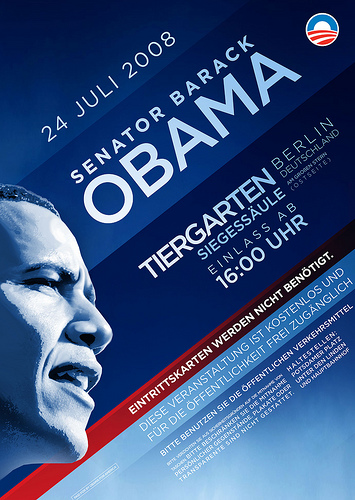
 Barack Obama arrived in Berlin a bit ago, “the first stop on a whirlwind tour that will take the presumptive Democratic nominee to Germany, France and Britain in an effort to burnish his foreign credentials.”
Patrick Ruffini created a minor stir in the blogosphere by pointing out that his rally posters advertising his speech was written in German. (Not noticed: He used the local time, too!) Publius rightly dismisses that non-issue while noting that Patrick is usually not one for getting carried away.
He does, however, see this as a good opportunity to relate an anecdote about his own embarrassing attempts to speak German and conclude,
The point of all this is that Obama probably could have communicated in English and it would have been fine. From what I gathered, every German under the age of 40 speaks English — most of them fluently. (Why is that by the way?) It would have been extremely obnoxious of course — and could have even had diplomatic repercussions. But the crowd probably could have read the material.
I’d add that the whole thing is also a sad reflection on our own inability to speak other languages, but I’m told pointing that out is un-American and amnesty-loving or something.
My German was never fluent and is in any case quite rusty. But, yes, even twenty years ago, most younger Germans could speak English. The explantion is pretty simple: They started studying a foreign language in 5th grade and continued until graduating school.
Why English? Because, if you don’t currently speak English, it’s rather a no-brainer as to which second language to choose. It’s the language of the world’s dominant political, economic, and cultural power (the USA), the United Kingdom, the Commonwealth, and dozens of former colonies. It’s also, therefore, the second language of almost everyone who speaks a second language (a self-reinforcing loop). This means that Germans can travel to any other country in Europe — and pretty much anywhere else — and get by with a command of German and English.
By contrast, those of us who speak English as a first language have neither as much incentive to learn a second language or nearly as obvious a choice. We can already get by just about anywhere we’re likely to go even if we’re frequent travelers abroad. And any particular second language has relatively little utility unless we frequently go to one particular other country or live in an area with a large unassimilated immigrant community.
The main reason I learned German was that I lived there several times by virtue of having grown up in an Army family and having been in the Army myself. Since leaving Germany in 1992, though, I have had little occasion to speak or read German. (The occasional German diplomat or soldier who visits the Atlantic Council will certainly speak superb English and my German was never strong enough to converse at that level, anyway.) The only time it’s been at all useful was on my trip to Amsterdam a couple years back and, even then, it was simply a matter of written Dutch being sufficiently similar to written German that I could interpret signs and whatnot; I couldn’t make out much, if any, spoken Dutch. Not that it much mattered, of course, since everyone there speaks English.









