
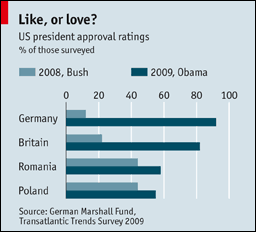
 Back in 2003, then-Defense Secretary Donald Rumsfeld famously noted that while “Old Europe” (particularly France and Germany) was hard to work with, America could count on “New Europe.” Fast forward to 2009 and we may have reversed polarity.
My latest New Atlanticist essay, “Losing New Europe, Too?” explores this evolution, including why Western Europe is back in the fold and why Eastern Europe has every reason to be disappointed.
The eagerness of “New Europe” to side with the U.S. came from the combination of the cold shoulder they were receiving from their Western neighbors and the warm rhetoric from across the Atlantic. But it now seems obvious that the talk will not be backed with action at the cost of risking war with Russia, especially for those states in its “near abroad” that have not yet been admitted into the NATO club. That realization obviously and reasonably puts a damper on “New Europe’s” enthusiasm.
Relations with “Old Europe,” meanwhile, will return to what they have been for the postwar period: a mature engagement between peers that will ebb and flow as the situation warrants. Such a relationship can withstand sharp disagreements, angry words, and hurt feelings. Resentments and rifts will occasionally arise but they will be temporary. Our shared values and interests, however, are permanent.
Much more at the link.
Graphic via Economist.








