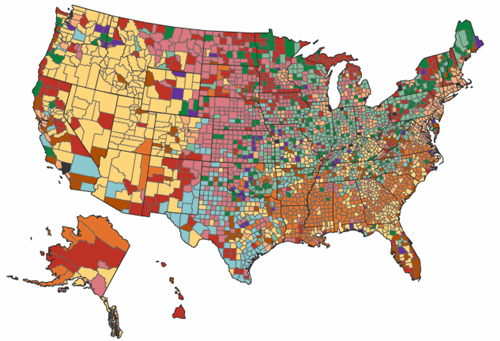
The folks at the Christian Science Monitor argue that the division of America into Red and Blue states based on aggregate voting behavior is flawed. They propose, instead, that we’re a “Patchwork Nation” comprised of at least eleven different voter communities.

Nearly 305 million people live in the United States, according to the US Census Bureau. Yet in recent elections it’s all been about fitting into two categories: red states that vote Republican and blue states that vote Democratic. But this red/blue breakdown of political opinion doesn’t explain what underpins the voters’ decisions.
That’s what this effort, funded by the Knight Foundation, a nonprofit philanthropic organization based in Miami, explores in real time during the 2008 presidential campaign.
We’ve identified 11 places across the US that represent distinct types of voter communities. They are Monied ‘Burbs, Minority Central, Evangelical Epicenters, Tractor Country, Campus and Careers, Immigration Nation, Industrial Metropolis, Boom Towns, Service Worker Centers, Emptying Nests, and Military Bastions. For example, Sioux Center, Iowa, typifies Tractor Country.
The basic premise here is reasonable enough. Brad DeLong and others have argued for years that painting America Red and Blue over-emphasized differences and that we’re really Purple. This project goes much further:
Boom Towns (Eagle, CO) Midsize cities and smaller towns with well-balanced economies of affluence, education, and professional employment; growing ethnic diversity, some retired elderly with high incomes.
Military Bastions (Hopkinsville, KY) High levels of employment in military or related government employment; often adjacent to major military installations, private military contractors, or have a history of military-dependent economies; middle income, transient, younger populations, with some trade and service workers in the local economy.
Campus and Careers (Ann Arbor, MI) High percentage of the population between 18-34, few retirees or elderly; includes university/college towns and locations with high employment in education and educational services; high levels of formal education; religious diversity, secularism.
Minority Central (Baton Rouge, LA) Lower-income counties with large proportions of African-Americans and native Americans on Indian reservations; low population growth or steady population losses, high unemployment and poverty; low-end housing stock; African-American locales are concentrated within the Deep South.
Emptying Nests (Clermont, FL) Middle-income, retirement age; and baby-boom populations; presence of evangelical and mainline Protestants, fewer Catholics, stable but not booming economies.
Monied ‘Burbs (Los Alamos, NM) High-income counties, with high professional employment and formal education; high expenditures by consumers on new vehicles, luxury goods, property taxes, and charitable giving; midsize in terms of population and population density, primarily within metro areas; family age populations, low density housing; predominantly white, but with some Asian-American presence.
Evangelical Epicenters (Nixa, MO) Briskly growing small and midsize towns with family age populations; middle income with some affluent and poor; low incidence of mainline Protestant and Catholic churchgoers, higher incidence of evangelical adherents, particularly in the South and border states; Mormons in the West; some minority presence, chiefly blacks (in the South) and Latinos (in the West).
Service Worker Centers (Lincoln City, OR) Midsize cities and smaller towns with very high percentages employed in trade and service businesses but not manufacturing or agriculture; many new residents, growing Latino populations; more Catholics and fewer Evangelicals or mainline Protestants.
Immigration Nation (El Mirage, AZ) High percentages of Latinos and Asians; immigrants living in midsize to larger cities; moderately high levels of unemployment; Roman Catholic with sprinkling of religious diversity; lower income with moderate to high percentage in poverty.
Tractor Country (Sioux Center, IA) Predominantly white, smaller towns and more remote counties outside of metropolitan areas; low level of manufacturing employment, high levels of self-employment, employment in agriculture, as well as small-town retail and wholesale trade; Lutheran, Reformed, and mainline Protestant adherents predominate in the upper Midwest.
Industrial Metropolis (Philadelphia, PA) Older Northeastern and Midwestern cities once dependent on manufacturing; diverse populations, including significant Jewish populations; some high-end residents in established historically wealthy neighborhoods, mixed with lower income populations.
Much, much more here, including blogs, interactive maps, a chance to fill out your own demographic profile, and more.
It’s an interesting project but there’s a certainly David Brooksian “Bobos in Paradise” feel to it. I live in the “Monied ‘Burbs” of Northern Virginia. Does my community really have all that much in common with Los Alamos, New Mexico? Color me skeptical.
Albert Einstein said that, “Everything should be made as simple as possible, but no simpler.” Red versus Blue is almost certainly too simple. The political cultures of Ohio, Alabama, and Idaho aren’t identical simply because they made the same aggregate choice between two parties. Eleven sub-groups, divided down to the county level, is much more helpful than that. But it takes away a lot of parsimony while giving too strong an impression of precision.