
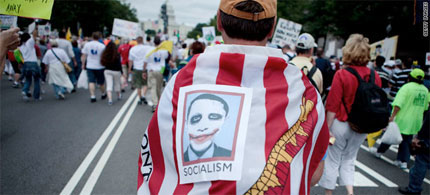

Regular reader and commenter Michael Reynolds forwarded me Arian Campo-Flores‘ Newsweek article entitled “Are Tea Partiers Racist?” It contains provocative new data:
Opponents have seized on these examples as proof that Tea Partiers are angry white folks who can’t abide having a black president. Supporters, on the other hand, claim that the hateful signs are the work of a small fringe and that they unfairly malign a movement that simply seeks to rein in big government. In the absence of empirical evidence to support either characterization, the debate has essentially deadlocked.
Until now, that is. A new survey by the University of Washington Institute for the Study of Ethnicity, Race & Sexuality offers fresh insight into the racial attitudes of Tea Party sympathizers. “The data suggests that people who are Tea Party supporters have a higher probability” – 25 percent, to be exact – “of being racially resentful than those who are not Tea Party supporters,” says Christopher Parker, who directed the study. “The Tea Party is not just about politics and size of government. The data suggests it may also be about race.”
Surveyers asked respondents in California and a half dozen battleground states (like Michigan and Ohio) a series of questions that political scientists typically use to measure racial hostility. On each one, Tea Party backers expressed more resentment than the rest of the population, even when controlling for partisanship and ideology. When read the statement that “if blacks would only try harder, they could be just as well off as whites,” 73 percent of the movement’s supporters agreed, while only 33 percent of people who disapproved of the Tea Party agreed. Asked if blacks should work their way up “without special favors,” as the Irish, Italians, and other groups did, 88 percent of supporters agreed, compared to 56 percent of opponents. The study revealed that Tea Party enthusiasts were also more likely to have negative opinions of Latinos and immigrants.
These results are bolstered by a recent New York Times/CBS News survey finding that white Tea Party supporters were more likely to believe that “the Obama administration favors blacks over whites” and that “too much has been made of the problems facing black people.” The survey also showed that Tea Party sympathizers are whiter, older, wealthier, and more well-educated than the average American. They’re “just as likely to be employed, and more likely to describe their economic situation as very or fairly good,” according to a summary of the poll.
I’m not sure what to make of it. As I emailed Michael after an initial scan of the piece, “I’m not sure if ‘racially resentful’ is the right characterization of the answers. In theory at least, I tend to agree with the Yes answers to both questions. But they’re so poorly worded that Yes/No doesn’t work. Which, I guess, forces people to look through filters.”
Via Glenn Reynolds, I see that James Taranto had a similar reaction to the “WISER” study:
When the only tool you have is a hammer, every problem looks like a nail. A group whose purpose is to see the world in terms of race is going to collect and structure its data in such a way as to show that whatever it is studying is “about race.” And yet the claim of “racial resentment” turns out to be baseless.
The institute’s “2010 Multi-State Survey on Race and Politics” covers seven states. Survey participants were asked what they think of the tea-party movement; those who “strongly approve” were cast as “true believers”; those who “strongly disapprove,” as “true skeptics”; and those whose opinions were weak or neutral as “middle of the road.” To gauge their racial attitudes, they were asked whether they agree or disagree with the following statements:
• “Irish, Italians, Jewish, and many other minorities overcame prejudice and worked their way up. Blacks should do the same without special favors.”
• “Generations of slavery and discrimination have created conditions that make it difficult for blacks to work their way out of the lower class.”
• “Over the past few years blacks have gotten less than they deserve.”
• “It’s really a matter of some people not trying hard enough; if blacks would only try harder they could be just as well off as whites.”
“True believers” were most likely to agree with the first and last of these assertions and to disagree with the middle two. The opposite was true of “true skeptics,” with “middle of the road” indeed producing consistently middling results.
So what does this tell us? We’d say it’s fair to characterize the first and last assertions as representing politically conservative views about race and the middle two as expressing liberal ones. The more that one sympathizes with the tea parties, then, the more likely one is to assent to conservative views on race, and to reject liberal ones. Wow, stop the presses!As for the claim that conservative views on these questions reflect “racial resentment,” however, the survey provides no evidence one way or the other. It did not plumb the emotions of the participants, who were given a prepackaged assertion and permitted only a binary response. It’s possible that agreement with a statement like “Blacks should do the same without special favors” reflects a resentful spirit, but it could also reflect a respectful one–a confidence that blacks are as capable as anyone else.
When Parker asserts that tea-party sympathizers are “racially resentful,” then, he is imputing to them his own emotional reactions to the questions. The entire exercise illustrates only that political liberals are predisposed to believe that politically conservative views on racial matters are the product of resentment. It would not surprise us if this belief is true in some cases, but by conflating viewpoint and motive, this survey merely presupposes what it purports to prove.
The issues of reverse discrimination, special treatment, and the like have been conservative tropes at least as long as I’ve been actively following politics — some 30 years now. While there’s doubtless some element of “racial resentment” in the mix, it’s also simply a matter of one’s sense of fairness. Brown v. Board of Education was 56 years ago, the Civil Rights Act of 1964 was 46 years ago, and so on. At some point, history becomes history.
Taking the WISER questions one by one:
“Irish, Italians, Jewish, and many other minorities overcame prejudice and worked their way up. Blacks should do the same without special favors.”
This is a truly shitty poll question. Its double-barreled composition is the type of thing I taught undergraduates to avoid in the 30 minutes I spent teaching polling each semester in American Politics 101. Indeed, it’s much worse than double-barreled, as it’s preceded by a leading distractor.
The first part is doubtless true: Those groups faced tremendous prejudiced and yet managed, over time, to escape the stigma so much so that they’re mostly just thought of as “white people.” Jews have maintained a distinctive cultural identity (as have, to a much lesser extent Irish and Italians) and presumably face some legacy anti-Semitism but they’ve assimilated and thrived.
After getting that planted in your mind, the second Yes is easier to come to. But, of course, the situation for blacks is infinitely more complicated by the institution of slavery and the long legacy of Jim Crow. But, again, slavery was ended a century and a half ago and de jure discrimination against blacks ended before I was born. De facto discrimination, of course, remains alive and well but it’s been driven underground by social stigma and other pressures.
Should blacks “do the same”? What does that mean? Work their way up? Overcome prejudice? Yes and yes.
Should they do whatever it is they’re supposed to do “without special favors?” Yes. We’re supposed to be race-neutral on an institutional level, after all.
• “Generations of slavery and discrimination have created conditions that make it difficult for blacks to work their way out of the lower class.”
A no-brainer Yes.
• “Over the past few years blacks have gotten less than they deserve.”
I don’t know what the hell this means. What is it that blacks deserve? Which blacks?
• “It’s really a matter of some people not trying hard enough; if blacks would only try harder they could be just as well off as whites.”
What’s the antecedent to “it’s”? Aside from that, this one is again complicated. “Blacks” are an aggregate, as are “whites.” But what groups can do versus what individuals within those groups can do is, again, complicated. And it’s not clear which the question is talking about.
Do I think there are aggregate barriers to blacks “trying hard”? Sure.
There are some extreme subcultural barriers, especially for black males who live in what we used to call ghettos and now refer to as “the inner city.” Doing well in school, for example, is condemned as “acting white.” More importantly, these same communities face the problem of a dearth of positive male role models. Success begats success and vice versa. If dad is a stranger, incarcerated, or dead, it’s a problem. Then there are the issues of gangs, drugs, violent crime, and so forth which make long-term planning decidedly more difficult.
Can blacks be “just as well off as whites”? Sure.
Lots of blacks are better off than me, let alone most whites. We’ve got a black president, black billionaires, black movie stars, black rock stars, black athletic stars, black doctors, black lawyers, black professors, black scientists, and so forth and so on.
Does that mean we expect blacks as an aggregate to do as well as whites as an aggregate any time soon? Not at all.
If you’re black and my age or younger, you’ve largely been unaffected by institutional discrimination. If anything, you’ve slightly benefited from institutional efforts to seek diversity. But generations worth of institutional discrimination put blacks as a group well behind whites as a group and that doesn’t magically correct itself just because we’ve stopped doing it.
Does this justify institutional efforts to recognize the situation and work harder to reach out to groups who’ve been damaged by past wrongs? Probably, although they tend to mostly benefit those who need the least help (the sons and daughters of wealthy blacks) and disadvantage the whites who’ve least benefited from a stacked system (sons and daughters of poor whites).









