
Thomas Edsall reports,
Through no fault of his own, Rep. Ron Paul’s anti-globalist, anti-government campaign for the Republican presidential nomination has become a magnet in neo-Nazi networks, pulling in activists and supporters from the fringe white nationalist community where anti-Semitism, anti-black and anti-immigrant views are commonplace.
In some cases, these internet-based activists acknowledge that even though the Paul campaign does not have a racist or anti-Semitic agenda, it can serve as a vehicle to find sympathizers and to recruit new loyalists drawn to the Republican congressman’s opposition to international trade agreements, federal police authority and to the income tax.
Such web-based organizations as Stormfront (motto: “White Pride, World Wide”), Vanguard News Network (“No Jews. Just Right.”) and the Nationalist Coalition (“working to create the relationships that will lay the foundation for the White community that is necessary to our survival”) have become sources of support for Paul’s bid for the Republican nomination, and in some cases have set up separate Ron Paul discussion groups.
As Edsall’s wording constantly emphasizes, this is essentially happenstance. It’s natural, to be sure, that white supremacists, which see the federal government as their chief nemesis, would support the most anti-federal government candidate. The only odd thing here is that anti-immigrant groups would support Paul, since stopping immigration, illegal or otherwise, could only be accomplished through the exercise of federal power.
Still, as Jeff Commaroto points out, this is the down side of a decentralized Web strategy. “That might seem like a great idea at first but when messages are not vetted by an official source, it is only a matter of time before some people rise up and exploit them.” Josh Levy agrees, seeing this as “an inevitable outgrowth of giving control of your message to your supporters.”
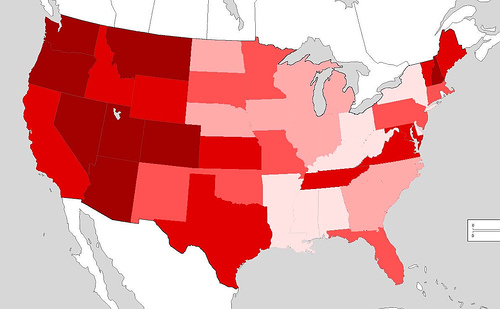
Meanwhile, Patrick Ruffini has done some analysis of Ron Paul’s donors — using information provided by Paul’s online effort — and finds that they are overwhelmingly (83 percent) male and come predominantly from the West and Northeast.
This really is a Western movement, with some of the Northeast thrown in. Basically, these are the places where you would expect libertarians to be strong. But I don’t think I’ve ever seen a data set this good about the state-by-state strength of libertarianism. And the data gets more reliable every day .
The Paul movement is weakest in the Deep South and the Ohio River Valley. Ohio (and surprisingly New York) are Paul’s weakest big states.
The differences are also fairly dramatic. One is 4 times more likely to be a Ron Paul donor in Nevada than in Mississippi. And more than twice as likely in blue Washington state than in blue New York. Alaska and Hawaii, which are not on the map, would also be colored the darkest shade of red.
I’m not sure what to make of that but it’s interesting. Essentially, Paul’s support is strongest in states that tend not to vote Republican. Does that mean that a theoretical nominee Paul would win in a landslide (after all, one doesn’t expect the South to vote for Hillary Clinton or Barack Obama if Paul is the alternative)? Or are the numbers just too small to matter?








