
WaPo (“States rushing to reopen are likely making a deadly error, coronavirus models and experts warn“):
By the end of the week, residents in Georgia will be able to get their hair permed and nails done. By Monday, they will be cleared for action flicks at the cineplex and burgers at their favorite greasy spoon.
And it will almost certainly lead to more novel coronavirus infections and deaths.
As several states — including South Carolina, Tennessee and Florida — rush to reopen businesses, the sudden relaxation of restrictions will supply new targets for the coronavirus that has kept the United States largely closed down, according to experts, math models and the basic rules that govern infectious diseases.
“The math is unfortunately pretty simple. It’s not a matter of whether infections will increase but by how much,” said Jeffrey Shaman, a leading epidemiologist at Columbia University.
Closing America was hard. But it came with one simple instruction: Everyone stay at home.
There are no easy answers for the phase that comes next, especially with a continued lack of testing, contact tracing and detailed guidance from federal health agencies, disease experts said. Instead, every state will conduct its own improvised experiment with thousands of lives in the balance.
Many of the earliest reopenings will probably be confusing, chaotic, risky affairs — especially for states restarting their economies before most infectious-disease experts and some mayors and residents believe it’s safe to do so.
South Carolina’s governor issued an executive order this week reopening department stores and retailers previously regarded as not essential. Tennessee’s governor said he plans to allow most businesses to reopen once his “safer-at-home” order expires next week. Governors in Mississippi and Ohio have said the same. And Colorado’s Gov. Jared Polis (D) said some businesses could reopen on Friday.
Some of those same states are, however, still struggling to contain outbreaks.
In Ohio, where businesses are expected to reopen by next week, a prison has become one of the most worrisome outbreaks in the country, with more than 2,000 inmates testing positive. In South Dakota, more than 700 infections have shut down a Smithfield Foods meatpacking plant. And because South Dakota remains one of the few states without a stay-at-home order, one business said it plans to go forward on Saturday with a car race drawing 700 spectators.
Georgia, according to some models, is one of the last states that should be reopening. The state has had more than 830 covid-19 deaths. It has tested less than 1 percent of its residents — low compared with other states and the national rate. And the limited amount of testing so far shows a high rate of positives at 23 percent.
[…]
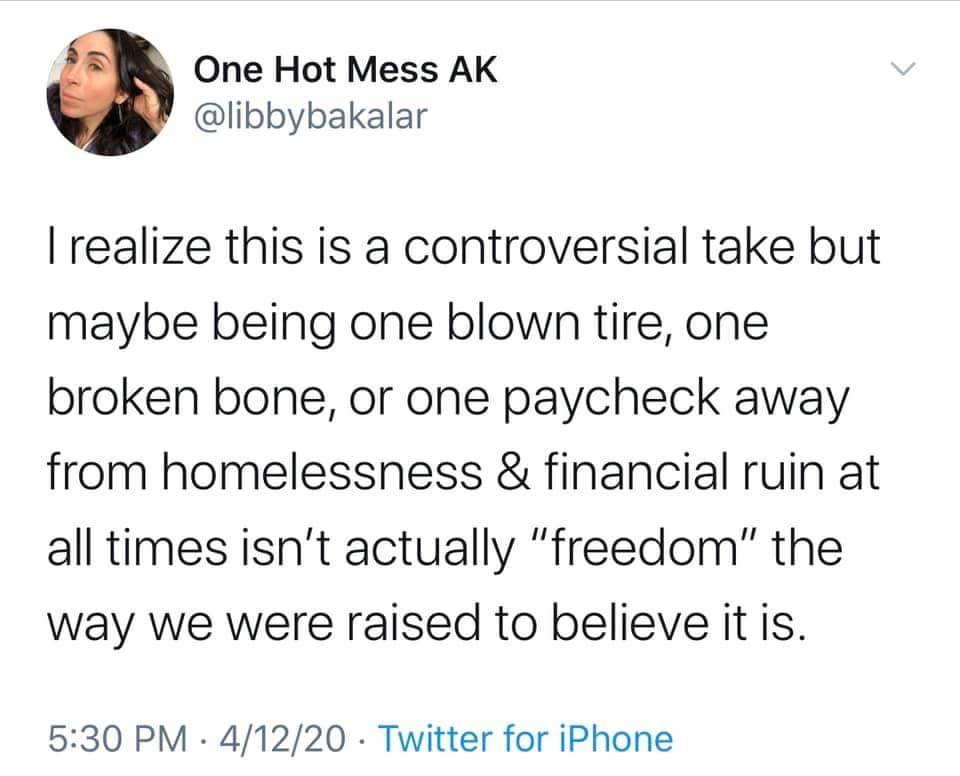
In recent days, other governors have defended their decisions to reopen quickly as an economic necessity, an exercise in states’ rights and a matter of freedom.
“What I’ve seen across the country is so many people give up their liberties for just a little bit of security, and they don’t have to do that,” South Dakota Gov. Kristi L. Noem (R).
“We can’t wait until there’s a cure to this,” said Mississippi Gov. Tate Reeves (R), who plans to reopen some businesses after a stay-at-home order expires Monday. “We can’t wait until every single person can get tested every single day to open up our economy.”
But even states proceeding more slowly, such as Massachusetts and California, will have to walk their residents through the coming experiment with competing pressures and voices threatening to drown out public health instructions.
Some of this is ideological bullshit. But most of it is differential impact: it’s simply easier for states where most residents can continue to get paid by working remotely to do what’s necessary than those where that’s not the case.
Northern Virginia, where I live, is among the wealthiest parts of the country. Mostly, that’s a function of our proximity to Washington, DC. Large numbers of us are employed directly by the Federal government or have jobs that exist because of the Federal government. That’s also helped drive a huge tech sector, lots of colleges and universities, and all manner of other white-collar jobs that can be done via email, Zoom, and other workarounds.
That’s a hell of a lot less true in Mississippi or South Dakota and the pressures on the government—and the citizens—there are simply different.
The initial plan seemed to be for the Federal government to pay people whose public-facing jobs weren’t “essential” to stay at home. We’ve passed multi-trillion-dollar stimulus packages but seemingly haven’t alleviated the economic pressures on ordinary workers, who are in turn pressuring their government to let them go earn a living.
Obviously, the Fox Newses and Rush Limbaughs of the world haven’t helped. Nor, especially, has President Trump. They’ve undermined the message as to how serious all of this is.
But, at its core, we’re giving people the impossible choice between risking our health and their’s by going out and about and not being able to pay their mortgages, feed their families, and otherwise survive economically.