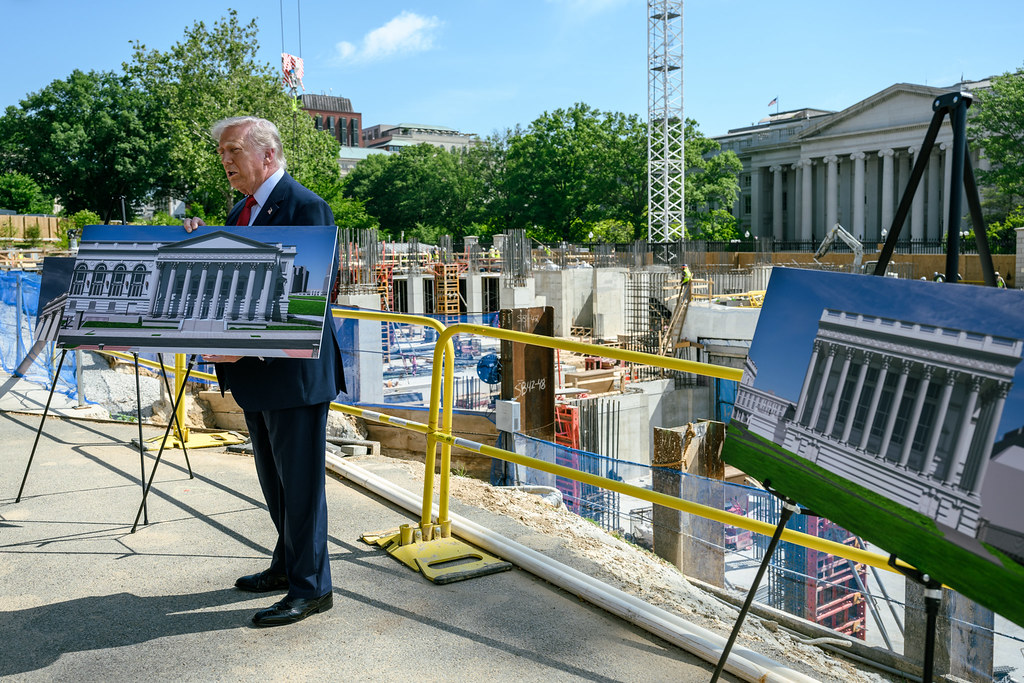
President Donald J. Trump speaks with members of the media next to the ongoing construction of the East Wing and Ballroom, Tuesday, May 19, 2026
Official White House Photo by Joyce N. Boghosian

Supreme Court Allows Trump Ballroom To Proceed, For Now

Chief Justice Roberts says “construction is likely unlawful,” but five Justices ruled the National Trust for Historic Preservation lacked standing.

20

Comments

AP (“Supreme Court lets White House continue construction on Trump’s $400 million ballroom“):

A divided Supreme Court on Monday allowed the White House to continue construction on a $400 million ballroom project as lawsuits play out, a win for President Donald Trump as he flexes unprecedented executive power and remakes the capital in his image.

The apparent 5-4 decision replaces a temporary order issued earlier this month, shortly before a court-ordered halt would have gone into effect.

That temporary order was signed by Chief Justice John Roberts, assigned to handle appeals from the capital. But he publicly disagreed with the latest decision, writing a strong dissent that said the project is likely unlawful because it hasn’t been approved by Congress.

“Today’s decision is no victory for the separation of powers,” Roberts wrote. The court’s three liberal-leaning justices agreed.

The majority, on the other hand, found the National Trust for Historic Preservation likely did not have the legal right to challenge the project.

The unsigned order pointed to government arguments that the ballroom would address national security concerns by shielding a planned underground military installation and offering a more secure structure for large events than the tents currently used.

By contrast, “the only harm the Trust claims is the offense one of its members will suffer from having to view a structure of the ‘scale,’ ‘height,’ and ‘massing’ the government intends,” it states.

[…]

The majority’s order did not directly decide the legality of the project, and the suit will return to lower courts. Documents filed in the case, though, say that key portions of the project could be complete within months — a quick timeline compared with a typical legal case.

The trust’s president and CEO, Brent Leggs, said the group was disappointed with the decision but pleased with Roberts’ dissent. “This is not the final decision on the merits of our case and does not resolve our fundamental argument — that each President is a temporary steward of the People’s House and does not have the unilateral authority to demolish and redesign it without the approval of Congress,” he said in a statement.

[…]

The lawsuit from the trust argued that Trump has no unilateral authority to undertake the work, which has included demolishing the East Wing. The group’s lawyers accused the White House of trying to “outrun the courts” by accelerating construction.

In lower courts, the administration has argued that the president has total authority to renovate the White House and other federal buildings.

The trust and the four dissenters, however, note that federal law prohibits the construction of any structure on federal parks or public grounds in D.C. “without express authority of Congress.”

Standing is a complicated legal issue, and I claim no expertise on the matter. In his dissent, Chief Justice Roberts observes,

That construction is likely unlawful. Pursuant to its plenary constitutional authority over the District of Columbia and federal property, Congress has explicitly prohibited the construction of any “building or structure . . . on any reservation, park, or public grounds of the Federal Government in the District of Columbia without express authority of Congress.” 40 U. S. C. §8106. The ballroom is a building or structure being erected on federal park grounds—President’s Park—in the District of Columbia. Yet Congress has not passed any law resembling “express authority” for the Executive’s construction of it.

But, alas, the unlawfulness of the action is not enough. The persons bringing the suit have to demonstrate they are suffering sufficient harm from the illegality to have standing to sue, since courts only have authority to resolve actual disputes. And, as Roberts notes, “To have standing to sue as the representative of its members, an organization such as the Trust must show, among other things, that one of its members would have standing to sue in her own right.” His argument in that regard is weak from a lay standpoint:

Given the distinctive nature of the White House and Hoagland’s focused and substantiated interest in viewing it in its traditional form, her aesthetic injury from the construction of the ballroom is concrete and particularized.

The White House is an iconic American building whose symbolism and history are wrapped up in its architecture. As President Theodore Roosevelt once remarked while thanking Congress for expressly appropriating funds for the construction of the East and West Wings: “The stately simplicity of [the White House’s] architecture is an expression of the character of the period in which it was built, and is in accord with the purposes it was designed to serve. It is a good thing to preserve such buildings as historic monuments which keep alive our sense of continuity with the Nation’s past.” 36 Cong. Rec. 12 (1902) (Roosevelt’s second annual message).

Hoagland, meanwhile, is deeply committed to the preservation of such historic American buildings, as evidenced by her decades-long membership in the Trust, leadership role in the organization, academic work as a professor of history and historic preservation, volunteer work providing presentations on the District of Columbia’s historic architecture, and authorship of works on historic American architecture. Given this commitment to the preservation of historic buildings, Hoagland enjoys viewing and appreciating such buildings in person. As a Capitol Hill resident, Hoagland regularly visits the White House to take in the historic building’s beauty and to appreciate its symbolism.

It is not obvious to me why her aesthetic harm is any more powerful than anyone else’s. Roberts cites some case law where somewhat similar harms were recognized as sufficient for standing; the majority argues otherwise.

It seems to me—again, from a lay standpoint—that the far better basis for standing is that The National Trust for Historic Preservation was chartered by Congress in 1949 to promote preservation of sites, buildings, and objects of national significance or interest. While it is not a regulatory agency, and has no direct authority to veto Trump’s construction plans, it has essentially been deputized by Congress to file lawsuits and otherwise weigh in on such matters.

Further, given the balance of harms here—lifting the stay essentially renders the case moot by the time it winds through the system — doing so on a highly debatable ruling on standing is highly problematic. Especially when the law is so direct: “A building or structure shall not be erected on any reservation, park, or public grounds of the Federal Government in the District of Columbia without express authority of Congress.”

20 responses to “Supreme Court Allows Trump Ballroom To Proceed, For Now”

  1. that the far better basis for standing is that The National Trust for Historic Preservation was chartered by Congress in 1949

    There’s your answer: today’s GOP doesn’t care for Congress at all. They want an imperial presidency that is (or perhaps isn’t, as the case may be) actively supervised by the Federalist Society. It’s so much cheaper for the big donors.

    What we have been witnessing for some time now is an unprecedented power grab by SCOTUS’s reactionary majority.

    Standing is an excellent tool for this as it doesn’t force you to take a position on the merits.

    If – God forbid – a Democrat will once again be installed as President, everybody and their grandma will have standing again. But not now.

    3
  2. doing so on a highly debatable ruling on standing is highly problematic.

    What else can they do? Were they to rule now the legality of the project they’d have to stop construction before it becomes a fait accompli and that would violate their originalist commitment to the Fuhrerprinzip unitary executive principle they made up.

    There does seem to be an excellent case that the East Wing construction is illegal without congressional authorization and funding. So who does have standing on that? Congress itself? Since Congress is hopeless, anyone else?

    4
  3. Everything in this administration is being rushed and money spent as soon as possible. Probably because they fear that Congress will get some backbone and use their power of the purse to stop all kinds of things including this ballroom. Unfortunately, the Senate Democrats just gave away that power by passing another CR without any conditions.

    1. There were concessions. The Democrats conceded that less evil was as good as they were going to get. It’s okay for some to suffer if their suffering makes a better life for the ones who matter rest of us. The Bible even tells us that. What kind of heathen nation do you want Murka to be?

  4. Quote by Ty Cobb, former Trump lawyer on changes to the White House:

    Yeah, very much so. I mean, it certainly touched me because, as somebody who had spent a lot of time in the White House and, and in or about the grounds, you know, it was a beautiful setting and a historic setting. And it’s, you know, it’s turning into some combination of a whorehouse and Las Vegas at this stage of the game with all the golden paving of it. So, it’s tragic what’s going on. But sadly, it’s gonna continue, at least for the time being.

    1
    1. This is what bothers me. The entire White House is being Mar-A-Lago-fied, and it is tacky AF. Some of it (removing the plastic crap appliques) will be straightforward to rectify. But the ballroom…after a certain point, there’s no hope for that to be done with taste.

      There are so, so many things to be angry about.

      3
  5. Michael Reynolds Avatar
    Michael Reynolds

    I guess the only question left is: what are we going to re-name the monstrosity when we are back in power. The Jimmy Kimmel Ballroom? The Biden Ballroom?

    1. The Epstein Ballroom

      2
  6. I am going to allow two points.

    1. Yes, standing is a complex issue.
    2. I am not an expert on the topic.

    However, I would note that the Court’s majority has it in their power to pretty much conjure whatever argument they want on the subject without any external check (of consequence) on their reasoning.

    Further, the matter of standing does not require the Court to allow construction to continue.

    This is underscored by the fact that four Justices dissented in this case.

    As such, it is clear that the majority simply wants to empower this president.

    Attorneys are trained to make whatever arguments they can to defend the interests of their client, and we are seeing this in action by the majority. And since they don’t have to test their “arguments” anywhere save their own chambers, they can pretty much conjure whatever they want. And it is clear that they are more interested in protecting Trump’s interests than some more abstract responsibility to protect the constitutional order.

    In this case (and others), they use standing as the mechanism.

    In the vote-by-mail case, it is “ripeness” (even as it is clear what the Constitution says).

    3
    1. I forget who, but on the vote-by-mail case somebody observed that between the principle they can’t make changes too close to the election (at least pro-democratic changes) and requiring the case be ripe (the P.O. has to have actually issued the rule they’re pretending the P.O. hadn’t already issued) the Supremes have created a tightrope plaintiffs have to walk, and only the Supremes know the rules.

      1
    2. @sltaylor

      I would note that the Court’s majority has it in their power to pretty much conjure whatever argument they want on the subject without any external check (of consequence) on their reasoning.

      For sure. They seem to be able to justify a rationale for granting standing when they want to.

      Further, the matter of standing does not require the Court to allow construction to continue.

      Here, I’m not so sure. If the plaintiffs lack standing, there is no case in controversy for the Justices to adjudicate.

      1. If this were a final decision on the merits I might agree with you. But it’s not. It is, instead, a decision on the narrower issue of whether the equities require preserving the status quo ante until a final decision is reached or whether the President can render the entire case moot by doing whatever he wants until a final decision is reached.

        Set aside the fact that the court’s precedents on standing create a test that lower court’s can’t really be expected to guess right on, somewhere between Humpty Dumpty’s “”When I use a word, it means just what I choose it to mean—neither more nor less,” and Potter Steward’s “I know it when I see it,” and that there is a live issue as to whether there was standing here. (When the court is expanded to 13 justices we really need them to develop a workable rule on what is required for standing in cases like this, where the government’s actions harm everyone and so, for purposes of standing, harms no one.) Under the rules the court is supposed to follow, this should be a no-brainer: the balance of equities clearly favors allowing the injunction to remain in place until the issue is decided. But, of course, we no longer live in a world where the normal rules are followed.

        5
      2. @drjjoyner

        Here, I’m not so sure. If the plaintiffs lack standing, there is no case in controversy for the Justices to adjudicate.

        My point is that the Court is not required to weigh in at all at this stage. As such, I would argue that at this moment in time the standing issue does not require the Court to let construction continue.

        They could have let the lower court ruling stand and punted entirely on the standing question in the short term.

        1. @sltaylor That’s fair. I honestly don’t know what the protocol is on that front historically. But the fact that the construction is manifestly unlawful should mitigate against undoing the TRO.

        2. I’m sure there have been numerous conversations among Supreme Court justices about what they could and should do if Trump simply ignores one of their decisions, as he’s come close to doing a few times already. I surmise those conversations have been inconclusive.

          This was surely a case where Trump was very likely to ignore the order to stop work, citing national security and safety concerns if the half-finished project was left in its unfinished state. Much safer for the Court to avoid a confrontation where it was not apparent how they could avoid a humiliating loss of face.

  7. Charley in Cleveland Avatar
    Charley in Cleveland

    This is another example of Trump’s Nike approach: Just Do It. By the time the courts or Congress catch up the deed is irreversible. ICE thugs abusing citizens, the National Guard “patrolling” Washington, Musk heading a made-up agency and firing thousands of federal workers without cause, unconstitutional tariffs, and an illegal, immoral, inflationary war. The Republican Congress has made itself irrelevant while Trump, aided and abetted by a rogue Supreme Court, runs amok.

  8. 2029, just knock that shit down.

    1
  9. I would love to see a significant chunk of the federal judiciary sign an open letter of no confidence in the USSC. I am aware that would have no official impact, but it would have significant political impact. Again and again it seems to me that the lower court judges are getting things right and the USSC majority just says “nah, because reasons.” This is no way to run a judiciary

  10. In this instance, I have some sympathy for the courts. Congress should have been outraged when Trump announced his intentions; passed an immediate resolution prohibiting him from proceeding; and moved to impeach him and remove him from office if he persisted with the project. But Congress has cravenly ceded the authority to Trump to decide which of its laws should be enforced. The Supreme Court is in no position to ensure constitutional governance when the most powerful arm of the state throws in the towel and says “Nah, let the executive run everything”.

Leave a Reply

This site uses Akismet to reduce spam. Learn how your comment data is processed.