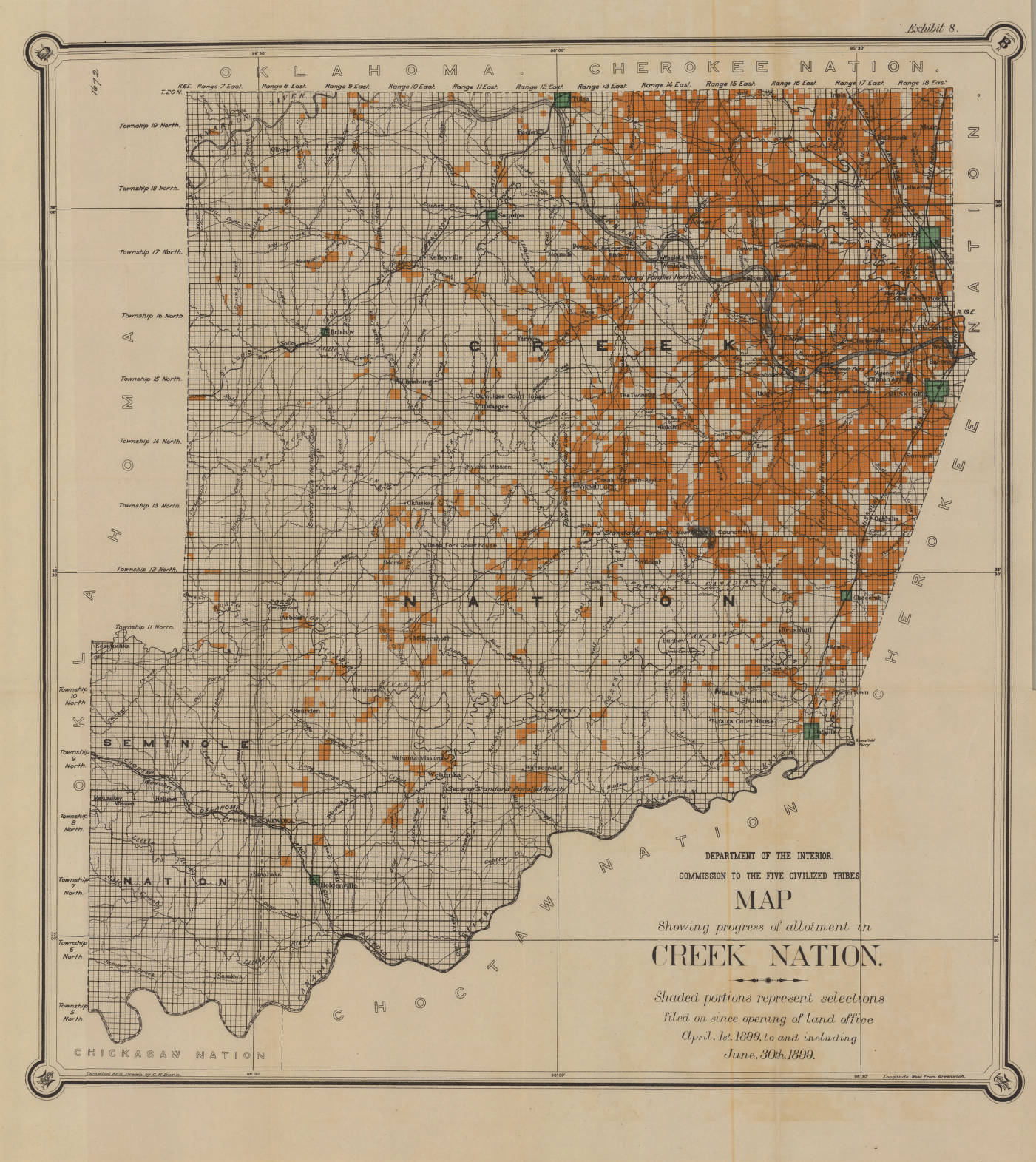
Breaking News from USA Today (“Supreme Court gives Native Americans jurisdiction over eastern half of Oklahoma“):
The Supreme Court ruled Thursday that the eastern half of Oklahoma can be considered Native American territory, a decision the state previously warned could create “civil, criminal and regulatory turmoil.”
The 5-4 decision was written by Associate Justice Neil Gorsuch and joined by the court’s four liberal justices. The justices were considering the issue for the second time after failing to decide a different case last year, when Gorsuch was recused and the court likely deadlocked.
The case concerned an appeal from Jimcy McGirt, a Native American, who claimed his state rape conviction from 1997 should be overturned because Oklahoma lacked jurisdiction. Congress, his lawyer Ian Gershengorn said, never properly terminated the reservation.
During oral arguments in May, the justices reached back to 1907 to determine whether Congress, using imprecise language, failed to disestablish the 1866 boundaries of the reservation.
If so, virtually half of Oklahoma – home to 1.8 million residents and including Tulsa, where President Donald Trump recently held a controversial campaign rally amid a global pandemic – would remain Native American territory. That means Native Americans are subject to federal, not state, laws.
The state’s solicitor general, Mithun Mansinghani, warned that could require the release of more than 1,700 inmates. That didn’t sit well with several justices who feared a chaotic overhaul of long-decided criminal cases.
“What makes this case hard is that there have been hundreds, hundreds of prosecutions, some very heinous offenses of the state law. On your view, they would all become undone,” Associate Justice Ruth Bader Ginsburg told Gershengorn.
“Won’t (residents) be surprised to learn that they are living on a reservation and that they are now subject to laws imposed by a body that is not accountable to them in any way?” Associate Justice Samuel Alito asked.
In the earlier case, the U.S. Court of Appeals for the 10th Circuit ruled the state lacked jurisdiction to prosecute a gruesome murder because it happened within 3 million acres belonging to the Muscogee (Creek) Nation. The ruling threatened more than 19 million acres in eastern Oklahoma once inhabited by five Native American tribes.
Again, I don’t have time to read through the reasoning and the USA Today report is clearly a hasty rewrite of the case preview without much reference to the opinion itself.
I’m presuming that the opinion was crafted exceedingly narrowly. Otherwise, it’s the craziest damn thing I’ve ever seen.
UPDATE: Yes, the decision is narrow, applying only to tribal members.
NYT (“Supreme Court Rules in Favor of Oklahoma Indian Claim“):
The Supreme Court on Thursday ruled by a 5-4 margin that much of eastern Oklahoma “remains ‘Indian Country,’” preventing state authorities from prosecuting offenses there that involve Native Americans. [emphasis mine]
The case concerned Jimcy McGirt, a member of the Muscogee (Creek) Nation who was convicted of sex crimes against a child by state authorities in the Nation’s historical boundaries. He said that only federal authorities were entitled to prosecute him.
Mr. McGirt argued that Congress had never clearly destroyed the sovereignty of the Creek Nation over the area, covering about half the state. The solicitor general of Oklahoma took the opposite view, saying the area had never been reservation land.
Again, this is breaking news and nobody outside the Court has digested the opinion fully yet. Still, on its face, it seems a bizarre ruling.
UPDATE 2: Further explanation,
The decision was potentially one of the most consequential legal victories for Native Americans in decades. It was written by Justice Neil Gorsuch, a Westerner who has sided with tribes in previous cases and joined the court’s more liberal members.
“Today we are asked whether the land these treaties promised remains an Indian reservation for purposes of federal criminal law,” Justice Gorsuch wrote. “Because Congress has not said otherwise, we hold the government to its word.”
One presumes Congress will rectify this swiftly. It would be absurd to let this stand.
UPDATE 3: From the syllabus:
For [Major Crimes Act] purposes, land reserved for the Creek Nation since the 19th century remains “Indian country.” Pp. 3-42.
(a) Congress established a reservation for the Creek Nation. An 1833 Treaty fixed borders for a “permanent home to the whole Creek Nation of Indians,” 7 Stat. 418, and promised that the United States would “grant a patent, in fee simple, to the Creek nation of Indians for the [assigned] land” to continue “so long as they shall exist as a nation, and continue to occupy the country hereby assigned to them,” id., at The patent formally issued in 1852.
Though the early treaties did not refer to the Creek lands as a “reservation,” similar language in treaties from the same era has been held sufficient to create a reservation, see, e.g., Menominee Tribe v. United States, 391 U. S. 404, 405, and later Acts of Congress—referring to the “Creek reservation”—leave no room for doubt, see, e.g., 17 Stat. 626.
In addition, an 1856 Treaty promised that “no portion” of Creek lands “would ever be embraced or included within, or annexed to, any Territory or State,” 11 Stat. 700, and that the Creeks would have the “unrestricted right of self-government,” with “full jurisdiction” over enrolled Tribe members and their property, id., at 704. Pp. 3-6.
(b) Congress has since broken more than a few promises to the Tribe.
Nevertheless, the Creek Reservation persists today. Pp. 6-28.(1) Once a federal reservation is established, only Congress can diminish or disestablish it. Doing so requires a clear expression of congressional intent. Pp. 6-8.
(2) Oklahoma claims that Congress ended the Creek Reservation during the so-called “allotment era”—a period when Congress sought to pressure many tribes to abandon their communal lifestyles and parcel their lands into smaller lots owned by individual tribal members. Missing from the allotment-era agreement with the Creek, see 31 Stat. 862-864, however, is any statute evincing anything like the “present and total surrender of all tribal interests” in the affected lands. And this Court has already rejected the argument that allotments automatically ended reservations. Pp. 8-13.
(3) Oklahoma points to other ways Congress intruded on the Creeks’ promised right to self-governance during the allotment era, including abolishing the Creeks’ tribal courts, 30 Stat. 504-505, and requiring Presidential approval for certain tribal ordinances, 31 Stat.But these laws fall short of eliminating all tribal interest in the contested lands. Pp. 13-17.
(4) Oklahoma ultimately claims that historical practice and demographics are enough by themselves to prove disestablishment. This Court has consulted contemporaneous usages, customs, and practices to the extent they shed light on the meaning of ambiguous statutory terms, but Oklahoma points to no ambiguous language in any of the relevant statutes that could plausibly be read as an act of cession. Such extratextual considerations are of ” ‘limited interpretive value,’ “
Nebraska v. Parker, 577 U. S. 481, _, and the “least compelling” form
of evidence, South Dakota v. Yankton Sioux Tribe, 522 U. S. 329, 356.In the end, Oklahoma resorts to the State’s long historical practice of
prosecuting Indians in state court for serious crimes on the contested
lands, various statements made during the allotment era, and the speedy and persistent movement of white settlers into the area. But these supply little help with the law’s meaning and much potential for mischief. Pp. 17-28.[…]
(d) Even assuming that the Creek land is a reservation, Oklahoma argues that the MCA has never applied in eastern Oklahoma. It claims that the Oklahoma Enabling Act, which transferred all nonfederal cases pending in the territorial courts to Oklahoma’s state courts, made the State’s courts the successors to the federal territorial courts’ sweeping authority to try Indians for crimes committed on reservations. That argument, however, rests on state prosecutorial practices that defy the MCA, rather than on the law’s plain terms. Pp. 32-36.
(e) Finally, Oklahoma warns of the potential consequences that will
follow a ruling against it, such as unsettling an untold number of convictions and frustrating the State’s ability to prosecute crimes in the
future. This Court is aware of the potential for cost and conflict around
jurisdictional boundaries. But Oklahoma and its tribes have proven
time and again that they can work successfully together as partners,
and Congress remains free to supplement its statutory directions
about the lands in question at any time. Pp. 36-42.
Again, the ruling strikes me as bizarre. I haven’t read the dissents yet but the mere fact that Oklahoma has been prosecuting offenses in eastern Oklahoma for generations would seem to settle the matter. One would think the Creek Nation would have had some duty to contest the issue before now.
While Congress can easily remedy the issue going forward, simply releasing every Creek Indian convicted by Oklahoma courts seems extreme. Even if federal prosecutors (yes: under the Major Crimes Act, they just become federal cases; they don’t fall under tribal jurisdiction) have the inclination to retry all of those cases, evidence is gone, witnesses have died, and so forth.
UPDATE 4: From Chief Justice Roberts’ dissent:
In 1997, the State of Oklahoma convicted petitioner Jimcy McGirt of molesting, raping, and forcibly sodomizing a four-year-old girl, his wife’s granddaughter. McGirt was sentenced to 1,000 years plus life in prison. Today, the Court holds that Oklahoma lacked jurisdiction to prosecute
McGirt—on the improbable ground that, unbeknownst to anyone for the past century, a huge swathe of Oklahoma is actually a Creek Indian reservation, on which the State may not prosecute serious crimes committed by Indians like McGirt. Not only does the Court discover a Creek reservation that spans three million acres and includes most of the
city of Tulsa, but the Court’s reasoning portends that there are four more such reservations in Oklahoma. The rediscovered reservations encompass the entire eastern half of the State—19 million acres that are home to 1.8 million people, only 10%-15% of whom are Indians.Across this vast area, the State’s ability to prosecute serious crimes will be hobbled and decades of past convictions could well be thrown out. On top of that, the Court has profoundly destabilized the governance of eastern Oklahoma. The decision today creates significant uncertainty for the State’s continuing authority over any area that touches Indian affairs, ranging from zoning and taxation to family and environmental law.
None of this is warranted. What has gone unquestioned for a century remains true today: A huge portion of Oklahoma is not a Creek Indian reservation. Congress disestablished any reservation in a series of statutes leading up to Oklahoma statehood at the turn of the 19th century. The Court reaches the opposite conclusion only by disregarding the “well settled” approach required by our precedents. Nebraska v. Parker, 577 U. S. 481, _ (2016) (slip op., at 5).
This seems much more plausible than the majority’s reasoning. There’s also this bit of history I somehow did not know until just now:
Forever, it turns out, did not last very long, because the Civil War disrupted both relationships and borders. The Five Tribes, whose members collectively held at least 8,000 slaves, signed treaties of alliance with the Confederacy and contributed forces to fight alongside Rebel troops. See Gibson, Native Americans and the Civil War, 9 Am. Indian Q. 4, 385, 388-389, 393 (1985); Doran, Negro Slaves of the Five Civilized Tribes, 68 Annals Assn. Am. Geographers 335, 346-347, and Table 3 (1978); Cohen §4.07(1)(a), at 289. After the war, the United States and the Tribes formed new treaties, which required each Tribe to free its slaves and allow them to become tribal citizens. E.g., Treaty with the Creek Indians, Art. II, June 14, 1866, 14 Stat. 786 (1866 Treaty); see Cohen §4.07(1)(a), at 289, and n. 9. The treaties also stated that the Tribes had “ignored their allegiance to the United States” and “unsettled the [existing] treaty relations,” thereby rendering themselves “liable to forfeit” all “benefits and advantages enjoyed by them”—including their lands. E.g., 1866 Treaty, Preamble, 14 Stat. 785. Due to “said liabilities,” the treaties departed from prior promises and required each Tribe to give up the “west half ” of its “entire domain.” E.g., Preamble and Art. III, id., at 785-These western lands became the Oklahoma Territory.
[…]
Congress began by establishing a uniform body of law applicable to all occupants of the territory, regardless of race. To apply these laws, Congress established the U. S. Courts for the Indian Territory. Next Congress systematically dismantled the tribal governments. It abolished tribal courts, hollowed out tribal lawmaking power, and stripped tribal
taxing authority. Congress also eliminated the foundation of tribal sovereignty, extinguishing the Creek Nation’s title to the lands. Finally, Congress made the tribe members citizens of the United States and incorporated them in the drafting and ratification of the constitution for their new State, Oklahoma.In taking these transformative steps, Congress made no secret of its intentions. It created a commission tasked with extinguishing the Five Tribes’ territory and, in one report after another, explained that it was creating a homogenous population led by a common government. That contemporaneous understanding was shared by the tribal leadership and the State of Oklahoma. The tribal leadership acknowledged that its only remaining power was to parcel out the last of its land, and the State assumed jurisdiction over criminal cases that, if a reservation had continued to exist, would have belonged in federal court.
A century of practice confirms that the Five Tribes’ prior domains were extinguished. The State has maintained unquestioned jurisdiction for more than 100 years. Tribe members make up less than 10%-15% of the population of their former domain, and until a few years ago the Creek
Nation itself acknowledged that it no longer possessed the reservation the Court discovers today.
This honestly seems like a slam dunk. It’s not only rather obvious Congress took multiple steps doing what the majority claims it failed to do but we have a century of acquiescence to that fact by the tribes themselves.
That this was absolutely despicable treatment by Congress of the tribes would seem undeniable. But the Court acknowledges today that they have the power to do these things. The value of pretending they did not and upending a modus vivendi that has lasted more than a century is not obvious.