
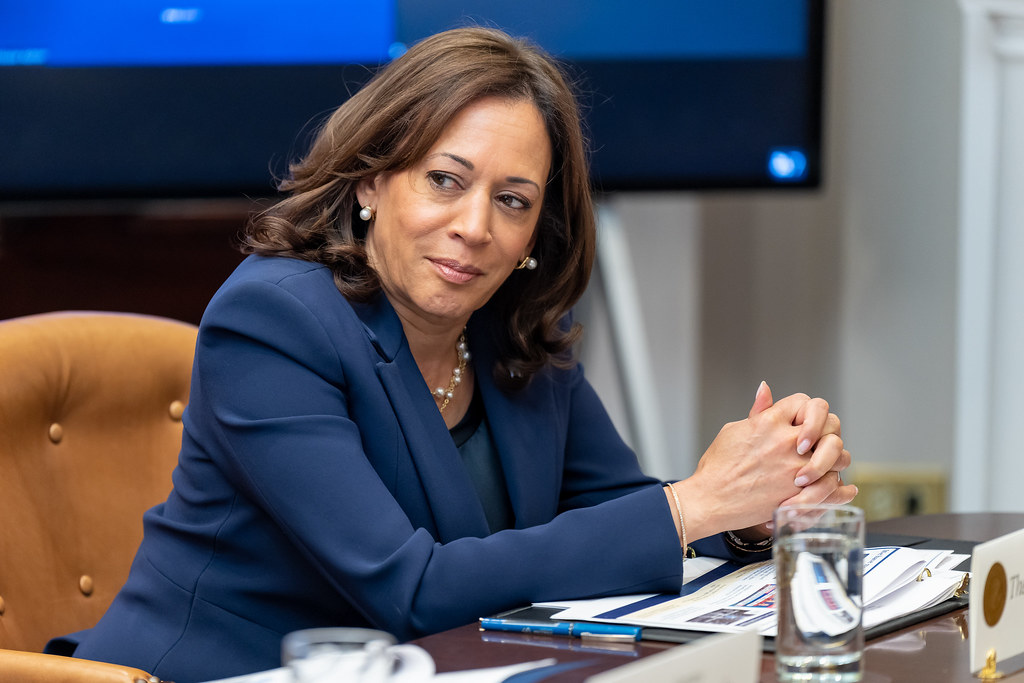

As Steven Taylor has already noted, Democrats are coalescing around Kamala Harris as the nominee in the wake of President Biden’s dropping his re-election bid. Whether the Democrats are thereby solving their dilemma remains to be seen.
For reasons discussed on both the front page and the comments section, rallying behind Harris makes a lot of sense. She is, after all, the sitting Vice President and, as such, is the only plausible contender not named “Joe Biden” for whom Democrats have at least nominally voted in both the last general election and in the 2024 primaries. And failing to nominate a Black-Indian woman under those circumstances would be highly problematic for obvious reasons.
While Steven—an expert on comparative political institutions—has repeatedly explained why U.S. parties are extremely weak, the Democratic Party is at the apex of its power in this situation. With a convention commencing in less than a month, it is too late for a primary do-over. The sitting Democratic President has endorsed Harris, both implicitly by choosing her as his running mate for 2020 and the 2024 primaries and explicitly by endorsing her as his replacement. So have Bill and Hillary Clinton, the 1992, 1996, and 2016 nominees. Crucially, Governors Gavin Newsom (CA), Josh Shapiro (PA), and Roy Cooper (NC)—all of whom are high on lists of ideal Biden replacements—have already endorsed her. So have all 50 state party chairs.
Thus, as Steven noted, “any would-be challenger would have to decide how much of the party it wants to fight with to get a job which would require uniting the party.” Aside from Joe Manchin, nobody who would be a plausible candidate* has given even the slightest indication they’re prepared to do so.
So, the cake is likely already baked.
Still, I have pretty strong misgivings about simply handing the baton to Harris without party brokers at least considering alternatives.
First, while she has certainly gained considerable experience over the last four years, it’s not at all clear that she’s an effective campaigner on a broad scale. Aside from one strong debate performance, she fared poorly in her national debut, dropping out of the 2020 race before the first primary. Is she really the ideal candidate to face Donald Trump?
Second, she carries most of the baggage of the Biden-Harris Administration.** To the extent uncommitted voters are frustrated with the economy and “the direction of the country,” I don’t see how switching to Biden’s understudy helps chance the dynamic. The only thing she brings in that regard is that she’s not 81 with signs of dementia. And, having simply been handed the nomination rather than winning it through a competitive process, it will be exceedingly hard to run against any of the Biden-Harris agenda. It was awkward enough for Al Gore in 2000, the last time a sitting VP ran.
Third, simply anointing her without some sort of competition just feels undemocratic. Yes, she was on the ticket in 2020 and in the 2024 primaries. But, in reality, she was hand-picked by Biden for both and voters had no real choice in the mater.
Fourth, the party is potentially picking its leader for the next eight years here. There are a lot of talented governors and other rising stars in the party who are poised for a presidential run who would essentially be sidelined until 2032 without even having a chance to persuade Democratic primary voters. Cooper just turned 67; he would be 75 in 2023. Newsom is 56; he would be 65 by Election Day 2032. Gretchen Whitmer turns 53 next month; she’d be 61. Shapiro is 51 and would be 59. Granted, they’d all still be younger than Trump, much less Biden, is today, but they’d certainly be well past the peak of their political appeal. (This is admittedly much less of an issue for rising stars in the Senate like Michael Bennet and Mark Kelly, 59 and 60, respectively, who would still be active players in eight years.)
Again, this is all likely a moot point. The only power player who has voiced support for an open nomination process is Speaker Emerita Nancy Pelosi—and that was when Biden dropping out was a hope rather than a reality. That someone with her keen parliamentary instincts is saying that leads me to believe that it’s at least plausible.
Still, as Jamelle Bouie rightly noted on a recent episode of the Ezra Klein Show,
The delegates to conventions, if you go on a very micro level, these are not party bosses. This is not 1944, when you have the boss of Saint Louis on the floor hassling people to get Truman on the ticket.
This is not a party convention, even in 1960 or 1964, where you have party bosses, and people who represent constituencies and interests and votes on the floor, hassling people, making deals, trading that kind of thing. That doesn’t exist anymore. It’s some elected officials, but it’s a lot of just ordinary people who are dedicated volunteers in their local parties, their state parties. And they are — they go on behalf of a candidate.
And so I think this is important to emphasize because — no offense to any of these people, they’re all great. I’ve been to conventions. I’ve talked to people who go. They’re wonderful people who are really engaged in the day to day of American democracy. And I have a lot of respect for them.
But I don’t think there are people equipped to do the high stakes negotiating that comes with choosing a presidential nominee. And I think that putting that kind of weight on the process as it actually exists is not going to lend itself well to a kind of orderly or even sort of only temporarily chaotic decision making that I think people want. I think what’s more likely to happen is confusion and disarray in a way that does harm the Democratic ticket.
It’s not obvious what an alternative route would look like. But I’d prefer that there at least be some serious discussion within the party before going all-in on someone in this position because of the Democratic Party zeitgeist of the summer of 2020.
To be sure, I’ll vote for Harris or any other name that I’ve seen on any of these lists come November if Trump is the alternative. But we need to get low-information voters in a handful of swing states on board and, by definition, they are not similarly committed.
*I think he’d be an excellent general election candidate and would almost certainly beat Trump. There’s no way on earth he gets the Democratic Party nomination. Indeed, I think they’d be more inclined to pick Mitt Romney, given their frustrations with his obstruction of the Biden legislative agenda.
**I’ve long disliked that odd branding, but the administration has done this from Day 1. Harris may well come to regret that.









