
 Is education really the key to a bright economic future? That may not be the case in China:
Reporting from Beijing – Six months after graduating from university, Guan Jian was unemployed and living in an 8-by-8-foot rented room on the fringes of this sprawling capital.
His quarters were so hastily built that the landlord didn’t bother to include a bathroom. When duty calls, Guan must trudge to the neighborhood toilet. Yet at $65 a month, it’s all he can afford. Money is so tight at times that he has learned to suppress his hunger with a single steamed bun a day.
This wasn’t how things were supposed to be for Guan, a 24-year-old broadcast journalism graduate who sports an easy smile and has a love affair with foreign film. A native of China’s northeastern Rust Belt and the first in his family to earn a college degree, Guan thought opportunities would come more easily.
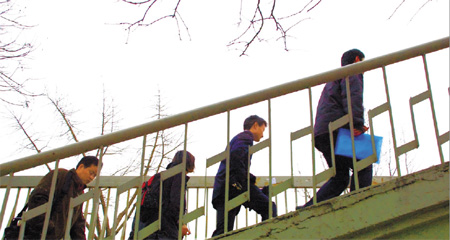
Instead, he is one of an estimated 3 million jobless or underemployed college graduates in China, products of a mass social experiment by central planners to churn out more professionals for China’s economic development. Nicknamed the Ant Tribe, after the title of a recent book documenting their struggles, they now constitute a vast army of educated young people whose growing restlessness worries the Chinese government.
[…]
The ants’ story began a little over a decade ago, in 1999, when the Chinese government launched an ambitious plan to boost university enrollment by 30% annually. At the time, the country’s factories were suffering from the Asian financial crisis. Planners believed a rise in college rolls would help China transition from a largely export-driven, low-wage manufacturing economy to a more balanced one populated by upwardly mobile white-collar workers.
Undergraduate enrollment quintupled to 20 million students by 2008; last year 6.1 million Chinese earned diplomas, up from 1 million in 1999. But it soon became clear there weren’t enough suitable jobs for these freshly minted graduates. Beijing has slashed college enrollment growth to 5% annually.
College graduates have made investments in the form of time, energy, money, and foregone income in their educations. In China just as here they expect some return on that investment.
Unfortunately, just having a degree is no guarantee of such a return on investment. The economy doesn’t automatically create jobs suitable for the skills that newly-minted graduates have acquired. Rather it’s the other way around: if students view their educations as investments that gain returns in terms of future prospects in jobs and incomes, they’ve got to tailor their studies to the areas in which those returns are most likely.








