

The CBO has provided an estimate of the impact of the stimulus bill on GDP and unemployment.
- Raised the level of real (inflation-adjusted) gross domestic product (GDP) by between 1.7 percent and 4.2 percent,
- Lowered the unemployment rate by between 0.7 percentage points and 1.5 percentage points,
- Increased the number of people employed by between 1.2 million and 2.8 million, and
- Increased the number of full-time-equivalent (FTE) jobs by 1.8 million to 4.1 million compared with what those amounts would have been otherwise. (Increases in FTE jobs include shifts from part-time to full-time work or overtime and are thus generally larger than increases in the number of employed workers.)
However there is a problem with this kind of estimation as the CBO notes,
Data on actual output and employment during the period since ARRA’s enactment are not as helpful in determining ARRA’s economic effects as might be supposed, because isolating those effects would require knowing what path the economy would have taken in the absence of the law. Because that path cannot be observed, there is no way to be certain about how the economy would have performed if the legislation had not been enacted, and data on its actual performance add only limited information about ARRA’s impact.
In other words, the CBO’s estimate is done as follows: You develop a macro-economic model of the U.S. economy and run it twice. The first time you run it with the stimulus, the second without. The difference between the two results is your estimate. In other words, the output depends on some of the assumptions in your model, such as assumptions about how stimulus spending impacts the economy.
If you are starting to think, “Wait a minute that sounds suspiciously like circular reasoning….” you might be a right wing kook. If you are thinking that this CBO report shows conclusively that the “Stimulus worked!” you might be a left wing loon.
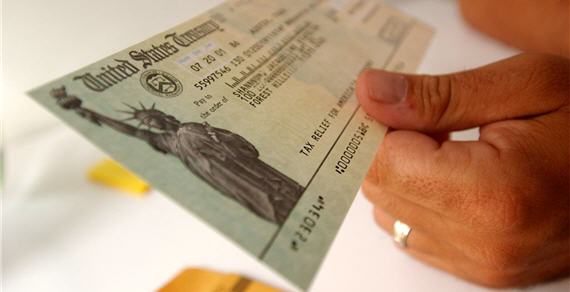
What the CBO did was look at other studies of various types of fiscal policy to try and determine how large of an effect various elements of the the stimulus bill would be. For example, the point to this article by David Johnson, Johnathan Parker, and Nicholas Soulese on the effects of the 2001 tax rebates on household expenditures. In other words, the CBO looked at other work and from that work, came up with what they thought were reasonable paramters to plug into their model. Using research like that of Johnson et. al., though is not entirely problem free though as that work was seen by their closing comments in the paper,
We conclude by returning to a caveat. While the 2001 tax rebates stimulated consumer spending, without knowing the full structural model underlying these results, we cannot conclude that future tax rebates will necessarily have quantitatively the same effect. The response of spending to tax rebates may differ across time and circumstances. In 2001 the rebates were part of countercyclical stabilization policy, but the response might be smaller outside of a recession or given a different situation for household balance sheets and liquidity. Nonetheless, our results provide a starting point for analyzing the impact of future tax rebates on expenditure.
In other words, it isn’t just the parameter choices that matter, but the underlying structural model of the economy.
The CBO’s estimates are based on macro-economic models of the U.S. economy and rely on other empirical studies as well to come up with a “what if” scenario”. There is no direct data on how many jobs have been created, saved, or how much GDP has gone up due to the stimulus spending.
One of the things that annoys me about the discussions on the efficacy of the stimulus spending is that many conclude that the various estimates that come out are much more grounded in facts that they actually are. The impact of the stimulus is at best difficult to measure if not impossible. It goes back to the rather clever political jujitsu by the Obama Administration in using the claim, “…jobs created or saved…” The latter, jobs saved, is inherently unmeasurable. Based on the official government statistics all you can do is tell what the change in the number of jobs was from one month to the next. You can’t tell how many jobs were “saved”. Even if there was no change and most economists and market watchers expected a decline in employment and there is none, does that mean the stimulus saved jobs? Or is it due to something else like the impact of the recession lessening sooner than was anticipated.
Another question that this type of analysis does not answer is, Was this the best policy for the money we are spending?
For example, the research I linked above indicates that the tax rebates in 2001 had a larger effect than is typically thought. Would a policy with greater emphasis on tax rebates have worked better. Could they have been structured to come in phases with the option of cancelling later phases if the economy is showing growth that is robust enough to limit the rather rapid accumulation in debt?









