
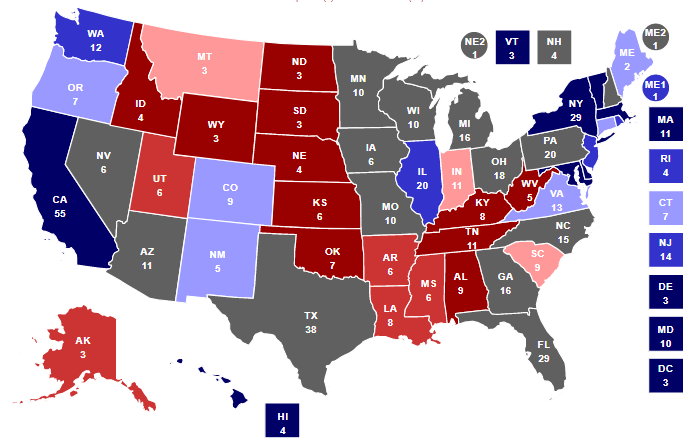

Political Scientists Jonathan Cervas and Bernard Grofman* have a piece at Medium that asks: How Likely is Trump to Lose the Popular Vote but Win the Electoral College? They do some statistical analysis of past elections and come to the following conclusion:
When one candidate wins with just barely more than 50% of the vote, the probability of inversion is over 40%. However, when one candidate wins more than 52% of the two-party vote, the probability of inversion is effectively zero.
(All emphases in quotes are theirs).
Note they are talking about the two-party vote, and not the overall vote. Clinton won 51.1% of the two-party votes in 2016.
In 2016, Clinton lost the Electoral College despite winning nearly 3 million more than her opponent; 51.1% of the two-party vote. However, our simulations tell us that the inversion was not inevitable. In 44.3% of our simulations, Clinton won the Electoral College at her actual vote-share. In an election as close as 2016, we would normally expect about 21.8% to result in an inversion. Clinton’s inversion probability was twice the historic average.
What this tells us is just how unusual 2016 was or, perhaps more accurately, how Trump really defied the odds to win (which is ironic given how poorly he did in the casino business).
They also went back to 2000:
The simulations for the year 2000 with Gore winning the popular vote by 547,398 resulted in an Electoral College win for Gore half of the time, with another 2.6% ending with an exact tie. Unlike in 2016 when the expected probability of inversion was one in twenty, we estimated that Gore would have been expected to lose in the EC about 45% of the time based on historical simulations. Electoral ties are also very likely when the margin of victory is that narrow, around 22% of the time at Gore’s popular vote. That the 2000 election resulted in an inversion should not have been surprising. Had Bush won the election by the same 547,398 vote difference, our simulations indicate that Gore would have been expected to win the Electoral College 35% of the time.
They go on to note that there is a partisan bias in the system that makes the inversion more likely for Democrats to experience than for Republicans (that is, the distribution of electoral votes in the states means that it is simply more likely that a Republican who wins the popular vote would also win the electoral vote in the a close race than the other way around).
In 2016, for example, had Trump instead won the popular vote by the same margin as Clinton did, our simulation tells us that the probability that he would have lost the Electoral College was essentially zero (1.4%).
We see this asymmetry even more clearly at the point where each candidate would have received the same number of votes. In 2016, with 50% of the vote we might expect each candidate to have an equal likelihood of winning the Electoral College vote, but at 50-50 Trump would have been expected to win 86% of the time.
What this boils down to for accessing the current race is that margin of victory is important for Biden to avoid an inversion. Again, if he can win 52% or more of the two-party vote, he is all but certain to avoid an inversion. For example:
Polls show that President Trump is very likely to lose the popular vote. The claim that Joe Biden could lose if he won 5 million more votes than Donald Trump is technically true but, for all practical purposes, it is false. If Joe Biden does win by 5 million votes, which would be an estimated two-party vote share of around 53.8%, and if the states kept the same relative ranking in Republican support levels in 2020 as they had in 2016, then our estimated probability of inversion is close to zero — 0.6%. The latest RealClearPolitics polling average (accessed August 22, 2020) has Biden winning by 7.6 points. If that number holds, it is virtually impossible for him to lose in the Electoral College. The geographic distribution of voters in 2020 is more likely to look like 2016 than 2000 or 2004. Based on the figure for 2016 we can see that if Biden wins a majority but his victory margin is not that big, Donald Trump is very likely to win the Electoral College. But, if Biden wins by more votes than did Hillary Clinton, then it is Joe Biden who is likely to be our next president.
So, our system with its current distribution of voters and electoral votes creates, as we knew, a system wherein for the Democrat to win office requires them to beat the Republican by more votes than is true in the reverse.
If this were a football game, the Dems would have to win by a FG to win the game, instead of by just scoring one more point than the Reps, but the Reps would win even if they didn’t score the most points.
Regardless, the key to avoiding the inversion is margin of victory, as that predicts state-leve outcomes.
This discussion also comports with this from Nate Silver earlier in the week:
Note that would be the margin of the popular vote overall and not just the two-party vote.
At the moment, the polling has Biden nationally at +7.5%. It hasn’t been below +6 since early June and hasn’t been below +5 since mid-April (when it even briefly dipped below +4).
So, while things like Covid-related turnout problems, mail-in-voting snafus, or a true October Surprise might yet derail the situation, the probabilities remain that Biden will be elected in November.
*Grofman is one of my A Different Democracy, co-authors.









