
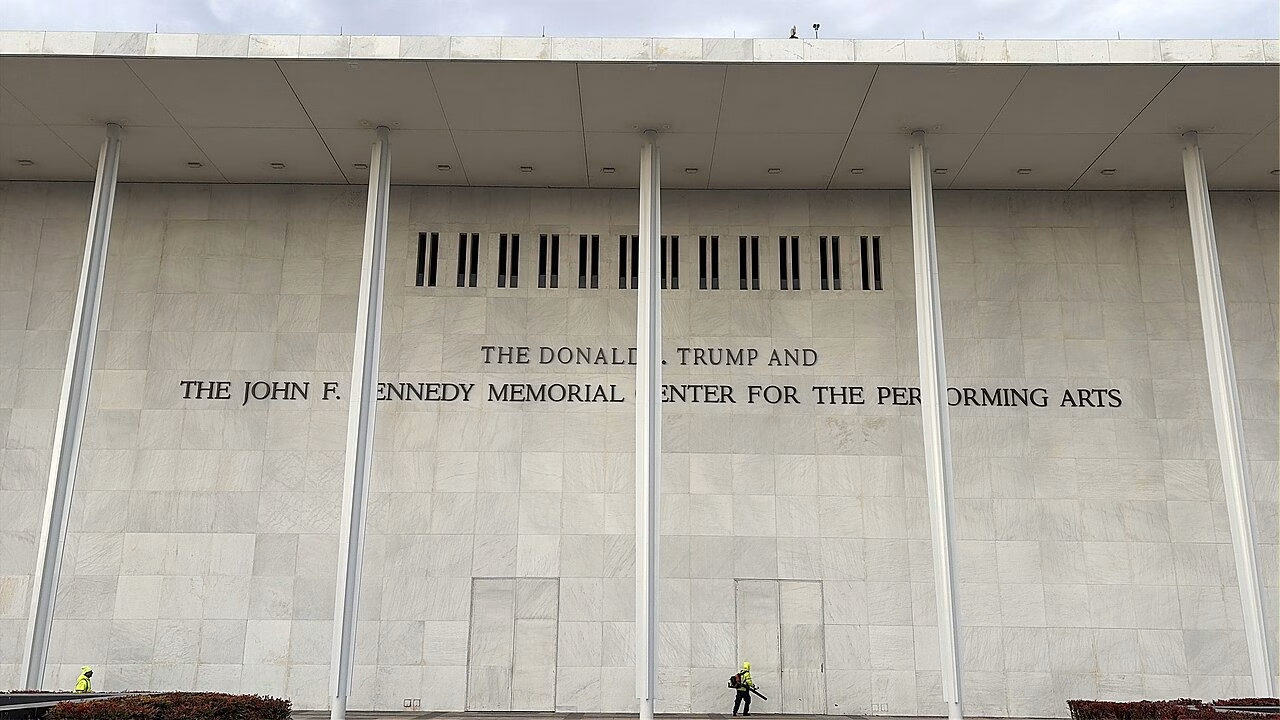
NYT (“Judge Orders President’s Name Off Kennedy Center, and He Reacts With Fury“):
A federal judge ordered on Friday that the John F. Kennedy Center for the Performing Arts remove President Trump’s name from the building’s facade and all official branding and temporarily blocked the institution from shuttering this summer for renovations.
Mr. Trump railed against the judge’s ruling in an incensed social media post, suggesting that he was considering casting the Kennedy Center aside as one of his personal projects. The president wrote that unless he was free to decide the center’s trajectory, he had “no interest in continuing what could only be a hopeless journey.”
“Unfortunately, Judge Cooper and the Radical Left would rather see it DIE than have President Trump transform it into something that everyone could be proud of, much as I have done, in many cases, throughout my life,” he wrote.
Judge Christopher R. Cooper, of the Federal District Court in Washington, determined that the board’s decision to add Mr. Trump’s name to the Kennedy Center violated a law passed by Congress in 1964 that made “crystal clear” the institution was to be named for former President John F. Kennedy.
“Congress gave the Kennedy Center its name, and only Congress can change it,” the judge wrote in a 94-page opinion. He ordered that the 18 letters added to the center’s front portico be removed within two weeks.
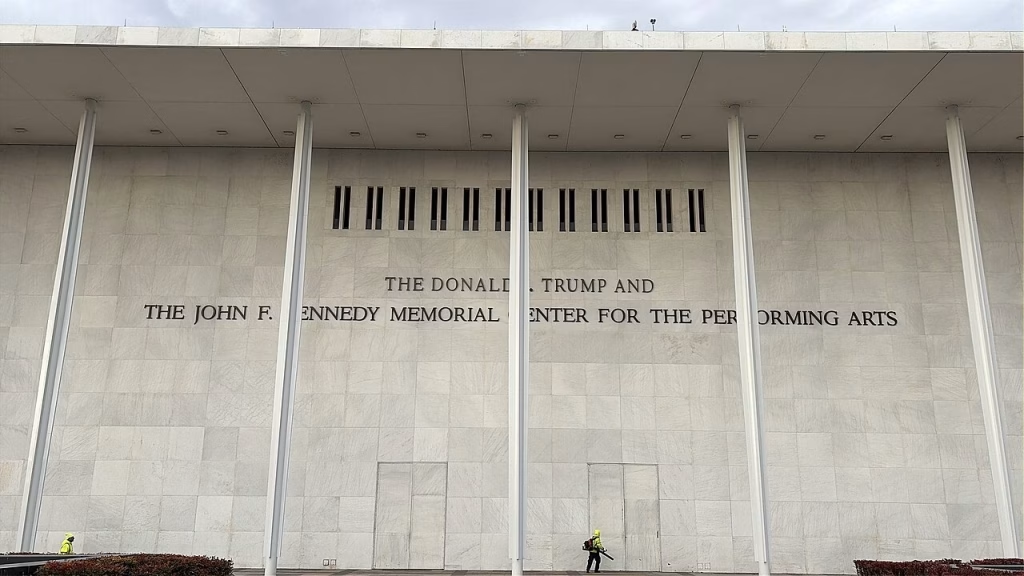
The center’s board of trustees, a vast majority of whom are allies of Mr. Trump, voted in December to add the president’s name to the performing arts center. Less than a day later, new lettering was added to the building’s marble facade, which now reads: “The Donald J. Trump and the John F. Kennedy Memorial Center for the Performing Arts.”
Roma Daravi, a spokeswoman for the center, said that it would appeal the ruling, signing her statement as the “Trump Kennedy Center Vice President of Public Relations.”
“We are confident that on appeal the court will uphold the board’s will to recognize President Trump’s historic contributions to our nation’s cultural center,” she said.
The judge’s order came in response to a lawsuit by Representative Joyce Beatty, Democrat of Ohio, who is an ex officio member of the Kennedy Center’s board. She objected to both the renaming and the plans to close the institution, which her lawyers argued was in fact a decision “designed to hide their embarrassment about declining ticket sales.”
Judge Cooper found that the board had been “derelict” in considering the possible consequences to programming when shuttering the center, as well as its legal responsibility to maintain the center as a memorial to the slain president. His order did not make any specific directives for reinstating programming as the board reassesses its renovation plans.
Ms. Beatty said in a statement celebrating the ruling that “the Kennedy Center is an institution that belongs to the American people, not to Donald Trump.”
NYT (“Judge Reopens Trump’s I.R.S. Suit and Questions His ‘Weaponization’ Fund“):
A federal judge in Miami reopened President Trump’s $10 billion case against the I.R.S. in a striking turnabout, saying that she wanted to investigate “grievous allegations” that the hasty deal to resolve it was “premised on deception.”
The ruling by the judge, Kathleen M. Williams, on Friday to revive the case shortly after closing it was a significant blow both to Mr. Trump, who had voluntarily dismissed the suit last week, and to the Justice Department. After the president withdrew the suit, senior department officials released a pair of extraordinary agreements that settled the case by establishing a $1.8 billion fund to compensate people who claimed they were victims of government “weaponization” by Democrats.
The deal also conferred lucrative tax benefits on Mr. Trump, his family and his businesses.
Judge Williams’s decision came in response to court papers filed on Wednesday by a bipartisan group of 35 former federal judges who urged her to bring the case back to life and dig into the details of the agreement to settle it.
The former judges said that Mr. Trump’s settlement agreement raised serious questions about his “candor toward the court and manipulation of the judicial system.”
Before she closed the case, Judge Williams, an Obama appointee, had in fact questioned whether the lawsuit presented an actual conflict that she could adjudicate, given that Mr. Trump was on both sides of the suit, bringing claims against a federal agency that he controlled. When she closed it, she noted there was no “settlement of record,” but shortly after, the Justice Department released its agreement foreclosing the action.
In her brief but stern order on Friday, Judge Williams said that she wanted to investigate the circumstances surrounding Mr. Trump’s efforts to settle the lawsuit in a way that benefited him and his allies. If she succeeds in moving forward with her inquiry, it could ultimately result in questions being asked of the Justice Department leaders who signed the agreements to settle the suit — chief among them, Todd Blanche, the acting attorney general, and Stanley Woodward Jr., the No. 3 official in the department.
In her order, Judge Williams asserted that she was “empowered to investigate serious misconduct” in any case before her, and ordered Mr. Trump’s lawyers to tell her by June 12 whether the lawsuit should be formally reopened because “the court was the victim of a fraud.”
She also wanted Mr. Trump’s lawyers to respond to the question of whether he had colluded with his own government to settle the case “to avoid judicial scrutiny.”
It’s possible, of course, that these orders are reversed on appeal. Both Judge Cooper and Judge Williams are Obama appointees, whereas the Supreme Court is dominated by Republican appointees. Still, the rulings here seem rather obvious.
Regardless of where one ranks Donald J. Trump among America’s presidents, naming federal buildings and the like after one still in office is unprecedented. The closest we’ve come is naming a Space Center and Center for the Performing Arts after John Kennedy only months after his assassination.
Similarly, even if you strongly believe the Capitol Rioters were American patriots unjustly persecuted by the Biden Justice Department, there’s simply no precedent for a sitting President suing the Justice Department, which reports to him, and then reaching a $1.5 billion settlement whose disbursement he controls.
Indeed, even the President’s sycophants are pushing back on the latter.
WSJ (“Trump’s $1.8 Billion Settlement Fund Sparks Alarm Inside White House“):
President Trump’s top aides have discussed whether he should kill the administration’s nearly $1.8 billion “anti-weaponization” fund in exchange for getting immigration enforcement funding passed next month, according to people familiar with the matter.
More than a dozen Republican senators have privately urged top Trump aides to drop the fund since its creation last week, said people familiar with the outreach, including Sen. Lindsey Graham of South Carolina, who is usually supportive of the president’s efforts.
Administration officials have grown increasingly concerned about the viability of the fund, people familiar with the matter said, which had been expected to provide payouts to an array of Trump allies. Trump hasn’t agreed to drop the fund, but has told allies that he understands he has political problems with Senate Republicans, the people said.
It rather obviously undermines the rule of law. And the subterfuge under which the settlement was reached compounds the issue.
Regardless, both of these disputes—and so many more caused by the administration’s flouting of longstanding norms—are further evidence that we need some sort of Constitutional Court to expedite rulings on these matters. The combination of the ability of litigants to essentially assure outcomes in the lower courts by forum shopping, the (correct IMO) SCOTUS ruling limiting the ability of lower court judges to issue nationwide injunctions, and the length of time it requires for a controversy to make it to SCOTUS (assuming they even take the case) all beg for a fix.









