
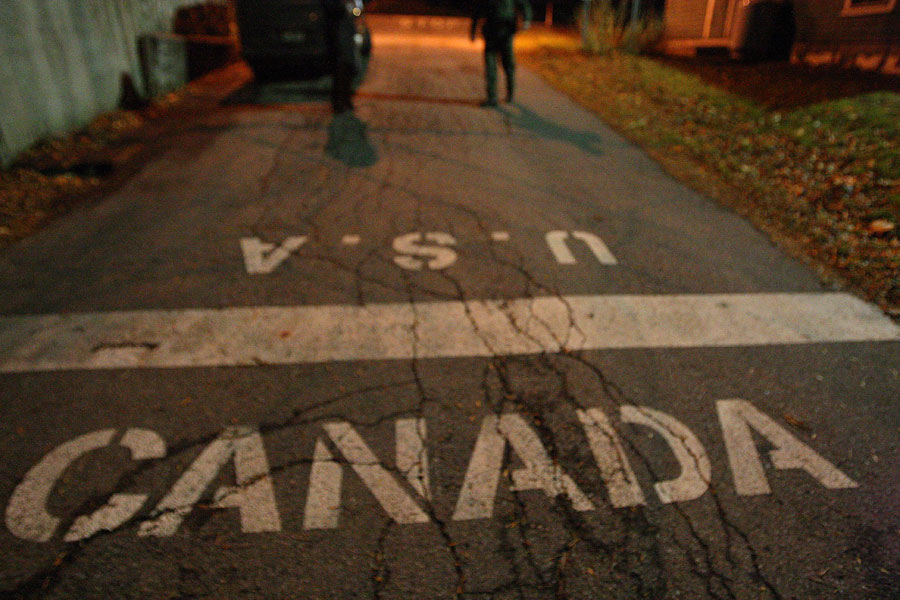
AP (“US imposes 50% tariffs on $20 billion worth of Canadian products. Canada says it will retaliate“):
The United States imposed 50% tariffs on $20 billion worth of Canadian products early Saturday, and Canada immediately said it would retaliate after last-ditch negotiations failed to resolve the latest strain in relations between the historic allies.
President Donald Trump’s import taxes will hit about 5% of what Canada ships to the United States every year, including products ranging from hockey sticks to tongue depressors.
“Canada will match those tariffs dollar for dollar to protect our workers and businesses,” Prime Minister Mark Carney said in a statement. The retaliation escalates the trade conflict and calls into question the future of a North American trade agreement covering the United States, Canada and Mexico that is crucial to industry in all three countries.
Canada sought concessions on tariffs on steel, aluminum, autos and lumber that Washington was unwilling to provide, a senior Trump administration official told reporters.
“Tonight, Canada declined to finalize the trade deal under the terms agreed earlier this week. Despite the U.S. offer to Canada to receive the best treatment of any major exporter to our market, new demands and walk-backs of other commitments by Canada have upended the careful balance reached in the past days,” U.S. Trade Representative Jamieson Greer said in a statement read to reporters shortly before midnight.
Carney blamed the Republican administration for the breakdown, saying “last-minute changes in the U.S. proposed terms were unfair, uneconomic, and called into question the reliability of any deal.” He said he had suspended negotiations and directed Canada’s negotiating team to return to Ottawa.
[…]
The whole thing is bizarre. Canada is our second-largest trading partner ($880 billion last year), behind only Mexico ($971 billion). US trade with Canada is 77% higher than it is with China, which ranks third ($496 billion). Moreover, the three North American economies are highly integrated, with robust supply chain interdependency. Trade with China is almost entirely in finished goods.
Still, as much as this seems like an own-goal economically, I’m more concerned about the impact on our relationship with what has long been one of our closest allies.
The political impact will likely be even bigger than the economic fallout. The countries sold each other $880 billion worth of goods and services last year.
[…]
The U.S. and Canada have wrangled for decades over trade, poking each other over sore spots such as Canadian softwood lumber imports and U.S. access to Canada’s protected dairy market.
Somehow, they still managed to remain friends, allies and trading partners. Canadian soldiers fought alongside Americans in Afghanistan after 9/11. The 5,525-mile U.S.-Canada border is undefended, and nearly 330,000 people and $2 billion worth of goods cross it every day; 800,000 Canadians live in the United States.
Trump’s approach to dealing with Canada marks an extraordinary departure from the traditionally cooperative relationship between the two countries. Trump has imposed tariffs on Canadian goods in a push to bring manufacturing back to the United States and made inflammatory comments about turning Canada into America’s 51st state.
Carney said Canada had recognized that “America has changed” and that the two countries would “not return to our old relationship.”
The Canadian public is fed up. A petition to expel U.S. Ambassador Pete Hoekstra, a Trump ally, has collected nearly 248,000 signatures since July 21. It accuses the former Republican congressman from Michigan of having “normalized’’ Trump’s talk of annexing Canada, among other things.
That we’re treating Canada worse than we are China, Russia, and North Korea is just unfathomable. But here we are.
And, even if President Trump doesn’t care about such things, this will almost certainly negatively impact his already-small chances of keeping Republican control of the Senate.
The two countries had good reasons to find a compromise.
Nearly 72% of Canada’s goods exports last year went to the United States. The Trump administration might be wary of imposing new tariffs — paid by U.S. importers who try to pass along the cost to consumers via higher prices — before the November’s midterm elections. American voters are already frustrated with the high cost of living.
“Canada likely wanted further sector-specific relief than the U.S. was willing to offer, or Canada’s concessions did not go far enough,’’ said Ryan Majerus, a partner at King & Spalding and a former U.S. trade official. “Either way, I think both sides will be under immense pressure in the coming days to still find an off-ramp. But if Canada has agreed to also impose tariffs, the off-ramp may be even harder to find.”
Candace Laing, president and CEO of the Canadian Chamber of Commerce, called the tariffs “a body blow to North American competitiveness” and warned they would raise costs for Americans while threatening Canadian customers, investment and small businesses.
I honestly can not think of a single upside to any of this.









