
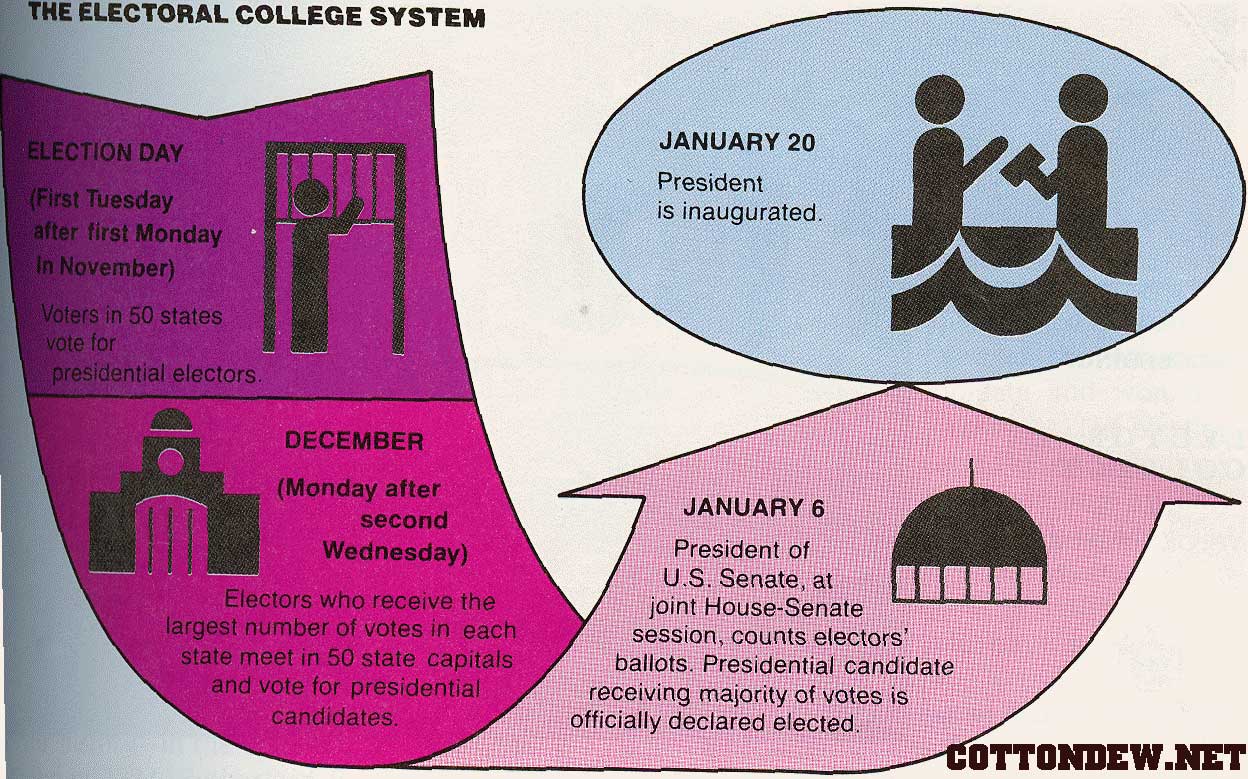

Among the little reported outcomes of the midterm elections is the fact that Republicans managed to secure majority control of the state legislatures of several more states to add to the list of those that were won in the wake of the 2010 midterm elections. As we saw starting in January 2011 when those newly elected legislatures took office, this proved to be an opportunity for Republicans to enact legislation on a variety of controversial topics that continue to reverberate today ranging from immigration measures in Alabama, Georgia, and Arizona, to a more widespread adoption of Voter ID laws and other changes to election laws that continue to be the subject of Federal Court litigation, to abortion measures in a number of states that are still being litigated in the Federal Court system. Some states also touched on more esoteric topics, though, and one of the more interesting was the brief flirtation that the Republican legislatures in Pennsylvania and Virginia had with adoption of the District Method of allocating Electoral College votes. Under this method, Electoral College votes are allocated not on a winner take all basis as happens in all but two states now, but based awarded based on which candidate wins each Congressional District in a given state, with the remaining two votes representing a state’s Senators awarded to the candidate winning the statewide popular vote. Right now, this is the method that both Maine and Nebraska use to allocate their Electoral College votes, although there has only been a district split in either state once, in 2008 when Barack Obama won Nebraka’s 2nd Congressional District while Mitt Romney won the state as a whole.
After the GOP’s wins in state legislative elections in 2010, some variation on the District Method was considered by state legislatures in Pennsylvania, Virginia, and Michigan, but in each case the plan was abandoned in no small part to negative reaction from the public, and even from some Republican pundits and politicians. Now, with the GOP in control of more state legislatures, and the 2016 election and the prospect of a third loss at the Presidential level, it appears that Republicans may be thinking of reviving the plan:
Pennsylvania and Michigan lead the list of states that might act on their own. Despite near-battleground status, both states have been won by Democratic presidential candidates for a quarter century, frustrating many of the Republicans who run state government. Pennsylvania’s state Senate Majority Leader Domenic Pileggi proposed allocating electoral votes by congressional district in 2011, and now has legislation to allocate his state’s 20 electoral votes semi-proportionally — meaning that a 52 percent to 48 percent outcome would result in 11 electoral votes for the winner and nine for the loser.
Michigan leaders have focused on congressional district allocation, with delegates at the GOP’s state convention in 2013 voting 1,370 to 132 to back that change. Susan Demas, editor of Inside Michigan Politics, recently forecast action on the proposal later this year.
But these proposals to divide electoral votes within states are highly problematic. The first problem is that they inevitably draw charges of partisan conspiracy. If used nationally in 2012, the congressional district plan would have comfortably elected Mitt Romney despite Barack Obama’s win by nearly 5 million popular votes. Romney also would have won electoral vote majorities in five of the states that he lost, including Michigan and Pennsylvania.
National Review’s Jim Geraghty seems to think it would be a good idea:
Starting in January, Republicans will hold state legislative majorities and the governor’s mansions in Michigan, Ohio, Wisconsin, Florida, Iowa, and Nevada. If some or all of those states passed laws allocating their electoral votes by districts, all of these purple-to-blue states would allocate their electoral votes in a way that would make it extremely likely for Republicans to win at least half of them. And without half the electoral votes in those states, it would nearly impossible for the Democratic nominee to win.
For example, Barack Obama won Ohio twice, and because he won the popular vote in 2012, won all of the state’s 18 electoral votes. Under the district system, if the Republican presidential nominee wins all of the U.S. House districts in Ohio currently held by the GOP, he would get twelve electoral votes and the Democrat would get only six.
In Michigan, Obama won all 16 of the state’s electoral votes; if the Republican 2016 nominee won all the currently GOP-held House districts, he would get nine and the Democrat would get seven.
Of course, by doing this, states would become much less decisive in the presidential race.
There is nothing unconstitutional about the District Method, of course. The Constitution gives individual states the authority to use any method at all to decide how their Electoral Votes are allocated and the methods used have changed over time. For many years in the early days of the Republic, for example, there was no real connection at all between the balloting on Election Day and the selection of delegates to the Electoral College, which was generally done by state legislature in a manner to the way that Senators were selected to prior to adoption of the 17th Amendment. In a post over the weekend, Matthew Yglesias suggested that states still possessed the power to choose electors in this manner. Many conservatives shot back that Section 2 of the 14th Amendment would prohibit a state legislature from picking electors in a manner that didn’t take into account, in some way, the votes of the public. There doesn’t appear to be any direct case law on this issue, but it’s largely an academic point because, as we’ll see, the methods of Electoral College reform that have been discussed by Republicans in the recent past would still take actual votes into account, the change would be in how that would be done.
In addition to the District Method, other methods have have been suggested have included a Proportional Vote allocation that would allocate Electoral Votes based on the proportion of the vote that each candidate received above a certain threshold. Using this method, and placing the minimum percentage of the popular vote at 10% just for argument’s sake, California, instead of giving all of its 55 electoral votes to Barack Obama, would have assigned 33 of those votes to Barack Obama and the remaining 22 to Mitt Romney based on the candidate’s respective percentage of the popular vote. Another proposed reform that has provide popular on the left is the National Popular Vote, which purports to be an interstate agreement that states that each state will assign its electoral votes based on the national popular vote regardless of the outcome in the state itself. This proposal, however, faces serious legal obstacles since it appears to constitute the kind of Interstate Compact that is forbidden by Article I, Section 10 of the Constitution unless it is approved by Congress. Finally, of course, there is the idea of eliminating the Electoral College entirely but that would require a Constitutional Amendment, unlike any of the state-level reforms discussed here.
Of all these methods, though, it is the District Method that seems to be the one that conservatives have taken to advocating in recent years. There has been some brief flirtation with the proportional allocation method, particularly in Virginia after 2009, but that hasn’t lasted very long. In many cases, the motivations for proposing such an idea have been blatantly partisan. Michigan and Pennsylvania, for example, are states that Republican candidates haven’t won since the 1980s, and Virginia has now twice gone for a Democratic candidate in a Presidential election. Changing the way such a state allocates its Electoral Votes would obviously help the GOP overcome the advantage that Democrats have thanks to the fact that California, Illinois, and New York, which make up 95 Electoral votes, or more than one-third of the 270 votes needed to win a Presidential election, are solidly in their corner If such reforms could be implemented in states that go for Democrats in Presidential years, then it would obviously help a Republican candidate and hurt the Democratic candidate. Of course, advocates aren’t necessarily always so blatantly partisan in their arguments. Typically, they argue that the District Method would be fairer to voters because it would more closely mirror the popular vote, In the end, though, the proposals are obviously blindly partisan and, especially in our current climate where Congressional Districts are drawn for political advantage far more than with the intent of being representative of a relevant population group.
When this idea was first proposed in Pennsylvania in 2011, I was inclined to support the idea for many of the reasons that advocates had put forward and, indeed, had been supportive of the idea long before the Republican wave of 2010 More recently, though, I’ve been quite skeptical of the idea, especially given the fact that Congressional Districts are typically drawn for partisan advantage to begin with. What this means, of course, is that the same state legislature that decides how the districts are drawn would then decide to allocate Electoral Votes based on those Congressional Districts.But for the problems with redistricting, perhaps, this might be an idea worth considering, and one that would alleviate many of the problems with the Electoral College that people complain about without having to go through the cumbersome and likely futile process of amending the Constitution to get rid of the Electoral College altogether. That’s not the world we live in, though, and absent some radical change to the way Congressional Districts are drawn, it seems unfair for any state to use them as the basis to allocate Electoral Votes.
Of all of the methods for allocation that have been proposed, the one that strikes me as making the most sense is proportional allocation, where each state allocates its Electoral Votes by the percentage of the vote received by each candidate, with the understanding that no candidate that gets less than, say, 10% of the popular vote will get any Electoral Votes. By my quick back of the envelope calculation that would’ve put the Electoral Vote allocation in 2012 at Obama 279 (51.1%) and Romney 259 (48.15%), which would have been remarkably close to the actual popular vote breakdown which came to 51.1% for Obama and 47.82% for Romney. Another version of the proportional method would allocate two electoral votes to the winner of each state, and then allocate the remainder proportionally and would have resulted in a final total of 272 for Obama and 266 for Romney. (source) Either one would be closer to the actual popular vote than the winner take all method we use today, and would be fairer than the District Method. More importantly, if candidates were aware that they could win Electoral Votes in any state, it would arguably make them more likely to conduct their campaigns differently and not ignore states that they can’t win in favor of a dwindling and often shifting number of battleground states. This system would only really work, of course, if it were adopted in all the states, or at least the vast majority of them, but it’s more likely to be enacted than Electoral College repeal at this point, and it’s fairer than methods that would unfairly benefit one party over the other and make it more likely that the winner of the Electoral College would be different from the winner of the Popular Vote.








