

Regardless of whether the Democrats closing ranks around Vice President Harris as their replacement nominee is a good idea, they have done so. In addition to all the plausible contenders having already endorsed her, she has secured pledges from a sufficient number of the delegates to next month’s convention to secure the nomination.
The result is that we have a brand new race on our hands. Former President Trump and his supporters have devoted months to arguing that Joe Biden’s presidency has been terrible for the country and that he should be replaced. That argument is now moot.
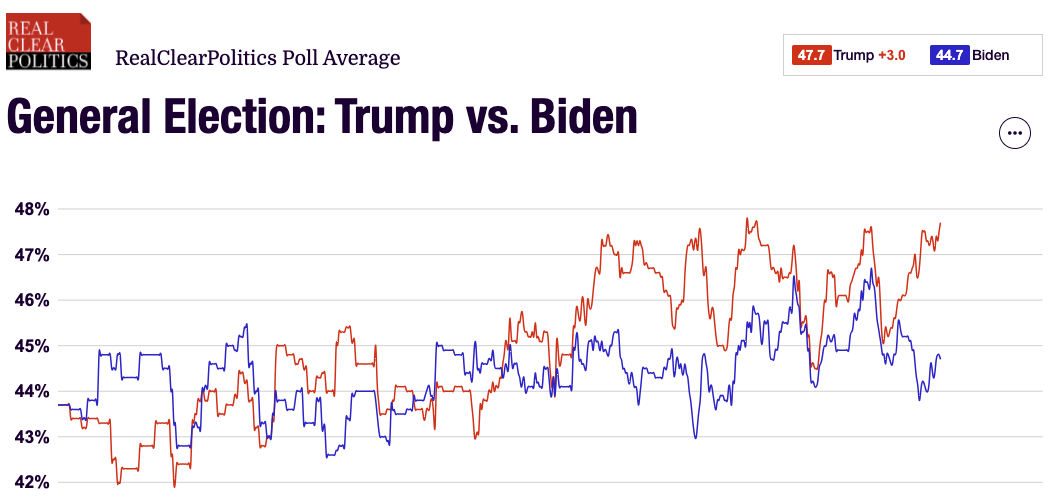
The race that was finished roughly like this:

And, not shockingly, the new one looks much the same:

On the surface, then, not much has changed. But there’s a huge difference. I’ve been saying for months that there was very little room for movement in the Trump-Biden polling because the two candidates were so incredibly well known that public opinion was essentially fixed. (The RCP data looks artificially volatile because of the compressed scale; all of the variation is taking place between 42% and 48%.)
Despite having been on the national stage in some way since her announcement in January 2015 that she was running to replace Barbara Boxer in the Senate and, especially, since her January 2019 announcement that she was running for the Democratic nomination for President, Harris is a relative unknown. Even though (or because!) she’s been Vice President for three and a half years, most Americans couldn’t pick her out of a lineup. Or pronounce her first name.
Further, despite Biden’s rather extraordinary efforts from Day 1 to put the spotlight on her, branding every initiative with “Biden-Harris Administration,” the nature of the Vice Presidency is to play second fiddle. Even though I’m a political junkie who writes about politics on a near-daily basis, I have a only a vague sense of who she is and what she stands for. And, if I’ve heard her speak since the 2020 Vice Presidential debate, it clearly didn’t make much of an impression.
That’s a long way of saying that all of these numbers

are essentially meaningless. It might as well be Trump vs. Brand X.
Indeed, here’s a recent Reuters/Ipsos poll pitting Trump and various other people Americans don’t know much about:

Trump’s floor and ceiling are damn near the same. The others are really about name recognition. Despite the buzz around Gretchen Whitmer in certain circles, I doubt one in three Americans could tell you who she is, much less anything about her. (Hell, one in four probably couldn’t identify Michigan as a state.)
It’s also worth reminding ourselves that we do not elect Presidents based on a national popular vote. Rather, we have 50 state contests plus the 3 DC Electors that go automatically to the Democratic nominee.* There are, at most, seven states (Arizona, Georgia, Michigan, Nevada, North Carolina, Pennsylvania, and Wisconsin) where the outcome is not certain. Likely five, as I don’t think Georgia or North Carolina are seriously in play; if they are, Harris will win in a landslide.
While picking Whitmer or Pennsylvania Governor Josh Shapiro for the top of the ticket might have swung one of those states, there’s no guarantee of that. But it’ll be up to Harris to demonstrate that she’s come a long way from the candidate who couldn’t even make it to 2020 in the race for the 2020 Democratic nomination to persuade voters in the Rust Belt that she’s a better bet than Trump.
Let’s hope she’s up to it.
*That’s a joke, of course, but might as well be true.










