
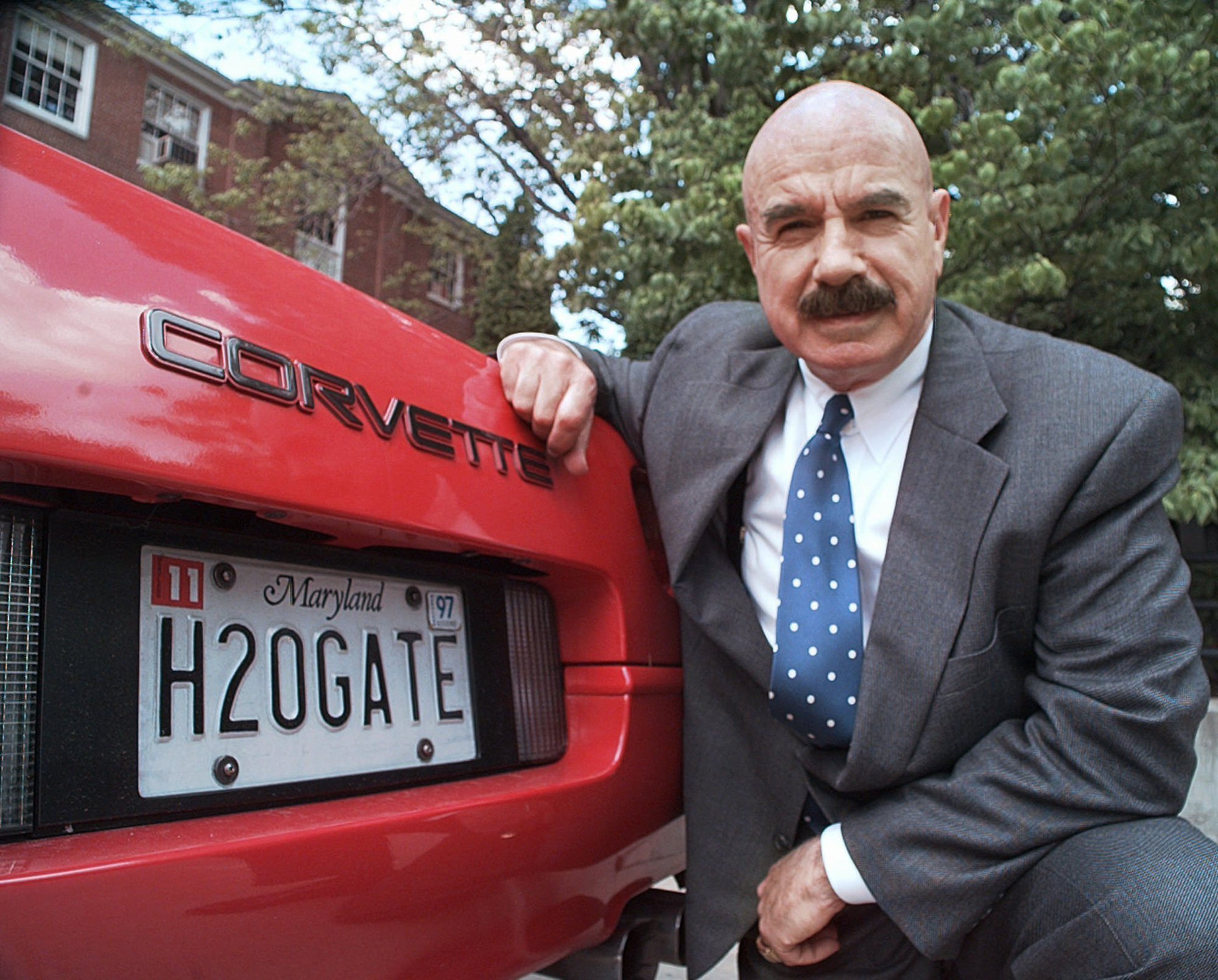
The most controversial and flamboyant figure in the scandal that brought down President Richard Nixon has passed at a ripe old age.

WaPo (“G. Gordon Liddy, undercover operative convicted in Watergate scandal, dies at 90“):
G. Gordon Liddy, the undercover operative whose bungling of the Watergate break-in triggered one of the gravest constitutional crises in American history and led to the resignation of President Richard M. Nixon, died March 30 at his daughter’s home in Fairfax County, Va. He was 90.
His son Thomas P. Liddy confirmed the death but did not give a cause, saying only that it was unrelated to the coronavirus.
A theatrical personality whose event-filled career included more twists and turns than a fictional potboiler, Mr. Liddy was at various times an FBI agent, jailbird, radio talk-show host, best-selling author, candidate for Congress, actor and promoter of gold investments.
The role for which he is best remembered was in the plot to bug the Democratic Party headquarters in the Watergate complex in June 1972.
Mr. Liddy’s combination of can-do ruthlessness, loyalty to Nixon and ends-justify-the-means philosophy made him a natural fit in a White House determined to get even with its political enemies.
At the same time, he was viewed by his superiors as “a little nuts,” in Nixon’s phrase. “I mean, he just isn’t well screwed on, is he?” the president complained to chief of staff H.R. Haldeman a week after the break-in.
With his intense stare, cannonball head, bristling mustache and machine-gun style of speaking, Mr. Liddy looked like the archetypal bad guys he later depicted in television shows including “Miami Vice.” His friend and fellow Watergate conspirator E. Howard Hunt described him as “a wired, wisecracking extrovert who seemed as if he might be a candidate for decaffeinated coffee.”
Mr. Liddy often boasted of his transformation “from a puny, fearful boy to a strong, fearless man” through a regime of intense exercise and physical bravado such as eating rats and holding his hand over a candle until the flesh burned.
“The trick is not minding,” he once explained of the pain, echoing a line used by Peter O’Toole in the 1962 movie “Lawrence of Arabia.”
He also developed an early fascination with Nazi Germany, saying that he felt an “electric current” surge through his body when he listened to Adolf Hitler on the radio. To the young Liddy, Hitler embodied the “power of will.”
Although Mr. Liddy frequently boasted of his impeccable tradecraft, he made elementary mistakes that allowed his former FBI colleagues to connect the break-in to the White House and ultimately to a small circle of Nixon aides.
He accepted personal responsibility for the fiasco, declaring that he was “the captain of the ship when she hit the reef.”
“If someone wants to shoot me, just tell me what corner to stand on, and I will be there,” he told presidential counsel John Dean.
Detractors viewed the gun-loving, hippie-hating Liddy as a threat to American democracy and the man responsible for many of the “dirty tricks” of the Nixon administration that led to the resignation of the president on Aug. 9, 1974. Supporters admired his war against “radicals” and “subversives” and his refusal to betray his fellow Watergate conspirators in return for a reduced prison term.
NYT (“G. Gordon Liddy, Mastermind Behind Watergate Burglary, Dies at 90“):
G. Gordon Liddy, a cloak-and-dagger lawyer who masterminded dirty tricks for the White House and concocted the bungled burglary that led to the Watergate scandal and the resignation of President Richard M. Nixon in 1974, died on Tuesday in Mount Vernon, Va. He was 90.
His death, at the home of his daughter Alexandra Liddy Bourne, was confirmed by his son Thomas P. Liddy, who said that his father had Parkinson’s disease and had been in declining health.
Decades after Watergate entered the lexicon, Mr. Liddy was still an enigma in the cast of characters who fell from grace with the 37th president — to some a patriot who went silently to prison refusing to betray his comrades, to others a zealot who cashed in on bogus celebrity to become an author and syndicated talk show host.
[…]
Unlike the other Watergate defendants, Mr. Liddy refused to testify about his activities for the White House or the Committee to Re-elect the President, and drew the longest term among those who went to prison. He was sentenced by Judge John J. Sirica to 6 to 20 years, but served only 52 months. President Jimmy Carter commuted his term in 1977.
“I have lived as I believed I ought to have lived,” Mr. Liddy, a small dapper man with a baldish pate and a brushy mustache, told reporters after his release. He said he had no regrets and would do it again. “When the prince approaches his lieutenant, the proper response of the lieutenant to the prince is, ‘Fiat voluntas tua,’” he said, using the Latin of the Lord’s Prayer for “Thy will be done.”
Disbarred from law practice and in debt for $300,000, mostly for legal fees, Mr. Liddy began a new career as a writer. His first book, “Out of Control,” (1979) was a spy thriller. He later wrote another novel, “The Monkey Handlers” (1990), and a nonfiction book, “When I Was a Kid, This Was a Free Country” (2002). He also co-wrote a guide to fighting terrorism, “Fight Back! Tackling Terrorism, Liddy Style” (2006), and produced many articles on politics, taxes, health and other matters.
In 1980, he broke his silence on Watergate with his autobiography, “Will.” The reviews were mixed, but it became a best seller. After years of revelations by other Watergate conspirators, there was little new in it about the scandal, but critics said his account of prison life was graphic. A television movie based on the book was aired in 1982 by NBC.
Mr. Liddy found himself in demand on the college-lecture circuit. In 1982 he teamed with Timothy Leary, the 1960s LSD guru, for campus debates that were edited into a documentary film, “Return Engagement.” The title referred to an encounter in 1966, when Mr. Liddy, as a prosecutor in Dutchess County, N.Y., joined a raid on a drug cult in which Mr. Leary was arrested.
In the 1980s, Mr. Liddy dabbled in acting, appearing on “Miami Vice” and in other television and film roles. But he was better known later as a syndicated talk-radio host with a right-wing agenda. “The G. Gordon Liddy Show,” begun in 1992, was carried on hundreds of stations by Viacom and later Radio America, with satellite hookups and internet streaming. It ran until his retirement in 2012. He lived in Fort Washington, Md.
Mr. Liddy, who promoted nutritional supplements and exercised, was still trim in his 70s. He made parachute jumps, took motorcycle trips, collected guns, played a piano and sang lieder. His website showed him craggy-faced with head held high, an American flag and the Capitol dome in the background.
NPR (“G. Gordon Liddy, Chief Operative Behind Watergate Scandal, Dies At 90“):
G. Gordon Liddy, the Republican adviser who was convicted for his role in the Watergate scandal that brought down President Richard Nixon, died on Tuesday.
[…]
While he had taken great pride in remaining silent throughout the Watergate investigation and his own criminal trial, Liddy seemed to relish the notoriety the scandal brought him and he delighted in talking about it.
During the early 1990s, when he hosted one of the nation’s most popular conservative talk shows, Liddy openly discussed the botched burglary that led Nixon to resign in disgrace — absent any remorse except that he was caught.
He also took on numerous TV roles, acting as a villain in popular shows, including Miami Vice. And he became a regular on the college speaking circuit alongside LSD evangelist Timothy Leary.
While I was interested in national politics far earlier than most, Watergate hit too early even for me. While I vaguely remember going with my parents to vote for Nixon in 1972, I would have been just shy of my 7th birthday. When the Senate hearings aired from May 17 to August 7 the next year, they were an interruption of the kids’ programming that was only available in the mornings in those days and thus an annoyance.
A decade or so later, while I was in high school, I became fascinated with the scandal, though, and read pretty much every book available on it over a short period. I read and enjoyed Liddy’s autobiography, Will, probably two or three years after it came out. (My practice at the time was to wait for the paperbacks to be available at the half-price used bookstores.) I would read his novels at some point, probably as an undergraduate, and found them pretty entertaining.
I started listening to Rush Limbaugh’s program around the time of the LA Riots, which took place in the short period between leaving the Army in February 1992 and starting graduate school in May. I’m not sure exactly when I discovered Liddy’s show but I know I was listening to it in the late 1990s when I was teaching at Troy.
From my current perspective, Liddy was something of a nut. Certainly, an extremist in a number of unsettling ways. Still, while his brand of humor was less effective than Limbaugh’s, he was also more intellectually honest and quite excellent at give-and-take. He was willing and eager to debate the likes of Leary or Al Franken, relishing the verbal combat.
I grew tired of his schtick sooner than I did Limbaugh’s. His attempts to project his hyper-masculinity grew tiresome, if not comical, after awhile. And gimmicks like his “stacked and packed” calendars, featuring scantily clad women holding firearms, were rather juvenile for a man who was by then a grandfather many times over. I presume he carried on in that vein until finally retiring in 2012, just shy of his 82nd birthday.
Alas, again with the benefit of hindsight, the degree to which the Republican Party shifted into Liddy’s mold, absent the intelligence and intellectual honesty, is remarkable. During the Nixon era, Liddy earnestly believed the country was in the midst of a virtual civil war and that any means were justified in ensuring the good guys won. While that seemed absurd to me even as a teenager a decade later, I nonetheless admired his conviction and his willingness to suffer the consequences, as compared to co-conspirators who sold out the others in exchange for leniency. But, contra Barry Goldwater, extremism in the pursuit of virtue can very much be a vice.
UPDATE: The first comment, from Sleepy Dog, reminds me that I had meant to draw the contrast with fellow Nixon hatchet man Charles Colson, who died almost exactly seven years ago. Liddy was unrepentant to the end, believing he was on the side of the angels. Colson repented while in prison and devoted the rest of his days to ministering prisoners.









