
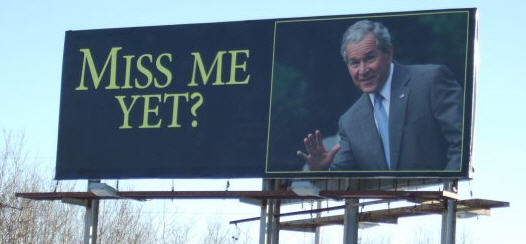
 Professional iconoclast Stanley Fish has been predicting for a while that people would come to miss George W. Bush once the heated controversies of the moment had faded and the big picture emerged. Now, he sees evidence that he was right.
A perhaps more substantial sign incorporates a sign famous (or infamous) in the Bush presidency. The March 8 cover of Newsweek reproduces the famous 2003 photograph of Bush on the flight deck of the U.S.S. Lincoln. The president is in the left of the picture, striding away from the famous banner proclaiming “Mission Accomplished.”
Those words haunted Bush for the next five years, but now, Newsweek reports, they may play differently because — and this is emblazoned on the cover — we may have “Victory At Last.” It has to be said, declare the cover-story’s writers, that “now almost seven hellish years later . . . something that looks mighty like democracy is emerging in Iraq”; and, they add (eerily echoing Bush’s words in 2003), this development “most certainly is a watershed event that could come to represent a whole new era in the history of the massively undemocratic Middle East.”
Of course, one might disagree with that assessment, but the fact that it is made in the lead article of a major mainstream magazine tells its own story. It is a story that intersects with another, the story of the precipitous decline in Barack Obama’s support and of a growing suspicion, found on the left as well as on the right, where it is much more than a suspicion, that the politics of change may have been a slogan with less promise in its future than “Mission Accomplished.” (The imminent passage of a health care bill keeps being predicted, but so far no “victory at last.”)
Analyses of how this has happened are plentiful and varied, but most agree that it had something to do with the summer of 2009, when the town meetings that seemed a good, nicely democratic idea in the spring turned into a recruiting device for the angry crowds that would become the Tea Party.
At the same time, Bush profited from the fact that he kept a low profile and didn’t snipe at his successor, a task left to his vice president, who therefore took upon himself the enmity and scorn previously directed at his former boss. Dick Cheney was, in effect, a lightning rod, and he was joined in that function by Sarah Palin, who slid neatly into the slot Bush had occupied in the mind of all good liberals for eight long years. Hatred and contempt of Palin is now the favorite pastime of those who have abandoned the cowboy from Texas and transferred their obsessive animus to the belle of Alaska (who, I say again, is more formidable than many in both parties believe.)
Meanwhile, Bush’s policies came to seem less obviously reprehensible as the Obama administration drifted into embracing watered-down versions of many of them. Guantanamo hasn’t been closed. No Child Left Behind is being revised and perhaps improved, but not repealed. The banks are still engaging in their bad practices. Partisanship is worse than ever. Obama seems about to back away from the decision to try 9/11 defendants in civilian courts, a prospect that led the ACLU to run an ad in Sunday’s Times with the subheading “Change or more of the same?” Above that question is a series of photographs that shows Obama morphing into guess who — yes, that’s right, George W. Bush.
And now, right on schedule, Bush has resurfaced (just as I imagined him doing a year ago last September ) to join Bill Clinton in a humanitarian relief effort. He is officially a member in good standing of the ex-presidents club, and the longer he lives the more his reputation will be burnished. To be sure, his post-presidency resume is still thin, but we can expect it to be beefed up by good deeds, ceremonial appearances and the activities that will surround the building and opening of his library at Southern Methodist University. We’ll see Bush the tour guide and Bush the patron of historical scholarship and, perhaps, even Bush the seminar leader.
And the judgment of history? Well, I’m not that foolish, but I will venture to say that it will be more nuanced than anything the professional Bush-haters — indistinguishable in temperament from the professional Obama-haters — are now able to imagine. He will not go to the top of the list, but neither will he be the figure of fun and derision he seemed destined to be only a year ago. You heard it here.
This all strikes me as reasonable up to a point. Frankly, given how low the opinion of Bush was when he left office — with many proclaiming him The Worst President Ever — he has nowhere to go but up.
Will Bush ever be regarded as a great president in the tradition of Washington, Jefferson, Lincoln, TR, FDR, and Reagan? Nope. But he wasn’t an awful president, either. And, depending on how Iraq shakes out, he might even be thought of as a pretty good one.
Harry Truman and Dwight Eisenhower were both viewed as, at best, mediocrities when they left office. Both are rated much more highly with the advantage of perspective.
In hindsight, the Iraq War won’t be viewed as a debacle along the lines of Vietnam. I don’t know that it’ll ever be viewed as a great success — and I say that as someone who has reluctantly supported the effort since 2003 — but the cost in American lives has been small in any historical sense and the possibility for significant, positive regional impact remains.
Additionally, I think, Bush’s handling of Katrina disaster will be more fairly judged in hindsight as a series of unfortunate events uncontrollable from Washington. FEMA was dispatched quickly but the infrastructure simply wasn’t in place — in still isn’t — to deal with an unprecedented flood in New Orleans. Nor did it help to have an incompetent mayor and governor mucking things up. But given the bitterness of the moment, it was easy to just shrug it off as Bush not wanting to lift a finger to help out a poor, predominately black city.
Fish is also right on the whole series of things that Democrats in general and Obama in particular railed about under Bush that are now quietly being adopted. Bush had to make a lot of hard decisions and made many of them badly. But, in many of those cases, the alternatives were awful, too. We all mocked Bush for repeatedly pointing out during the 2004 debates that being president was “hard work.” But, it turns out, it actually is.









