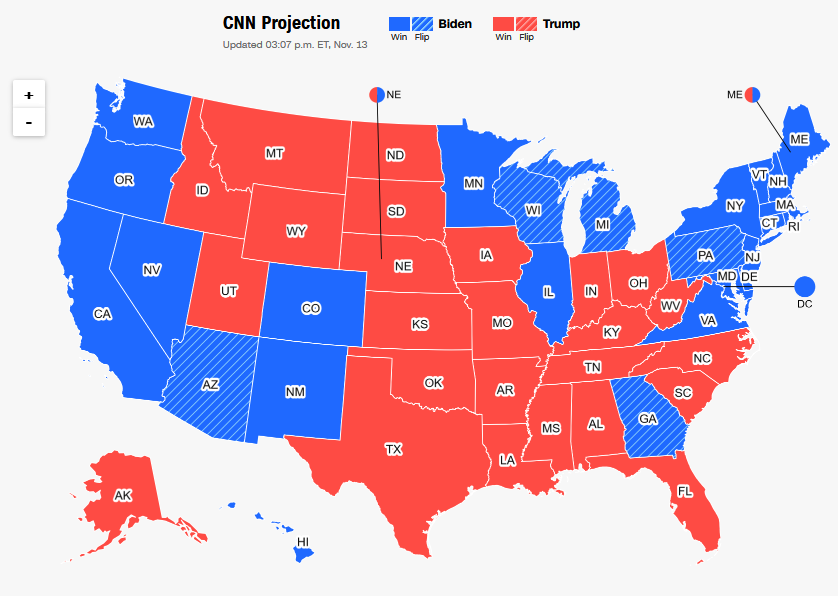

In passing over the weekend (perhaps in an open forum?), the following by Andrew McCarthy, writing for Fox News, came to my attention: Before Trump’s complaints, Democrats promoted radical plan to alter presidential elections. It is a truly absurd equating of the National Popular Vote Interstate Compact idea and Trump’s attempt at disenfranchising whole states.
The premise is as follows:
The people of the states of Pennsylvania, Michigan, Wisconsin, Georgia, and elsewhere have spoken. By majority vote, they have chosen Joe Biden over Donald Trump. Isn’t it outrageous to suggest that the vote of the people of those states should be cast for someone other than the candidate preferred by the millions of voters in these states?
Well, yes, it is.
[…]
But let’s not pretend that Trump is the first to promote the radical, politicized notion that the candidate who wins a state’s election should not get that state’s electoral votes.
Progressives beat him to it, long ago.
As we discussed back in July, a growing group of states dominated by left-wing Democrats has for years been cobbling together the so-called National Popular Vote Interstate Compact (NPVIC). The compact’s member states agree that they will award their state’s electoral votes not to the candidate who won the state’s popular election but to whichever candidate won the popular vote nationwide.
This is a reprehensible attempt at equivalency. Yes, both are about using the constitutional power of states to appoint electors, but one (Trump’s) is about literally disenfranchising American voters on a mass scale while the other (NPVIC) is about making all American voters count equally.
If you think those two things sound the least bit the same you have a profound comprehension problem.
Let’s break this down just in case.
When Trump and his allies have made suggestions about state legislatures appointing an alternate slate of electors that are asking for a post hoc changing of the law so that pro-Trump electors would be allowed to vote in the Electoral College instead of the electors chosen by the voters in the states in question as state laws currently require.
Once more for effect: the disenfranchising millions of voters because the election did not turn out the way Trump wanted.
Now, to be clear, McCarthy is not supporting that move. But, he is suggesting that that attempt is equivalent to the NPVIC.
That. Is. Absurd.
Regardless of one’s views on the NPVIC, the goal is in direct opposition to Trump’s goals. The baseline idea of the NPVIC is that the states would award their electoral votes to the candidate who won the national popular vote. It is a way, in theory, to use the fact that the US constitution gives the power to select electoral to the state legislators to then allow the president to be selected on the basis of the national popular vote (and not 51 separate contests to select electors).
Put another way: a state’s electors would be awarded to the winner of the national popular vote regardless of the way the state voted. It is an interstate compact because to work it requires states that sum to at least 270 EVs to be signatories for the plan to work.
The biggest obstacle is getting enough states to get to that threshold. The second obstacle is that Congress has a role in interstate compacts, and Republicans in the Congress would likely be opposed.
But back to the equivalence issue:
Trump wants an ex post facto change of the rules because he lost and he wants to invalid millions of votes to do so.
NPVIC advocates want a reform that would be in place before an election that would guarantee that all American voters are treated equally.
To quote Sesame Street: one of these things is not like the other.
It is utterly maddening for McCarthy to try and “both sides” Trump’s blatant attempt to overturn an election by comparing it to a reform explicitly based on democratic fairness.
After having manufactured this massive false equivalency, he then launches into some of the Greatest Hits of EC Defenders.
First,
This would radically change the way we’ve conducted presidential elections, inducing candidates to ignore much of the country and concentrate their campaigns in urban population centers — dramatically increasing the influence of progressives over the nomination of candidates and the campaign debate over policy.
First, the EC currently does not, in any way, increase the attention paid by candidates to the various states. Indeed, it just gets them to focus attention on swing states. See this post of mine from earlier this year. The evidence is quite clear.
Second, the notion that candidates would focus on “population centers” would be a heckuva lot better than just focusing on swing states. This is because “population centers” are full of, you guessed it, people! People are what matter. Further, there are lots of people of various ideological perspectives in those places. Millions of people in California voted for Trump, but he got zero electoral votes from CA. CA Republicans don’t matter. How is this defensible?
What the NPVIC would do is “dramatically increase” the equality of the voters of all citizens and require presidential candidates to have to appeal to a majority of the country.
What a concept!
Most significantly for present purposes, the NPVIC would substitute the preferences of political operators for the solemn choice of the people they represent. In 2004, for example, it would have required casting California’s 55 electoral votes for George W. Bush, even though John Kerry won the state by 1.2 million.
More accurately, the electors would be voting for the “solemn choice of the people” of the United States, rather than of a singular state. In other words, the NPVIC would change the electors’ duties to reflect the actual choice of the country.
And yes: in 2004 CA’s electors would have voted for Bush because, you know, he got the most votes across the country in that election.
Again, what a concept!
Side note: it is worth noting that McCarthy has to go back to 2004 to find an example of a Democratic state having to vote for a Republican under an NPVIC scenario because that was the last time the GOP won the national popular vote (his next example would have to be 1988). And we get to the real reason he is uninterested in reform, I suspect.