
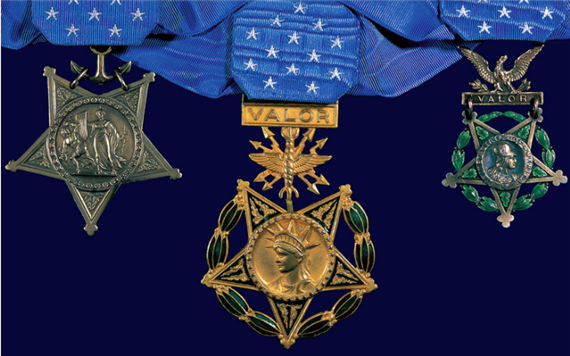

The US Supreme Court has struck down the Stolen Valor Act, which made it a federal crime to lie about military honors, on free speech grounds.
The decision was just released and news reports I’m seeing thus far are rewrites of old stories about the argument with a new one-sentence lede. SCOTUSblog live-blogged the reading of the opinion:
10:02 Tom: The statute violates the First Amendment. Breyer and Kagan concur and conclude that the Act as presently drafted fails First Amendment scrutiny. So Congress probably could rewrite it.
10:02 Tom: “Lying was his habit” is how the opinion begins.
10:02 Tom: Alito, Scalia, and Thomas dissent.
10:03 Tom: So the upshot is that this version of the Stolen Valor Act is unconstitutional, but Congress may be able to do a new law.10:05 Kali: Everyone who was waiting for the opinion in Stolen Valor, here it is: http://www.supremecourt.gov/opinions/11pdf/11-210d4e9.pdf
I’ll get around to reading the majority opinion at some point but the outcome struck me as obvious, from both a plain meaning of the words of the First Amendment and recent precedent. Surely, if there’s insufficient public interest in preventing scumbags from picketing funerals or in regulating the impact of big money on political campaigns, some loser lying about having been a war hero doesn’t meet the threshold.
I’ve written on this numerous times over the years, so won’t belabor the point here. See:
- Stolen Valor Act and the Supreme Court (Feb 2012)
- Supreme Court To Rule On Constitutionality Of Stolen Valor Act (Doug Mataconis, Oct 2011)
- Ninth Circuit: Lying About Military Honors Is Protected Speech (Doug Mataconis, Mar 2011)
- Military Medal Myths (Aug 2010)
- Stolen Valor Laws Unconstitutional (Aug 2010)
I’ll be interested in reading the rationale of the dissenters (I can’t get the PDF to load at the moment, presumably because so many are scrambling to read the ObamaCare decision) but I’m highly skeptical, indeed, that a persuasive argument exists. Updates to follow.
UPDATE: I’ve now read Alito’s dissent. Here’s the crux of his argument:
Only the bravest of the brave are awarded the Congressional Medal of Honor, but the Court today holds that
every American has a constitutional right to claim to have received this singular award. The Court strikes down the Stolen Valor Act of 2005, which was enacted to stem an epidemic of false claims about military decorations. These lies, Congress reasonably concluded, were undermining our country’s system of military honors and inflicting real harm on actual medal recipients and their families.
Building on earlier efforts to protect the military awards system, Congress responded to this problem by crafting a narrow statute that presents no threat to the freedom of speech. The statute reaches only knowingly false statements about hard facts directly within a speaker’s personal knowledge. These lies have no value in and of themselves, and proscribing them does not chill any valuable speech.
By holding that the First Amendment nevertheless shields these lies, the Court breaks sharply from a long line of cases recognizing that the right to free speech does not protect false factual statements that inflict real harm and serve no legitimate interest. I would adhere to that principle and would thus uphold the constitutionality of this valuable law.
Now, I’m sympathetic to the “valuable speech” argument here; indeed, I agree. And it’s true that the courts have always deemed certain classes of speech–especially political expression–as deserving of more protection than other types, such as commercial speech. Further, lies are less protected than the truth and some lies, such as fraud, can indeed be punished with criminal sanction.
Where I differ from Alito and his co-dissenters Scalia and Thomas is in their claim, “These lies … were undermining our country’s system of military honors and inflicting real harm on actual medal recipients and their families.” That, to use a bit of military jargon, is utter horseshit. The top medal that I earned in my brief Army tenure is a Bronze Star for service in Desert Storm. That a handful of cowards claimed to have earned higher medals than me caused me, as best I can determine, no harm whatsoever.
Claiming to have earned a Medal of Honor when you didn’t even serve in the military makes you a scoundrel. Being caught in that lie forever brands you a social outcast. It should not, however, be a crime.
In many instances, the harm is tangible in nature: Individuals often falsely represent themselves as award recipients in order to obtain financial or other material rewards, such as lucrative contracts and government benefits.10 An investigation of false claims in a single region of the United States, for example, revealed that 12 men had defrauded the Department of Veterans Affairs out of more than $1.4 million in veteran’s benefits.11
But, um, that actually constitutes fraud. Which is already a crime.
To recap: Stealing valor, which doesn’t actually exist as a tangible asset, isn’t a crime. Stealing money, a tangible asset, is a crime.
I’ll be in the area all day. No need to salute.









