


The 404 Media headline “Pornhub Is Now Blocked In Almost All of the U.S. South” is technically correct but somewhat misleading. The impetus for the report, from Sam Cole, author of How Sex Changed the Internet and the Internet Changed Sex:
Almost two years ago, Louisiana passed a law that started a wave that’s since spread across the entire U.S. south, and has changed the way people there can access adult content. As of today, Florida, Tennessee, and South Carolina join the list of 17 states that can’t access some of the most popular porn sites on the internet, because of regressive laws that claim to protect children but restrict adults’ use of the internet, instead.
The thing is, neither Louisiana nor any of the sixteen states that copied its law verbatim actually block Pornhub or any other website.
That law, passed as Act 440, was introduced by “sex addiction” counselor and state representative Laurie Schegel and quickly copied across the country. The exact phrasing varies, but in most states, the details of the law are the same: Any “commercial entity” that publishes “material harmful to minors” online can be held liable—meaning, tens of thousands of dollars in fines and/or private lawsuits—if it doesn’t “perform reasonable age verification methods to verify the age of individuals attempting to access the material.”
To remain compliant with the law while protecting users’ privacy, Aylo—the company that owns Pornhub and a network of sites including Brazzers, RedTube, YouPorn, Reality Kings, and several others—is making the choice, state by state, to block users altogether.
So, yes, Pornhub (and its affiliate sites) are blocked in those states (and others). But it’s blocked by the company that owns said sites as a means—thus far ineffective–of trying to get citizens of those states to put pressure on their state legislatures to repeal the law.
Regardless, it’s not just the South:
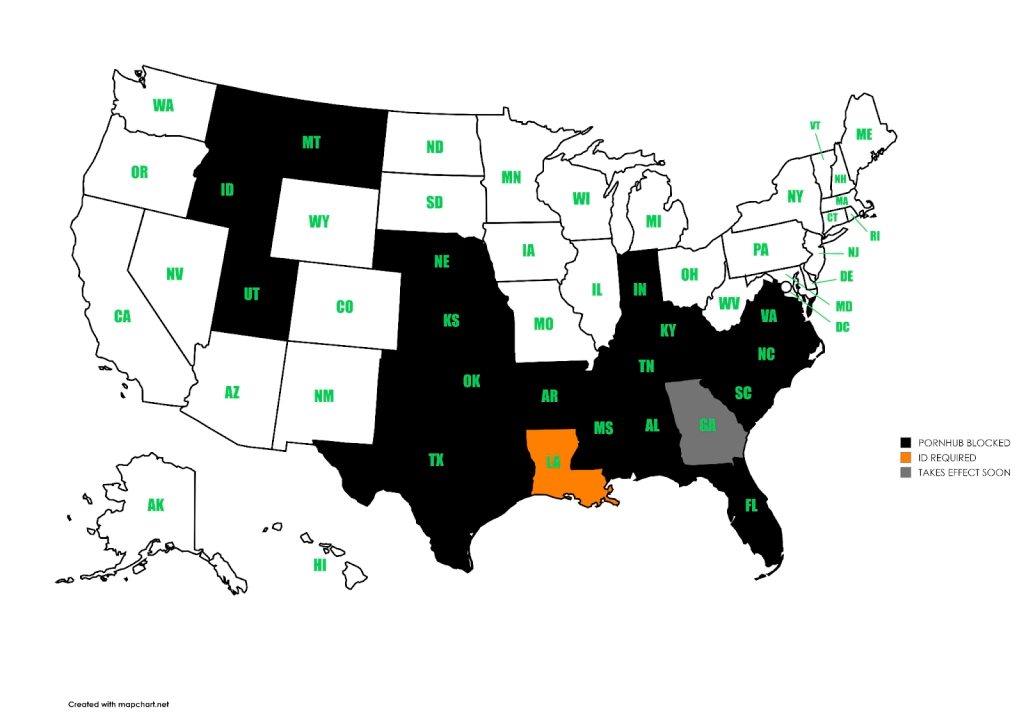
Regardless,
In Louisiana, sites in the Aylo network direct visitors to use the state’s LA Wallet, a digital driver’s license for Louisianans, before they can enter the site. That system has been in place since January 1, 2023. But the law is not working as the lawmakers would have us believe they intended it. Instead of protecting children from “harmful material,” it’s sending visitors elsewhere across the internet. An Aylo spokesperson told me that the number of visitors in Louisiana “instantly decreased by 80 percent” when the platform introduced age verification in the state. Instead, visitors go to sites with worse moderation practices and no requirements on identity verification for uploaders—just a few of the security and safety practices Pornhub started putting into place in late 2020 amid allegations of abusive imagery on the site and a campaign by religious conservative groups to have the whole platform shut down.
Even if someone wanted to visit Pornhub from Florida today, they could easily get around any age verification barriers with a VPN, which we consistently see searches for spike when these laws go into effect.
So, this is twofold. First, Aylo is the one blocking the sites in those states. Second, though, of course most people aren’t going to want to put their state ID into a database of people who use porn sites! Which, surely, is what the laws intended in the first place.
Which, relatedly, is presumably why Aylo’s strategy isn’t working. Citizens who want to ban pornography under the guise of protecting the children are quite willing to be public about it. Those who want to access pornography from their home computers . . . considerably less so! Indeed, if they were willing to be public about their pornography consumption, they would just submit to age verification.
Regardless, there are legal challenges underway:
2025 will be a year of intensifying legal battles against the creep of age verification laws. As such, there is some hope: Not every state where bills were introduced rolled over and allowed their constituents to face more censorship with less safety. In Arizona, governor Katie Hobbs vetoed the copycat bill there. “Children’s online safety is a pressing issue for parents and the state,” Hobbs wrote in a letter announcing her decision. “While we look for a solution, it should be bipartisan and work within the bounds of the First Amendment, which this bill does not.”
The Free Speech Coalition filed a challenge to the law in Florida earlier this month, along with several co-plaintiffs, including the sex education platform O.school, sexual wellness retailer Adam & Eve, adult fan platform JustFor.Fans, and Florida attorney Barry Chase. “These laws create a substantial burden on adults who want to access legal sites without fear of surveillance,” Alison Boden, Executive Director of the Free Speech Coalition, said in a press release published in December. “Despite the claims of the proponents, HB3 is not the same as showing an ID at a liquor store. It is invasive and carries significant risk to privacy. This law and others like it have effectively become state censorship, creating a massive chilling effect for those who speak about, or engage with, issues of sex or sexuality.”
And in Texas, Free Speech Coalition v. Paxton continues and will be heard this month.
It has been almost four decades since I studied the Supreme Court rulings on state efforts to ban “obscenity” and their relationship with the First Amendment, so I’m hardly an expert. I’m highly skeptical, though, that these laws won’t survive judicial scrutiny.
While I fully agree that having to share a photo ID and otherwise confirm one’s identity carries significant privacy risk that may well hinder adults’ rights to consume sexually explicit content, there is plenty of research showing that the easy availability of pornography is detrimental. And the courts have long been sympathetic to states in their efforts to protect minors, even at the cost of freedoms that are Constitutionally protected for adults.
At best, then, I could see the courts ruling that the specific verification regime at work here is problematic. But I would be shocked if the general effort to restrict minors from accessing this content was ruled a violation of the First Amendment.
Cole concludes:
Age verification bills like the ones flooding the south and beyond are regressive at best, and actively harmful at worst. They’re not just ineffective, they’re worse: they push people to sites where piracy is rampant and moderation—meaning, protection from actual harmful material—is almost nonexistent.
I suspect she’s right on that score.
Regardless, as I noted a year and a half ago, when my home state of Virginia was among the first to pass one of these laws,
[It] seems obvious to me that this is just a stupid way of going about doing something reasonable. There’s a legitimate public interest in shielding children from pornography, even if it’s almost surely a losing effort given the worldwide nature of the World Wide Web. But, rather clearly, this is mostly affecting adults. Presumably, it’s not children setting up VPNs.
While I don’t have parental controls set on my girls’ (aged 12 and 14) iPhones, I know how to do so. I had limited them to YouTube Kids for some time but finally let them download the standard YouTube app because quite a lot of perfectly harmless (or, at least, not adult) content they wanted to watch was restricted on the Kids version. Their Netflix profiles are age-appropriate but I’m sure that the 14-year-old, who’s pretty tech savvy, could bypass that if she really wanted.
As to Pornhub themselves, their claims are a bit rich. They were notorious for hosting revenge porn, child porn, and other unsavory content before public and corporate pressure forced them to crack down. They were also a major malware purveyor (although that’s common throughout the genre. The major credit card companies won’t do business with them. Social sites like Instagram won’t either. They’re not exactly an upstanding business enterprise.
Regardless, while I get Pornhub’s decision to simply block users from these states (unless they’re using VPNs claiming they’re from elsewhere), I can only imagine that the legislators who pushed these bills are happy beyond belief that they’re doing so. It’s the equivalent of self-deportation in the fight to quell illegal immigration.









