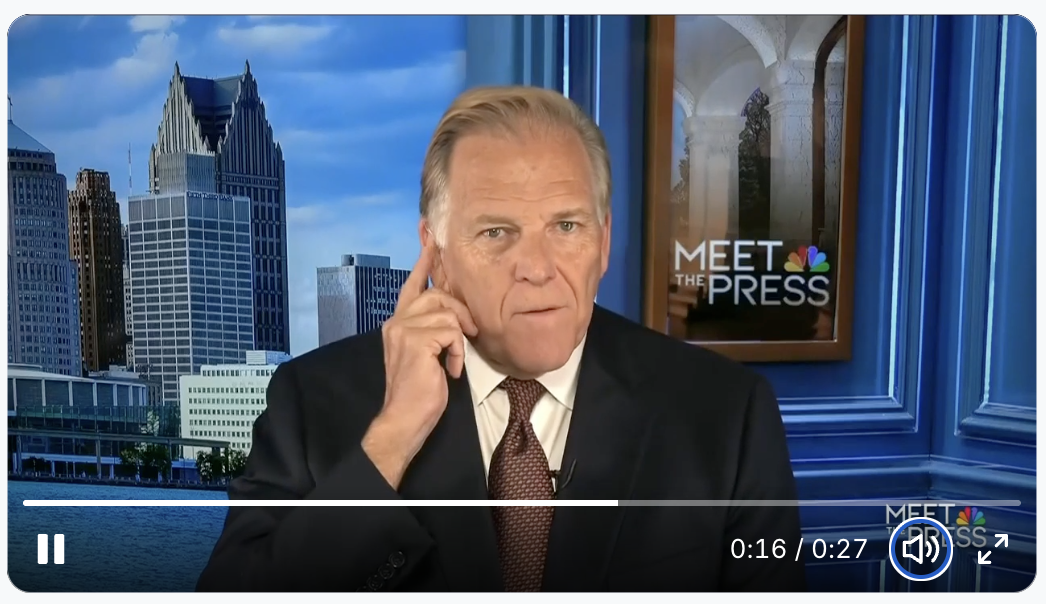
In an interview with Axios set to air over the weekend, President Trump says he plans to sign an Executive Order that would end birthright citizenship pursuant to the 14th Amendment to the Constitution via an Executive Order:
President Trump said he was preparing an executive order to end birthright citizenship in the United States, his latest maneuver days before midterm congressional elections to activate his base by clamping down on immigrants and immigration.
“We’re the only country in the world where a person comes in and has a baby, and the baby is essentially a citizen of the United States for 85 years, with all of those benefits,” Mr. Trump told Axios during an interview that was released in part on Tuesday. “It’s ridiculous. It’s ridiculous. And it has to end.”
Doing away with birthright citizenship for the children of undocumented immigrants was an idea Mr. Trump pitched as a presidential candidate, but it is unclear whether he can do so unilaterally, and doing so would be certain to prompt legal challenges.
At issue is the 14th Amendment to the Constitution, which states, “All persons born or naturalized in the United States, and subject to the jurisdiction thereof, are citizens of the United States and of the State wherein they reside.”
But some conservatives have long made the argument that the amendment was meant to apply only to citizens and legal permanent residents, not immigrants who are present in the country without authorization. Mr. Trump told Axios that while he initially believed he needed a constitutional amendment or action by Congress to make the change, the White House Counsel’s Office has advised him he can make the move on his own.
“Now they’re saying I can do it just with an executive order,” Mr. Trump said.
More from The Washington Post:
President Trump is planning to sign an executive order that would seek to end the right to U.S. citizenship for children born in the United States to noncitizens, a move most legal experts say runs afoul of the Constitution.
The action, which Trump previewed in a television clip broadcast Tuesday, would be the most aggressive yet by a president elected to office pledging to take a hard line on immigration, an issue he has revived in advance of next week’s midterm elections.
“We’re the only country in the world where a person comes in and has a baby, and the baby is essentially a citizen of the United States for 85 years with all of those benefits,” Trump said during an interview with Axios scheduled to air as part of a new HBO series starting this weekend. “It’s ridiculous. It’s ridiculous. And it has to end.”
Whether the move is legal or not, Trump seemed to welcome the controversy his comments ignited. The White House has been intent on stoking a debate over immigration as a way to motivate Trump’s base to turn out for midterm elections in which Republicans risk losing the House.
In recent weeks, Trump has also repeatedly called attention to a migrant caravan making its way toward the U.S.-Mexico border, invoking it as a symbol of what he sees as wrong with the U.S. immigration system and blaming Democrats for a lack of action.
Trump, who has long decried “anchor babies,” said he has discussed ending birthright citizenship with his legal counsel and believes it can be accomplished with executive action, a view at odds with the opinions of most legal scholars.
“It was always told to me that you needed a constitutional amendment. Guess what? You don’t,” Trump told Axios.
When told that view is disputed, Trump asserted: “You can definitely do it with an act of Congress. But now they’re saying I can do it just with an executive order.”
“It’s in the process. It’ll happen . . . with an executive order,” he said, without offering a time frame.
An executive order would be certain to spark a constitutional debate about the meaning of the 14th Amendment. It reads: “All persons born or naturalized in the United States, and subject to the jurisdiction thereof, are citizens of the United States and of the State wherein they reside.”
Legal scholars have widely interpreted that to mean that anyone born on American soil automatically becomes a natural-born citizen.
In a National Review column last month, for instance, New York lawyer Dan McLaughlin wrote that there are “fair grounds for debate” about the wisdom of the policy but little doubt on the law.
“A proper originalist interpretation of the U.S. Constitution, as presently written, guarantees American citizenship to those born within our borders, with only a few limited exceptions,” McLaughlin wrote.
Some other scholars have argued that the case for birthright citizenship is based on a misreading of the 14th Amendment, which was drafted in relation to former slaves following the U.S. Civil War. They argue that the amendment should apply only to children born in the United States to lawful permanent residents, not unauthorized immigrants.
Michael Anton, a former national security official in the Trump administration, recently sought to advance that argument in a Washington Post op-ed, writing that the “notion that simply being born within the geographical limits of the United States automatically confers U.S. citizenship is an absurdity — historically, constitutionally, philosophically and practically.”
In the Axios interview, Trump incorrectly asserted that the United States is the only country that offers birthright citizenship.
NumbersUSA, a group that favors reduced immigration, has compiled a list that shows 33 nations grant citizenship to anyone born within their borders.
The list includes Canada, Mexico, Brazil, Argentina and most other countries in Central and South America. The United States and Canada are the only two “developed” countries, as defined by the International Monetary Fund, that have unrestricted birthright citizenship laws.
Here’s the video of the portion of the Axios interview where Trump discusses this:
This isn’t the first time that Trump has brought up the issue of birthright citizenship, it was an issue he raised both during the campaign and after he became President and, before that, an issue that Republicans raised several times after they took control of the House way back in 2010. The idea first came up in the months before the 2010 midterms and even seeming (at the time) moderates like Lindsey Graham were talking about using legislation to redefine citizenship in a way that would stop the children of undocumented immigrants from becoming citizens. I argued at the time that this call seemed to be little more than a cynical attempt to rile up the base on an issue that would go nowhere. That assessment was seemingly proven to be correct when people like John Boehner seemed to support Graham’s position notwithstanding the fact that the idea was going nowhere. Once Republicans took control of the House in 2011, several legislators such as Senator Rand Paul and others, put forward a Constitutional Amendment that would have ended birthright citizenship but, of course, it went nowhere. The idea was resurrected in Congress yet again in 2015 after Republicans took control of the Senate but again went nowhere. Then, during the race for the Republican nomination, Donald Trump included the idea in his immigration plan and it was quickly endorsed by fellow candidates like Lindsey Graham, Bobby Jindal, and Scott Walker.
In those cases, of course, the idea was that Congress could change the 14th Amendment’s definition of citizenship without having to go through the laborious, and most likely doomed, process of amending the Constitution. Under this theory, Congress could simply pass a statute under its authority to set rules of naturalization that redefines who becomes a citizen at birth and who does not. Trump is now saying, without providing any support for the assertion, that he can do the same thing via Executive Order. Whichever way its done, though, whether its legislation or Executive Order, Section One of the 14th Amendment, which says:
All persons born or naturalized in the United States, and subject to the jurisdiction thereof, are citizens of the United States and of the State wherein they reside
Just over 30 years after the 14th Amendment was ratified, the Supreme Court dealt with the meaning of this provision in United States v. Wong Kim Ark, 169 U.S. 649 (1898), where it said:
[T]he Fourteenth Amendment affirms the ancient and fundamental rule of citizenship by birth within the territory, in the allegiance and under the protection of the country, including all children here born of resident aliens, with the exceptions or qualifications (as old as the rule itself) of children of foreign sovereigns or their ministers, or born on foreign public ships, or of enemies within and during a hostile occupation of part of our territory, and with the single additional exception of children of members of the Indian tribes owing direct allegiance to their several tribes. The Amendment, in clear words and in manifest intent, includes the children born, within the territory of the United States, of all other persons, of whatever race or color, domiciled within the United States. Every citizen or subject of another country, while domiciled here, is within the allegiance and the protection, and consequently subject to the jurisdiction, of the United States.
(…)
The evident intention, and the necessary effect, of the submission of this case to the decision of the court upon the facts agreed by the parties were to present for determination the single question stated at the beginning of this opinion, namely, whether a child born in the United States, of parent of Chinese descent, who, at the time of his birth, are subjects of the Emperor of China, but have a permanent domicil and residence in the United States, and are there carrying on business, and are not employed in any diplomatic or official capacity under the Emperor of China, becomes at the time of his birth a citizen of the United States.
The argument against birthright citizenship being mandated by the Fourteenth Amendment essentially point down to the idea that undocumented immigrants are not “subject to the jurisdiction” of the United States and therefore their children born in the United States cannot claim birthright citizenship. The problem with this argument, though, is that it makes no logical sense and that it goes against the plain language of the Amendment itself. If it were true that undocumented immigrants are not “subject to the jurisdiction” of the United States, then at least in theory this would mean that such a person could not be charged with committing a crime because the Court lacks jurisdiction over them. Perversely, it could also mean that they could not be deported since the immigration court would lack jurisdiction over them. While that may seem like a stretch, it strikes me as being the logical conclusion of the road down which the argument against birthright citizenship is headed, and no reasonable person would agree with an illogical situation such as that.
Additionally, it’s worth noting that the most recent revision to the Federal law that defines citizenship and naturalization, makes clear that, with certain exceptions that don’t apply here, a child born in the United States is a citizen of the United States from birth regardless of the citizenship of their parents. Specifically, in 8 USC 1401(a), it is made clear that “a person born in the United States, and subject to the jurisdiction thereof” is a citizen from birth. For purposes of statutory interpretation, “subject to the jurisdiction thereof” is taken to mean the same thing it does under the 14th Amendment, and it is clear from the applicable law that this includes children born to undocumented immigrants.
The most recent case from the Supreme Court dealing with the issues raised in Wong Kim Ark came in Plyer v. Doe 457 U.S. 202 (1982). That case made clear that the protections of the Equal Protection and Due Process Clauses of the 14th Amendment apply to undocumented immigrants and it found, not surprisingly, that the Court’s holding regarding what constitutes “jurisdiction” over an individual did not depend on whether or not a person was here legally or not. Justice William Brennan addressed this most succinctly in Footnote 10 of his majority opinion:
Although we have not previously focused on the intended meaning of this phrase, we have had occasion to examine the first sentence of the Fourteenth Amendment, which provides that “[a]ll persons born or naturalized in the United States, and subject to the jurisdiction thereof, are citizens of the United States . . . .” (Emphasis added.) Justice Gray, writing for the Court in United States v. Wong Kim Ark, 169 U.S. 649(1898), detailed at some length the history of the Citizenship Clause, and the predominantly geographic sense in which the term “jurisdiction” was used. He further noted that it was “impossible to construe the words `subject to the jurisdiction thereof,’ in the opening sentence [of the Fourteenth Amendment], as less comprehensive than the words `within its jurisdiction,’ in the concluding sentence of the same section; or to hold that persons `within the jurisdiction’ of one of the States of the Union are not `subject to the jurisdiction of the United States.’” Id., at 687.
Justice Gray concluded that “[e]very citizen or subject of another country, while domiciled here, is within the allegiance and the protection, and consequently subject to the jurisdiction, of the United States.” Id., at 693. As one early commentator noted, given the historical emphasis on geographic territoriality, bounded only, if at all, by principles of sovereignty and allegiance, no plausible distinction with respect to Fourteenth Amendment “jurisdiction” can be drawn between resident aliens whose entry into the United States was lawful, and resident aliens whose entry was unlawful. See C. Bouve, Exclusion and Expulsion of Aliens in the United States 425-427 (1912).
The Court’s ruling in Wong Kim Ark and Plyler would seem to be in line not only with the plain language of the Amendment but also, comments made by one of the framers of the 14th Amendment when it was first pending in Congress:
The author of the 14th Amendment, Senator Jacob Merritt Howard of Michigan proposed the addition of the jurisdiction phrase and stated that it tracked what he believed was already the law of the land. As such, he stated,“This will not, of course, include persons born in the United States who are foreigners, aliens, who belong to the family of ambassadors, or foreign ministers accredited to the the Government of the United States, but will include every other class of persons.
This interpretation of the 14th Amendment is supported by legal scholars across the ideological spectrum. For example, James Ho, who served as Solicitor General of Texas from 2008 to 2010 and was appointed to a position on the Fifth Circuit Court of Appeals by President Trump, where he has sat as Judge since January of this year, wrote about this issue in January 2011 when Republicans in Congress were raising the possibility of trying to change the definition of citizenship via legislation:
A coalition of state legislators, motivated by concerns about illegal immigration, is expected to endorse state-level legislation today at the National Press Club in Washington, D.C., to deny the privileges of U.S citizenship to the U.S.-born children of undocumented persons.
This effort to rewrite U.S. citizenship law from state to state is unconstitutional—and curious. Opponents of illegal immigration cannot claim to champion the rule of law and then, in the same breath, propose policies that violate our Constitution.
In the aftermath of the Civil War, members of the 39th Congress proposed amending the Constitution to reverse the Supreme Court’s notorious 1857 Dred Scott v. Sandford ruling denying citizenship to slaves. The result is the first sentence of the 14th Amendment: “All persons born or naturalized in the United States, and subject to the jurisdiction thereof, are citizens of the United States.”
The plain meaning of this language is clear. A foreign national living in the United States is “subject to the jurisdiction thereof” because he is legally required to obey U.S. law. (By contrast, a foreign diplomat who travels here on behalf of a foreign sovereign enjoys diplomatic immunity from—and thus is not subject to the jurisdiction of—U.S. law.)
(…)
During congressional debates, both proponents and opponents of the citizenship clause agreed with this interpretation of the 14th Amendment. For example, Pennsylvania Sen. Edgar Cowan opposed the clause precisely because it would extend birthright citizenship to the U.S.-born children of Chinese laborers and other noncitizens who “owe [the U.S.] no allegiance [and] who pretend to owe none.”
Tellingly, Cowan’s racially charged opposition was met with the following response from California Sen. John Conness: “The proposition before us . . . relates simply in that respect to the children begotten of Chinese parents in California, and it is proposed to declare that they shall be citizens. . . . I am in favor of doing so. . . . We are entirely ready to accept the provision proposed in this constitutional amendment.”
(…)
Determining U.S. citizenship is the unique province of the federal government. It does not take a constitutional expert to appreciate that we cannot have 50 different state laws governing who is a U.S. citizen. As a result, courts may very well strike down these state laws without even invoking the 14th Amendment. The entire enterprise appears doomed to failure.
Many Americans have sincere concerns about the rule of law. But there are many tools available to combat illegal immigration. Surely we can do so without wasting taxpayer funds on a losing court battle, reopening the scars of the Civil War, and offending our Constitution and the rule of law.
Additionally, as Axios notes, a number of legal experts have already chimed in to point out how wrong the President is:
- Dr. Martha S. Jones, author of “Birthright Citizens,” writes that “this issue is not one that has been directly tested or addressed by our courts. And the final interpretation here rests with the Supreme Court…A narrowly tailored EO that rested on the view that the children of unauthorized immigrants are not subject to the jurisdiction of the US (in citizenship terms) and thus not citizens by virtue of Birthright is an argument that can be made…My view is that this sort of wholesale or categorical exclusion is contrary to the spirit of the 14th Amendment which aimed to expand and open a way for citizenship, especially for those who might otherwise be denied because of racism. The case being former slaves.”
- Neal Katyal, a Supreme Court lawyer, writes, “This is some of the worst lawyering around. Cynical, stupid, unconstitutional, and is just another way for Trump to divide Americans—this time by starting to go for The Full Antebellum. If he does it, we will challenge it. And win.”
- Steve Kantrowitz, a top 19th century U.S. historian, writes, “On birthright citizenship, read the debate in the U.S. Senate, Jan. 30, 1866. The framers of the Civil Rights Act — the immediate precursor to the 14th Amendment, and the first place national citizenship was codified — knew exactly what they were doing. They were clarifying the well-understood principle that children born in the U.S. were citizens regardless of the immigration status of their parents. They even understood this to be true for children whose parents would then have been racially ineligible for citizenship, such as the Chinese. The only people excluded from citizenship on this basis were 1) Indians under tribal government and 2) children born to the families of foreign diplomats.”
While there are, admittedly, a handful of legal scholars who take the opposing position, and even take the position that a President would have the legal authority to essentially amend the Constitution and overturn more than 150 years of Constitutional law via Executive Order, the overwhelming position is clearly that the President cannot redefine birthright citizenship via Executive Order, that Congress cannot do it via legislation, and that the only way to redefine it would be for the Court to overrule both Wong Kim Ark and Plyler, which seems highly unlikely even in an era where the Supreme Court is dominated by conservatives, or via Constitutional Amendment, which is even less likely given what would be required to do that pursuant to Article V of the Constitution.
Taking into account the legal authority on this issue, one might wonder why Trump is proposing this idea at this point. One option, of course, is the idea that he really thinks he can do this and that he fully intends to do it. If that’s the case, though, then one wonders why he hasn’t done it yet. Instead of that interpretation, I might suggest that there is something more cynical about what Trump is saying here. Specifically, it’s no coincidence that he is bringing this up at the start of the final week before the midterm elections. As with his paranoid talk about the caravan of refugees in Mexico, this is just another way to rile up the base and get them to the polls. In all honesty, I surprised if Trump actually followed through with this in the end. It’s more likely that, with so many other things he’s put forward over the past year, this is something that will be forgotten once the midterms is over. If I’m wrong, though, and Trump actually does try to do this, it’s clear that it will quickly be challenged in the courts and, when it is, that the Administration will be shut down just as it has been on other issues over the past twenty-one months.