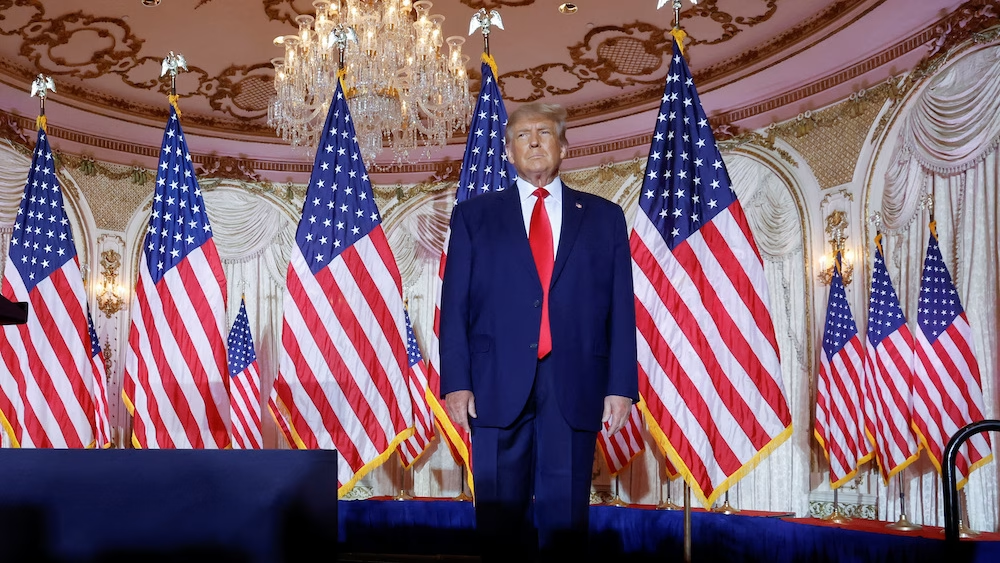
In his early-morning victory speech Wednesday, President-Elect Donald Trump proclaimed, “America has given us an unprecedented and powerful mandate.”
WaPo’s Aaron Blake (“Trump’s mandate isn’t as ‘powerful’ as he suggests. Here’s why.“):
While Trump’s win was larger than many expected and every swing state swung in his favor, his level of support is relatively par for the course for a victor. And Republicans on the whole didn’t do as well as he did.
It’s all worth diving into, given the major questions about whether Trump and the GOP will actually pursue some of the extreme proposals he has pitched on the campaign trail — and given that his and his party’s mandate, both perceived and real, will play a role in what lies ahead.
As things stand, Trump probably will sweep the seven swing states, but he will do so with only marginally more electoral votes (probably 312) than he won in 2016 (304) and President Joe Biden won in 2020 (306).
That 312 total would also outpace both of George W. Bush’s elections, but it’s fewer than in any election involving Barack Obama, Bill Clinton, George H.W. Bush or Ronald Reagan. And the 58 percent of electoral votes Trump probably will win would rank 41st all-time.
It’s more impressive given that we are a more polarized country today than we used to be, but it’s hardly out of step with other recent presidential election results.
The other key measure here is the popular vote, which has no bearing on who is actually elected but does say something about their support nationwide.
Trump is currently taking 50.9 percent of the popular vote and leading Vice President Kamala Harris by 3.3 points. That will shift as the remaining votes are counted, but it seems Trump will actually win the popular vote this time, which he didn’t do when he won the 2016 election.
At the same time, his popular-vote share probably will drop as the remaining (mostly western and largely Californian) votes are counted. It’s likely he’ll win a smaller percentage of the popular vote than any non-Trump president-elect since 2000, when George W. Bush won despite losing the popular vote. A big question is whether he could wind up shy of a popular majority.
Regardless, it’s overstating it to claim an “unprecedented and powerful” mandate when half of the population didn’t vote for you.
The Atlantic‘s Adam Serwer (“There Is No Constitutional Mandate for Fascism“) is more adamant:
Trump will claim a popular mandate for everything he does. He did that when he eked out a narrow Electoral College victory in 2016, and he will do it now. But there is no constitutional mandate for authoritarianism. No matter what the Roberts Supreme Court says, the president is not a king, and he is not entitled to ignore the law in order to do whatever he pleases.
Americans cannot vote themselves into a dictatorship any more than you as an individual can sell yourself into slavery. The restraints of the Constitution protect the American people from the unscrupulous designs of whatever lawless people might take the reins of their government, and that does not change simply because Trump believes that those restraints need not be respected by him. The Constitution does not allow a president to be a “dictator on day one,” or on any other day. The presidency will give Trump and his cronies the power to do many awful things. But that power does not make them moral or correct.
BBC North America correspondent Antony Zurcher (“Result hands Trump free rein“) disagrees.
His victory cements a fundamental realignment of American politics toward a conservative populism that began in 2016 and was thought to have been discarded with his defeat in 2020.
His political movement is back and seemingly more durable than ever.
Trump now will have the opportunity to set about building his new administration and enacting the policies that he has promised will create that new golden age.
Trump will be joined in power by a Senate that is now again in Republican hands after four years of Democratic control. This will ease the path for Trump’s political appointees, including Cabinet officials and judicial picks, who require Senate confirmation.
It will take days, if not weeks, to determine if Republicans retain control of the House of Representatives. But in the early hours of Wednesday morning, Trump predicted his party would prevail there as well.
[…]
Trump was at times unfocused and abrasive in his rally speeches, but he surrounded himself with a savvy, professional staff. Surveys indicated that Americans trusted Trump on the top two issues of this election – immigration and the economy – and his campaign relentlessly hammered his message on them.
Being on the right side of the big issues, at a time when the electoral mood in the US – and, for that matter, across may of the world’s democracies – was decidedly anti-incumbent was what mattered most.
Across the map, the former president improved many of his margins from 2020, sometimes dramatically. His campaign successfully turned out rural voters that were intensely loyal to him and ate into Democratic margins in the cities. While exit polls are still being adjusted to reflect the latest results, Trump appears to have made inroads into the traditional Democratic coalitions of young, Hispanic and black voters.
While Trump’s team appeared initially uncertain about how to handle the late switch from Biden to Kamala Harris, the former president ultimately found his footing and rode the wave of anti-incumbent sentiment back to the White House.
Now he has four more years to govern – this time with a more developed political organisation behind him, eager to turn his campaign promises into action.
Modern Age editor Daniel McCarthy (“The Trump Mandate“) is more enthusiastic still:
Donald Trump has won a victory even more stunning than his upset defeat of Hillary Clinton eight years ago. Two impeachments, relentless lawfare and innumerable criminal charges, two assassination attempts, and an unceasing chorus of the nation’s most powerful media calling him a “fascist” could not stop Trump. In the teeth of all that adversity, Trump has only grown stronger. And now he has the symbolic yet potent mandate of a popular-vote majority.
That majority adds psychological force that makes the Trump revolution cultural as well as political. Before, it was easy for Trump’s critics to believe his 2016 victory was a fluke. They might have to deal with its consequences, including the impetus his election gave to a populist turn within the institutions of the conservative movement.
[…]
Trump has shattered the laws of political physics. Realignments that had already begun as a result of Trump’s earlier success are accelerating. To appreciate the magnitude of what Trump achieved in this election, look beyond the states he won—in blue state after blue state, Trump made enormous, often double-digit gains. He made deep inroads into the Hispanic vote, particularly among men. Meanwhile, neoconservatives who held out hope of retaking the commanding heights of the Republican party if Trump was defeated have little choice now but to accept a place in the Democratic coalition. But they may not be comfortable there, either, as Democrats crack up over Israel’s war with Hamas.
[…]
The president will be confronted by stiff opposition within the federal bureaucracy as well as from Democrats in Congress. He should not flinch from forcing reform on the administrative state and dismantling entire departments of the federal government. In this, too, Trump can be transformative. His experiences during his first term with leaks and policy sabotage originating from the bureaucracy should inform his handling of the civil service this time. It has been a power unto itself for far too long, and it has pursued not a disinterested agenda in the service of the public but a partisan agenda in the service of liberal elites.
There’s something to all of these arguments, but they boil down to this: There’s no such thing as a mandate. There’s only what you can do.
There’s no such thing as a mandate because, with only two real choices on the ballot, a vote for a given candidate is not an endorsement of all their policy pronouncements. When I was a loyal Republican, I frequently disagreed with the nominee on any number of issues; I simply preferred them, on balance, to the alternative. Because I believed Trump morally and mentally unfit for the presidency, I voted against him in 2016, 2020, and 2024 despite rather severe disagreements with Hillary Clinton, Joe Biden, and Kamala Harris on even major planks in their campaign platform. This is true, to varying degrees, for virtually every voter.
Two Presidents in my lifetime, George W. Bush (in 2000) and Trump (in 2016), won office despite getting fewer votes than their opponent. Did that stop them from governing aggressively? It did not. It took losing control of the Senate to do that.
Does a President who wins a landslide have a better chance to enact their agenda? Absolutely. But that’s because they’re likely to have coattails that give them powerful Congressional majorities and, in some cases, even opposition Members will feel pressured to go along with their more popular proposals.
Presuming Trump wins the House, which looks to be a safe bet, he’s poised to have strong backing in Congress. His party has been transformed over the last eight years into one that’s very loyal to him. And he’s got a sympathetic Supreme Court majority.
But Serwer is ultimately right: while Trump has spouted all manner of authoritarian and, indeed, fascistic language on the stump, he lacks the Constitutional and statutory power to enact much of it. Even if, as one presumes they will, the Republican majority in the Senate votes to abolish or at least further weaken the filibuster, many of his ideas are essentially impossible to turn into policy.
Regardless, he has no “mandate.” He merely has four years to convince Congress to pass laws and issue executive orders, hoping they pass judicial scrutiny.