
Political scientist Seth Masket takes to The Dispatch to ask, “What Are We Talking About When We Talk About a ‘Realignment’?“
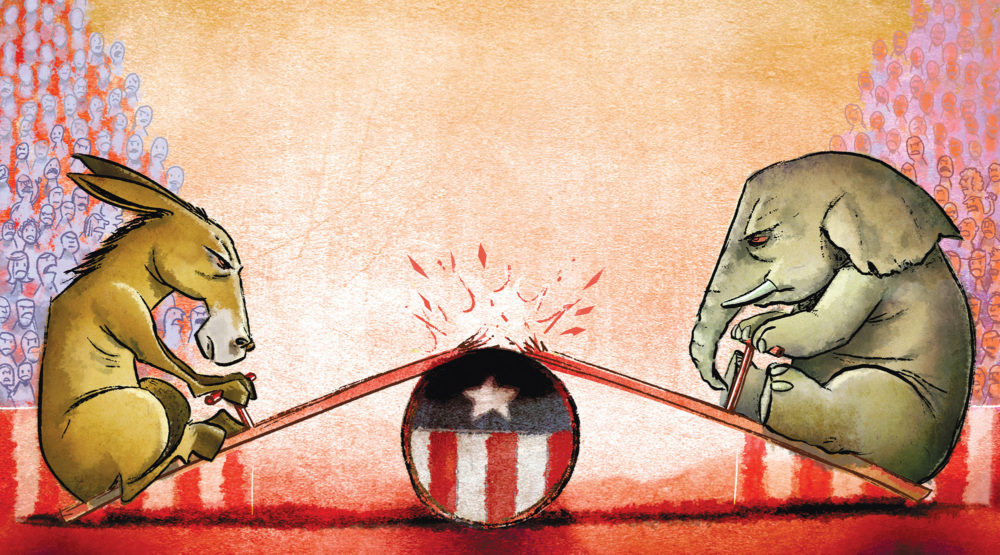
Although the concept of a “realignment” is important in American politics, it’s also controversial and contested. A realignment occurs when the parties substantially change their issue priorities, or when blocs of voters switch their loyalty from one party to another. Importantly, a realignment refers to much more than a good election year for a party. The Reagan landslide of 1984 and the Democratic takeover of Congress in 2018 were both consequential, but they did not constitute realignments. They did not fundamentally change the makeup of the two major parties or what those parties stood for.
If you’re looking for an actual realignment, the middle of the 19th century is a good place to start. The U.S. had two major political parties in the early 1850s: the Democrats and the Whigs. Though the existing parties were largely polarized on economic issues, they were notably not polarized over the institution of slavery. Both parties had a substantial presence in the North and South, and counted considerable numbers of pro- and anti-slavery voters among their ranks.
But as slavery became more and more central to national politics throughout the ensuing decade, the parties quickly realigned. Democrats emerged as decidedly pro-slavery, while the Whigs were unable to fully pivot to becoming an anti-slavery party. That ultimately proved the party’s demise, as most of its Northern supporters joined the newly formed Republican Party. By 1860, all the Republican electoral strength was located in the North and West, while Democrats solidly won the South.
That election of 1860 is a pretty clear example of a realignment—the emergence of a salient issue in the 1850s triggered shifts that would guide U.S. politics for decades to come—but such elections are exceedingly rare.
lf the end of one party system and the emergence of another is the standard, then we haven’t had a “realignment” since 1860 and are unlikely to ever see one again, given how much the two major parties have stacked the rules in their favor. But Masket doesn’t set the bar quite that high.
Even consequential elections do not necessarily result in such a sudden and stark realignment. The election of 1896, for example, established the Republicans as the party of northeastern industry and the Democrats as the party of the agrarian South and West. A few decades later, the election of 1932 established the New Deal coalition that would guide Democratic policy leadership throughout the mid-20th century. These realigning elections certainly mattered at the time, but as political scientist David Mayhew argued in his thorough book on the topic, these elections also illustrate an important fact about parties and realignments in U.S. history: Their story is not one of occasional seismic shifts, but rather of mostly gradual change.
The parties are always realigning a little bit from election to election, but rarely enough to be perceptible in state-level voting data.
Looking at the results of the last two Presidential elections and forecasts for next months, he doesn’t see a realignment:
How Clinton performed in a state in 2016 was highly predictive of how Biden performed in that same state four years later. The polling for 2024 so far suggests that Harris’ performance in 2024 will be similarly highly correlated with Biden’s performance in 2020.
But:
Expand the time horizon, however, and partisan shifts—while still subtle—become more visible. The Electoral College maps of 2000 and 2020 look broadly similar, with New England, the West Coast, and the Upper Midwest all leaning Democratic while much of the South and Mountain West leans Republican. But with a correlation of 0.71, the nature of the electorate clearly changed over the course of five presidential cycles. The odds of Harris winning Iowa next month are about the same as Trump winning Colorado: close to zero.
Indeed, Florida was the decisive state in 2000 and Ohio in 2004. They were, like Pennsylvania in recent cycles, the epitome of the “swing state.” Yet they’re now completely uncompetitive: Trump will win them both by large margins. That’s not a realignment, but it’s a significant shift. (As I’ve often noted, California was a solid red state in my memory and has subsequently become among the bluest; it has voted for the Democrat in every election since 1992 and hasn’t even been competitive during that time.)
That reality is the result of a steady trend that began in the 1970s and has resulted in one of the longest competitive periods in national politics in U.S. history, with southern and rural whites shifting over time to become more Republican while nonwhite and urban Americans continue to vote in greater numbers—generally with the Democrats. In 1992, there were still enough southern white Democrats for Bill Clinton to win Arkansas, Georgia, Tennessee, and Louisiana. Georgia flipped to the Republicans four years later, and by 2000, George W. Bush won all four.
Arguably, this is more “sorting” than “realignment.” Most Southern Democrats were Republicans in all but name and most Northern Republicans were really Democrats.
But, even here, things aren’t quite so simple. Virginia has moved from a reliably red state in national elections when I moved here in 2002 to a reliably blue one since 2008. Neighboring North Carolina is trending purple and it’s possible Georgia will go that way, too.
The electorate has continued to evolve in the ensuing decades. One of the most notable shifts has been among non-college-educated voters in the Upper Midwest, who caught political observers by surprise in 2016 by breaking significantly with college-educated whites and voting more Republican. Biden was able to win some of those votes back in 2020—flipping Wisconsin, Michigan, and Pennsylvania back into the Democrats’ column—but the steady decline of unions in the Rust Belt, along with Trump’s particularly racialized campaign appeals, has seemed to help the Republican woo some of these voters to his side in recent years.
But again, this trend didn’t begin with Donald Trump’s descent down an escalator in Manhattan almost a decade ago. Indeed, political scientist Thomas Frank outlined such shifts in his 2004 book, What’s the Matter With Kansas? Barack Obama won 60 percent of Wisconsin voters without a college education in 2008, but only 54 percent in 2012. Similarly, he won 54 percent of Wisconsin’s white voters in 2008, but only 47 percent four years later.
What Trump may have done, however, is accelerate these trends by leaning into the populist messages underpinning them. This approach is not without tradeoffs, of course, but it has essentially moved historical swing states like Ohio and Florida into the GOP’s column, made traditionally Democratic states in the Rust Belt and Upper Midwest competitive, and started to cleave off chunks of some reliable Democratic constituencies.
This certainly has the makings of a realignment. Going back to the New Deal, Democrats were always seen as “the party of the working man.” That image has clearly eroded in recent years. The converse trend is that, at least during the Trump era, college-educated folks have gradually abandoned the GOP for the alternative.
In fact, although a recent NAACP survey found Trump receiving a similar percentage of the black vote as he won in 2020, he’s performing particularly well this cycle with younger black men. Surveys earlier this year found Trump gaining ground among Latino voters as well, although his support there may have softened some since Biden dropped out and Harris became the Democratic nominee.
As research by political scientists Ismail White and Chryl Laird described it, community ties and social pressures have kept most black voters (around 90 percent) voting Democratic since the 1970s, with even the vast majority of self-described conservative black voters supporting Democrats during this time. But this cohesiveness may not last in perpetuity. Class could certainly overtake race as a central political identity, with less-educated voters of various races continuing to shift toward the Republican Party and Democrats becoming the party of the college-educated.
The Civil Rights era was a very long time ago now, so it’s natural that the cohesiveness it sparked has is slowly evaporating. But, with Trump at least, it seems that the appeal to masculine pride and anti-immigrant sentiment is the main driving factor.
After looking at some other dividing points, some of which may prove temporary, Masket answers his question:
For all the talk over the past few years about a coming realignment, the fact remains that it is very hard to see one approaching. Not only are realigning elections very rare, but we’re also amid an era of very close national elections with just subtle shifting between parties.
That said, put yourself in the position of a political pundit in September of 1929. Noting decades of Republican dominance in national politics, you would have had little reason to believe that an economic cataclysm was just weeks away. Yet those events would lead to a tectonic shift in the electorate and half a century of Democratic control.
What we’ve seen so far this year suggests that the electorate is breaking down in similar ways to how it did in 2016 and 2020, and specific swing states are not much of a surprise. But the potential for Donald Trump’s political career to end one way or another in the next few years, or the potential for the nation to elect a black woman as president, each have the power to cause some important shifts in how the parties line up and how they view themselves.
The other thing to re-emphasize here is that we have extraordinarily weak parties. While there are certain roots of Trumpism in the Tea Party movement and even the Newt Gingrich revolution, the nomination and subsequent election of a single change candidate rather significantly repositioned the Republican Party. If he were to win back the office, it’s quite possible that the Democrats will nominate a considerably more progressive candidate in 2028 and further push the sorting that’s been going on. Similarly, if Trump loses—especially by a large margin in the Electoral College—it’s conceivable that the MAGA bubble will burst and we’ll see a more mainstream nominee. That would significantly reduce the likelihood of a realignment.