
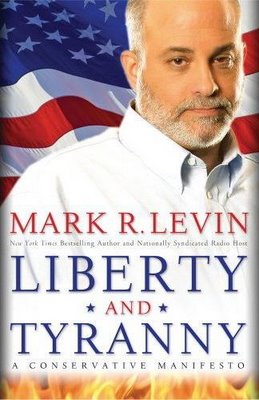

Part three of a continuing series wherein Liberty and Tyranny is blogged.
A word about my blogging style for this project — all I’m doing is reading the book and writing as I go along. Everything is pretty much just my immediate reaction to the words on the page. Most of my factual references are going to be just what’s pulled off the top of my head, edited for accuracy when I’m done with the post. So if the writing appears to be a bit schizophrenic at times, that’s why. A large part of my reactions are going to be mood dependent and mercurial, so be prepared for that.
Okay, enough meta-commentary. On with the show!
Chapter 2 – “On Prudence and Progress” – pp 12-23
Mark Levin opens this chapter with an idea that I wholeheartedly agree with: armed revolution against the government of the United States at the present time is a bad thing. I am happy to agree with him on something.
This is the world’s oddest segue way into a meditation to answer the question “What kind of change, then, does the Conservative support?” I’m presuming he means political change since this is a political manifesto. He boils it down to “change as reform was intended to preserve and improve the basic institutions of the state.” This is as contrasted with the Statist boogeyman, who
“justifies change as conferring new, abstract rights, which is nothing more than a Statist deception intended to empower the state and deny man his real rights–those that are both unalienable and anchored in custom, tradition, and faith.”
I’d love to see an example of what Levin actually means by this, but it doesn’t appear yet that he’s interested in actually providing evidence to support his claims. No doubt that’s a Statist deception, too.
Okay, so what’s the “right kind” (pun intended) of change? According to Levin, it’s that
“prudence must be exercised in assessing change. Prudence is the highest virtue for it is judgment drawn on wisdom. The proposed change should be informed by the experience, knowledge, and traditions of society, tailored for a specific purpose, and accomplished through a constitutional construct that ensures thoughtful deliberation by the community.”
For some reason, this sparked in my head the words of William Lloyd Garrison in the first edition of The Liberator:
I am aware that many object to the severity of my language; but is there not cause for severity? I will be as harsh as truth, and as uncompromising as justice. On this subject, I do not wish to think, or to speak, or write, with moderation. No! no! Tell a man whose house is on fire to give a moderate alarm; tell him to moderately rescue his wife from the hands of the ravisher; tell the mother to gradually extricate her babe from the fire into which it has fallen; — but urge me not to use moderation in a cause like the present. I am in earnest — I will not equivocate — I will not excuse — I will not retreat a single inch — AND I WILL BE HEARD. The apathy of the people is enough to make every statue leap from its pedestal, and to hasten the resurrection of the dead.
Sometimes, patience and prudence are the right path. But sometimes, you know, they’re just convenient covers for men to do nothing, you know? There’s a time and place for different attitudes. Sometimes prudence is called for. Sometimes we need radicals. Sometimes it’s better for change to come slow. Sometimes it needs to happen now. This applies to all kinds of social change — not just political change.
But I’m also intrigued by the concepts Levin invokes here, because they appear to be anti-free market! I’m interested to see how his Conservative reacts to creative destruction, rapid technological change, dance clubs, the internet, and rock music. Chapter six is entitled “On the Free Market” where I’m willing to bet that prudence isn’t discussed. But we’ll see. In the meantime, Levin’s description of change reminded me of the description of the government council in Ayn Rand’s Anthem, which rejected the invention of the light bulb because the world was still transitioning from torches to the candle, which had been invented a century prior….
A couple of paragraphs later, and we’re greeted with this sentence:
“The Conservative understands that Americans are living in a state of diminishing liberty–that statism is on the ascendance and the societal balance is tipping away from ordered liberty.”
This is an incredibly simplistic way of looking at the world. In most ways — not all ways, but most ways — Americans are freer now than they’ve ever been. Consider the country’s state at the Founding — only landowners could vote. Women couldn’t own property. Blacks were property. Native Americans were being murdered and having their land stolen from them. Asians were prohibited from immigrating into the country. Trials were short, provided very few protections for defendants, and most people accused of crimes were on their own when it came to representation. Most trades were locked down by guilds, which were protected by law. State chartered corporations dominated the economy. Government jobs were determined by who was in favor with the local party bigwigs. You couldn’t have a business open on Sunday or overnight. Blacks, Germans, Irish, and Italians were forbidden from even entering certain towns, or at least staying overnight in them.
Almost 250 years later, can you honestly tell me that people are less free than when the country was founded? The economy is enormously freer. Civil service is determined by merit, not political bootlicking. (Thanks for that, James Garfield Chester A. Arthur!) Women can own property and their husbands can’t rape them. Slavery has been abolished. Equal treatment is the law of the land. Immigration is no longer determined by race. Defendants have much more protection from the depredations of the State. Every citizen can vote regardless of whether they own land.
There are a lot of problems, to be sure. And the federal government, in the name of the “war on terror” has adopted an enormous number of illiberal, unconstitutional policies. But I’ll take today over 1790 in a heartbeat when it comes to personal liberty. There is no doubt in my mind that this is a freer country than it was in 1790. Hell, I’ll go so far as to say that we live in a freer country now than we did in 1990.
The next few paragraphs are more Statist boogeyman nonsense. Statists hate freedom. Statists hate the individual. Statists are “angry, resentful, petulant, and jealous.” Blah blah blah.
But it culminates in what might be one of the stupidest paragraphs I have ever read in my entire life:
The Statist’s Utopia can take many forms, and has throughout human history, including monarchism, feudalism, militarism, fascism, communism, national socialism, and economic socialism. They are all of the same species — tyranny. The primary principle around which the Statist organizes can be summed up in a single word — equality.
Do I even need to explain how stupid this is? Does Levin really think that fascism, feudalism, and monarchism are expressions of equality? Or that American liberals support anything like the idea that the individual needs to “abandon his own interests for the ambitions of the state”?
I am banging my head into my desk here.
The next couple of paragraphs are about how liberals, and Barack Obama in particular, hope that the “individual surrenders himself to the all-powerful state.” I went into this in detail in the last post, but it remains unfair and ignorantly Manichean.
The next part made me laugh, because it’s a paragraph about how what makes America special and better than Europe is that it doesn’t have any type of class aristocracy. I laugh at this because of our first ten Presidents, two of them were Adams. We’ve had two Presidents Bush and two Presidents Roosevelt. Several Kennedys have held public office. Al Gore was a Senator — just like his dad. Vice President Dan Quayle’s son, Ben Quayle, is a Congressman. And that’s just off the top of my head — there are lots more examples, and I haven’t even scratched the surface of the business world. But it’s enough to note that the United States has pretty low social mobility compared to other countries. In other words, you’re more likely to be stuck in the same economic class that your parents were in the United States than you are in Canada, where you’re more likely to move up the economic ladder.
No aristocracy in America, indeed.
The next paragraph is a tirade against international institutions. Never minding, I suppose, that the United States was an early adopter of internationalism as a means to promote trade, fight piracy (the aar matey kind, not the music kind) and establish codes of conduct during armed conflicts. They’re a proud part of our American heritage — which is why treaties are considered to be a higher law of the land under our Constitution than acts of Congress are.
The next two paragraphs are an indictment of all academics, who serve as “missionaries” for “the Statist.” Something that no doubt comes as a surprise to my academic colleagues here at OTB. One thing he rails against in particular is that through academics students learn through “distortion and repetition” such falsehoods as “corporations as polluters, the Founding Fathers as slave owners, the military as imperialist, etc.”
Except I’m not sure what he’s getting at. Many of the Founding Fathers were slaveowners. Is he denying that? Lots of corporations did and do pollute! Is he denying that? The United States has fought imperialist wars — which is why Texas, Arizona, California, and New Mexico are a part of the Untied States right now and not Mexico. Does he think that the history of the Mexican War is all made up and we really just hired a realtor to make a sweet land deal or something?
The next couple of paragraphs lambast actors and the media in their roles as tools of Statists. So I’m looking forward to hearing about how much he hates Ronald Reagan in later chapters, since he was both an actor and a broadcaster. (And a union leader! But there haven’t been any tirades against unions in the book so far.)
Levin closes the chapter with a quote from C.S. Lewis that actually isn’t bad, but I’ll close this edition of the blog review with this much better one from the same author:
What can you ever really know of other people’s souls — of their temptations, their opportunities, their struggles? One soul in the whole of creation you do know: and it is the only one whose fate is placed in your hands. If there is a God, you are, in a sense, alone with Him. You cannot put Him off with speculation about your neighbours or memories of what you have read in books.
I think that Levin should meditate on that the next time he’s tempted to create a straw man villain and use it to condemn his fellow citizens.
Next time – it’s Mark Levin’s chapter on religion!









