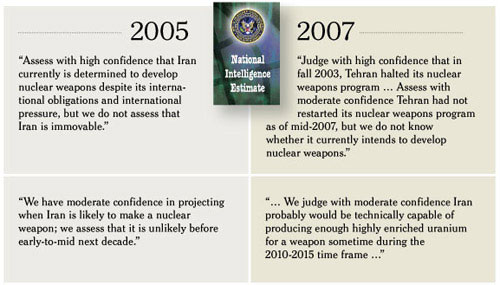

Rarely, if ever, has a single intelligence report so completely, so suddenly, and so surprisingly altered a foreign policy debate here. An administration that had cited Iran’s pursuit of nuclear weapons as the rationale for an aggressive foreign policy — as an attempt to head off World War III, as President Bush himself put it only weeks ago — now has in its hands a classified document that undercuts much of the foundation for that approach.
The impact of the National Intelligence Estimate’s conclusion — that Iran had halted a military program in 2003, though it continues to enrich uranium, ostensibly for peaceful uses — will be felt in endless ways at home and abroad.
It will certainly weaken international support for tougher sanctions against Iran, as a senior administration official grudgingly acknowledged. And it will raise questions, again, about the integrity of America’s beleaguered intelligence agencies, including whether what are now acknowledged to have been overstatements about Iran’s intentions in a 2005 assessment reflected poor tradecraft or political pressure. Seldom do those agencies vindicate irascible foreign leaders like President Vladimir V. Putin of Russia, who several weeks ago said there was “no evidence” that Iran was building a nuclear weapon, dismissing the American claims as exaggerated.
Peter Baker and Robin Wright add:
The new intelligence report released yesterday not only undercut the administration’s alarming rhetoric over Iran’s nuclear ambitions but could also throttle Bush’s effort to ratchet up international sanctions and take off the table the possibility of preemptive military action before the end of his presidency.
Iran had been shaping up as perhaps the dominant foreign policy issue of Bush’s remaining year in office and of the presidential campaign to succeed him. Now leaders at home and abroad will have to rethink what they thought they knew about Tehran’s intentions and capabilities.
“It’s a little head-spinning,” said Daniel Benjamin, an official on President Bill Clinton’s National Security Council. “Everybody’s going to be trying to scratch their heads and figure out what comes next.”
Critics seized on the new National Intelligence Estimate to lambaste what Democratic presidential candidate John Edwards called “George Bush and Dick Cheney’s rush to war with Iran.” Senate Majority Leader Harry M. Reid (Nev.), echoing other Democrats, called for “a diplomatic surge” to resolve the dispute with Tehran. Jon Wolfsthal, a scholar at the Center for Strategic and International Studies, termed the revelation “a blockbuster development” that “requires a wholesale reevaluation of U.S. policy.”
Many are digging in, though. Meyers again:
The findings, though, remain open for interpretation, as they always do, even in documents meant to reflect the consensus of the intelligence community. When it comes to Iran, at odds with the United States on many fronts beyond the nuclear question, hawks remain.
“Those who are suspicious of diplomacy are well dug in in this administration,” said Kurt M. Campbell, chief executive officer of the Center for a New American Security.
Victor Davis Hanson is fighting a two front war: Since our intelligence estimates are so often wrong, the neocons might still be right about Iran’s nukes. And, if not, it’s only because the neocons were right on Iraq!
The latest news from Iran about the supposed abandonment in 2003 of the effort to produce a Bomb — if even remotely accurate — presents somewhat of a dilemma for liberal Democrats.
Are they now to suggest that Republicans have been warmongering over a nonexistent threat for partisan purposes? But to advance that belief is also to concede that, Iran, like Libya, likely came to a conjecture around (say early spring 2003?) that it was not wise for regimes to conceal WMD programs, given the unpredictable, but lethal American military reaction.
After all, what critic would wish now to grant that one result of the 2003 war-aside from the real chance that Iraq can stabilize and function under the only consensual government in the region-might have been the elimination for some time of two growing and potentially nuclear threats to American security, quite apart from Saddam Hussein?
Less dramatically is the “it happened on our watch” fallback:
But the report included language that the administration can cite to claim success, according to some analysts. Paul R. Pillar, a former CIA official who has been critical of the Bush administration’s run-up to war with Iraq, said the revelation about the halted weapons program is a “shocker” but noted that “the administration can say that Iran halted its program during our administration and this is a success for us. And with some good reason.”
Not to be outdone, founding neocon Norman Podhoretz directs all its fire at the (take your pick) evil and/or stupid intelligence community:
In other words, a full two years after Iran supposedly called a halt to its nuclear program, the intelligence community was still as sure as it ever is about anything that Iran was determined to build a nuclear arsenal. Why then should we believe it when it now tells us, and with the same “high confidence,” that Iran had already called a halt to its nuclear-weapons program in 2003?
[…]
It is worth remembering that in 2002, one of the conclusions offered by the NIE, also with “high confidence,” was that “Iraq is continuing, and in some areas expanding its chemical, biological, nuclear, and missile programs contrary to UN resolutions.” And another conclusion, offered with high confidence too, was that “Iraq could make a nuclear weapon in months to a year once it acquires sufficient weapons-grade fissile material.”
I must confess to suspecting that the intelligence community, having been excoriated for supporting the then universal belief that Saddam had weapons of mass destruction, is now bending over backward to counter what has up to now been a similarly universal view (including as is evident from the 2005 NIE, within the intelligence community itself) that Iran is hell-bent on developing nuclear weapons.
[…]
But I entertain an even darker suspicion. It is that the intelligence community, which has for some years now been leaking material calculated to undermine George W. Bush, is doing it again.
The Weekly Standard‘s Thomas Joscelyn offers a more nuanced challenge to the NIE, wondering what has caused this dramatic change in the assessment. He is doubtful that we have good intelligence inside Iran, would like to know what information the IC has that it didn’t in 2005, wonders how one draws the line between military and civilian nuclear development, and is curious as to what internal changes in Iran would have caused such a sea change.
Those are actually pretty good questions, albeit ones to which we’re not likely to get answers. Sources and methods and all that.
The IC gets it wrong so often, not because they’re incompetent but because their task is so incredibly difficult. It’s therefore more than fair to doubt intelligence assessments, especially those that involve the most sensitive issues in authoritarian societies.
Still, one can’t treat intelligence assessments as gospel when they support one’s policy preferences and dismiss them as idle guesses when they don’t.
Further, there’s no question that bureaucratic politics plays a role in these reports. The incentives, though, are entirely in the direction of producing the most dire warnings. Podhoretz’ notion, that to compensate for being wrong on Iraq they’re now overly cautious on Iran, is absurd. For one thing, the IC knew they’d blown it on Iraq WMD in 2005 when they produced the last Iran estimate and they were still expressing strong confidence that a threat existed. More importantly, though, false positives are much more forgivable than false negatives.
Could this NIE be wrong? Could Iran be incredibly clever in hiding a weapons program? Should we still continue to act as if the Iranian regime is hostile? Absolutely.
But let’s not pretend that yesterday’s news doesn’t dramatically alter the debate.
Graphic: NYT