
Kevin Drum argues in two postings that FBI Director James Comey’s 11th hour letter advising Congress that his agency was re-opening its investigation into Hillary Clinton cost her the election.
Yesterday’s piece, “Let’s Talk About Bubbles and James Comey,” argues that, to the extent the fundamentals were working against Clinton and/or that she was an epically bad candidate who ran an awful campaign, those were constants throughout the cycle and yet she maintained a constant lead until the Comey letter.
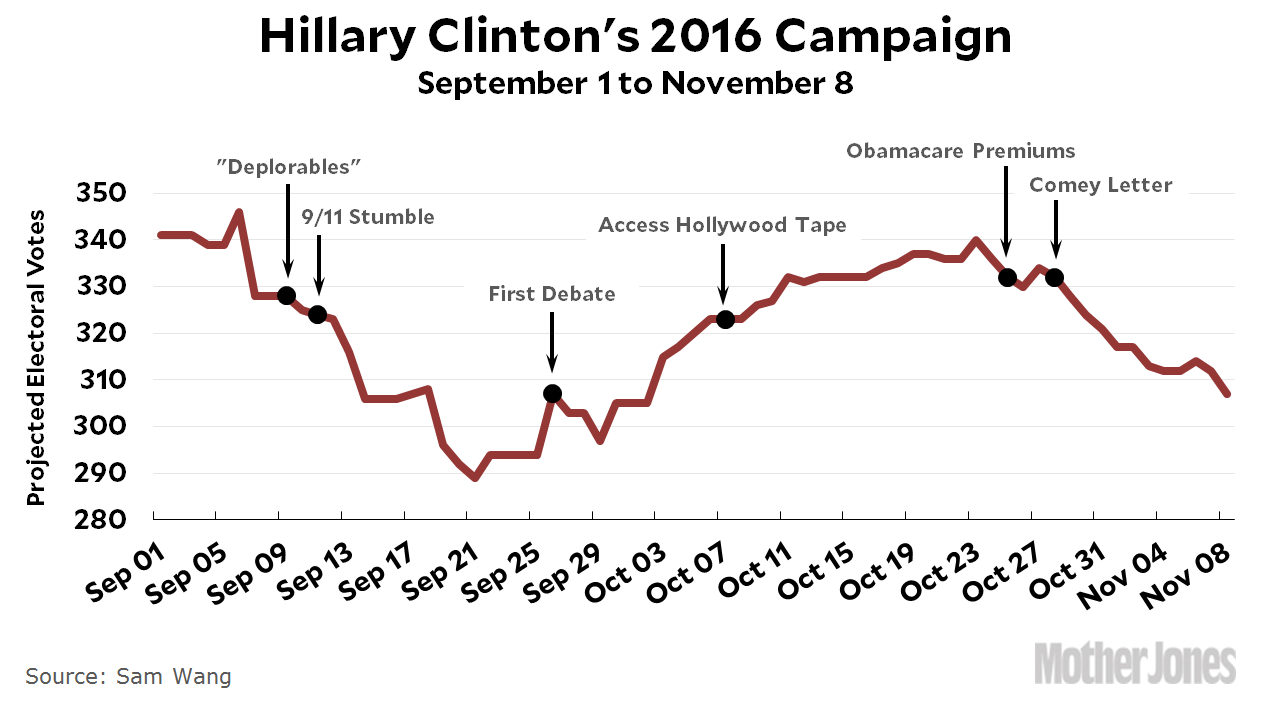
[L]et’s take a look at the final two months of the campaign. All of the poll estimates look pretty similar, but I’m going to use Sam Wang’s EV estimator because it gives a pretty sharp day-to-day look at the race. Wang’s final estimate was wrong, of course, like pretty much everyone else’s, but don’t worry about that. What we’re interested in is the ups and downs. What Wang’s estimate tells us is that, with the brief exception of the July Comey presser, the race was amazingly stable. From January through August, he has Clinton at 330-340 electoral votes. Let’s pick up the story in September:
At the beginning of September, Clinton slumps after her “deplorables” comment and her stumble at the 9/11 memorial. After Trump’s shockingly bad performance at the first debate she starts to regain ground, and continues to gain ground when the Access Hollywood tape is released. By the end of October she’s back to where she started, with a big lead over Trump. THIS IS IMPORTANT: despite everything — weak fundamentals, the “deplorables” comment, her personal unpopularity, her mushy centrism, her allegedly terrible campaign — by the end of October she’s well ahead of Trump, just as she had been all year.
On October 25, HHS announces that Obamacare premiums will go up substantially in the following year. This doesn’t appear to have any effect. Then, on October 28, Comey releases his letter. Clinton’s support plummets immediately, and there’s no time for it to recover. On November 8, Trump is elected president.

The counterargument to this is rather obvious just by looking at Wang’s graph: while Clinton led Trump throughout the period in question, her actual margin was quite volatile. She peaked somewhere around September 9 at 350ish projected Electoral votes, plummeted to 285ish by September 21, hit a second peak of around 335 on October 23, and then begins a slide to 305 or so by election day.
Did the Comey letter case that slide? Quite possibly. Certainly, as Kevin notes, a lot of analysts think so:
- Nate Silver estimates the Comey letter cost Clinton about 3 points.
- A panel survey from the Institute for the Study of Citizens and Politics suggests the Comey letter produced a net swing of 4 points toward Trump.
- Sam Wang estimates the Comey letter cost Clinton 4 points, though she may have made back some of that in the final days.
- Engagement Labs tracks “what people are talking about.” Immediately after the Comey letter, they registered a 17-point drop in favorable sentiment toward Clinton.
- Google searches for “Hillary’s email” spiked 300 percent after Comey’s letter.
- The tone of news coverage flipped enormously against Clinton after the Comey letter.
- A trio of researchers who looked at the evidence concluded that Comey’s letter was decisive, probably costing Clinton 3-4 points in the popular vote.
- Trump’s own analysts think the Comey letter was decisive.
- The Clinton campaign agrees that the Comey letter was decisive, and adds that Comey’s second letter hurt her too.1
It strikes me as quite plausible that being reminded of the nagging doubts that so many voters had about Clinton all along proved decisive. But it’s also possible that there was simply regression to the mean. There were many lower points in the graph for Clinton over this two-month span. And, indeed, two modest spikes in Wang’s projection in the week after the Comey letter. It strikes me just a plausible that, by early November, the shock of the “Access Hollywood” tape was wearing off so the race was normalizing.
More importantly, note that the y-axis on Wang’s graph starts at 280–ten points above the number of Electors needed to win the presidency. Clinton only got close to that mark once: the free-fall after the double whammy of the “deplorables” quote and her fainting spell at the 9/11 event. She was at a comfortable 305 on election day–a modest landslide. And, of course, she ultimately received nearly three million more votes than Trump; they just concentrated in an unfortunate way for her cause.
She ultimately lost because three states everyone presumed would go into her column narrowly went into his. Her turnout in those states was simply less than would have been predicted by past results. Was some of that a function of the Comey letter? Probably. But there were dozens of other things that factored into voters’ minds in a contest between two such polarizing candidates. Given the margin, any of them could plausibly be said to be definitive.
Kevin’s follow-up post from this morning, “James Comey Wasn’t a Partisan Hack. He Was Worse,” is a long analysis of a NYT piece from yesterday and we don’t significantly disagree on the facts of the matter. I find the analysis unfair, however:
Once again, the primary concern was protecting Comey and the FBI. Republicans had made it clear that their retribution against anyone who helped Clinton would be relentless, and that clearly had an impact on Comey. Steinbach’s suggestion that Republican vengeance would have destroyed the FBI is clearly nuts, but Comey was taking no chances. He didn’t want the grief.
[…]
Daniel Richman, a longtime friend of Comey’s, said this represented “a consistent pattern of someone trying to act with independence and integrity, but within established channels.”
The evidence does indeed show consistent behavior, but of a different kind. At every step of the way, Comey demonstrated either his fear of crossing Republicans or his concern over protecting his own reputation from Republican attack. It was the perfect intersection of a Republican Party that had developed a reputation for conducting relentlessly vicious smear campaigns and a Republican FBI director who didn’t have the fortitude to stand up to it. Comey may genuinely believe that his decisions along the way were nonpartisan, but the evidence pretty strongly suggests otherwise.
Everyone in the Obama administration was in damned if you do, damned if you don’t situation. President Obama didn’t want to be seen as covering for his 2008 opponent cum 2009-2013 Secretary of State, so he not only steered clear of commenting on the email mess but also steered too hard in the other direction on the clear evidence that the Russian government was trying to manipulate the election. Attorney General Loretta Lynch ordered the FBI to avoid calling the investigation that we all knew was going on an “investigation” and then made a serious gaffe in having an apparently impromptu private discussion with Bill Clinton on a tarmac.
Once that happened, there was going to be no pleasing anyone. The investigation rightly concluded that Clinton should not be charged with a crime. But simply putting out a press release to that effect would have been excoriated as a political cover-up, especially in the wake of the tarmac fiasco. Additionally, his own agents were furious that Clinton was getting away with conduct that would have ended the career of lesser employees of the government and, indeed, was likely going to be their boss soon. So Comey gave the infamous press conference that both exonerated Clinton of criminal wrongdoing but also broke the rules in a flagrant manner.
Weeks after that unusual press conference, he was put in an embarrassing position: new information came out that required investigation. He simply had no good options at that point. He had to notify Congress about the matter, both because he had promised to do so and because if he didn’t and it came out after the election—and it would, of course, have come out—then it would have looked like a cover-up.
Additionally, both Obama and Comey were operating under the same presumption that most of us were: that there was simply no way Clinton was going to lose the election. Taking her victory as a given, then, the incentives all point toward bending over backward to avoid appearing to favor her.
Comey is certainly no partisan hack. But his job is inherently political, especially in the ridiculously polarized environment in which he’s operating. He needs to project to the public that he’s operating independently of whichever party happens to control the White House. He needs the support of Congress. He needs his agents to believe he has their back. It’s an incredibly difficult balancing act. Even in hindsight, in which it’s quite plausible that he contributed to the election of the worst major party presidential nominee in my lifetime and the defeat of my preferred candidate in the race, I don’t know how he could have done this much better.
Even in hindsight, in which it’s quite plausible that he contributed to the election of the worst major party presidential nominee in my lifetime and the defeat of my preferred candidate in the race, I don’t know how he could have done this much better. I could very well imagine an alternate reality in which Clinton won and we spent the next four years in Benghazi-style hearings over Lynch’s tarmac meeting with the future First Gentleman and Comey’s treacherous cover-up of the Huma Abedine emails.









