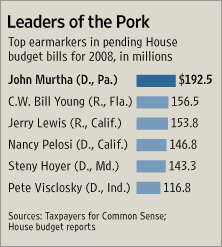
John Murtha gets more pork for his district than any other Representative.
If John Murtha were a businessman, he’d be the biggest employer in this town.
The powerful U.S. congressman has used his clout on Capitol Hill to create thousands of jobs and steer billions of dollars in federal spending to help his hometown in western Pennsylvania recover from devastating floods and the flight of its steelmakers.
More is on the way. In the massive 2008 military-spending bill now before Congress — which could go to a House-Senate conference as soon as Thursday — Mr. Murtha has steered more taxpayer funds to his congressional district than any other member. The Democratic lawmaker is chairman of the House Appropriations Subcommittee on Defense, which will oversee more than $459 billion in military spending this year.
Johnstown’s good fortune has come at the expense of taxpayers everywhere else. Defense contractors have found that if they open an office here and hire the right lobbyist, they can get lucrative, no-bid contracts. Over the past decade, Concurrent Technologies Corp., a defense-research firm that employs 800 here, got hundreds of millions of dollars thanks to Rep. Murtha despite poor reviews by Pentagon auditors. The National Drug Intelligence Center, with 300 workers, got $509 million, though the White House has tried for years to shut it down as wasteful and unnecessary. Another beneficiary: MTS Technologies, run by a man who got his start some 40 years ago shining shoes at Mr. Murtha’s Johnstown Minute Car Wash.
Thats’ quite a haul; Robert Byrd would be proud. So is Murtha.
Mr. Murtha defends Congress’s right to award such funds. Despite lobbying and earmark scandals of recent years, he argues that local lawmakers are best suited to understand the needs of their district. He says he’s backed new research into treating diabetes and breast cancer, largely funded with defense earmarks and steered to Pennsylvania hospitals and institutions.
He’s particularly proud of the military contractors that have flocked to his district. “They do their work on time and at a competitive price,” he said in an interview, saying earmarks have helped spur economic development. “I’m not going to apologize for that.”
There’s no reason he should under the current system. The Federal government spends an inordinate amount of money and it’s his job to get as much of it back for his district as possible. Further, it makes sense for both fiscal and security reasons to shift as much defense contract money away from the National Capital Region as possible.
No doubt, directing these funds based on which area is home to the key committee chairmen in the House and Senate is a bizarre, inefficient process. It’s unclear, though, what feasible alternative exists. The Framers intentionally set up our legislature to represent provincial interests and it’s impractical to run committees on something other than a rough seniority system, since there’s a legitimate value to accumulated experience. Term limits, both for Congress in general and committee chairs in particular, might help somewhat but it would likely have no practical effect beyond spreading the pork out more evenly.
More problematic is the fact that these contractors are pouring large sums into Murtha’s campaign coffer (see Ed Morrissey and Brian Faughnan). Again, though, this is an indictment of the game, not the player.
The Abscam scandal (see Michelle Malkin) involved legitimate corruption. But Murtha’s role was murky, at best, with the Justice Department concluding “that Murtha’s intent was to obtain investment in his district,” rather than to line his pockets. It was also 26 years ago.